




Ross Gutmeier Returns to Tradition
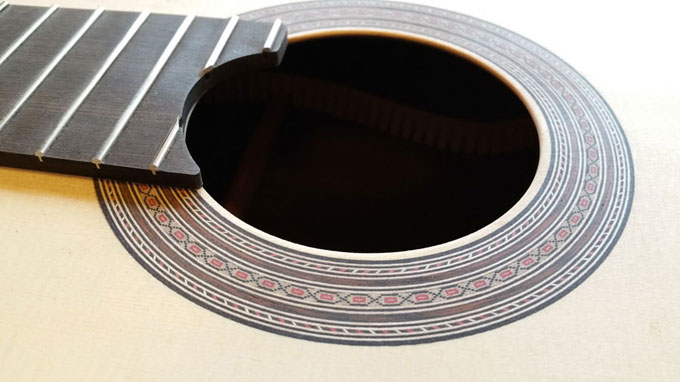
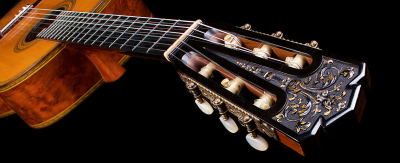
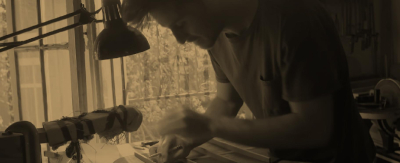
We have a new guitar coming soon from Baltimore-based luthier Ross Gutmeier, and we’re particularly interested to hear that after building double-top and otherwise ‘modern’ guitars for many years Ross is returning to a more traditional approach after spending some time with an early 1920’s Santos Hernandez. We asked Ross about that, and here’s what he had to say:
“Yes, I am starting to move away from double tops. I’ve just never been able to capture exactly the sound I wanted from that type of construction. Ever since I played an early 1930’s Santos I saw at the 2007 GFA convention, I’ve been infatuated with the sound. I tried for years to replicate what I saw and heard but wasn’t quite able to pull it off.
About two years ago I was hired to restore a 1920’s Santos. The guitar was more or less a basket case, but in rebuilding it I was able to evaluate it completely. I mapped the top compliances, soundboard curvatures, resonances (very clever stuff he did there), and was finally able to figure out his general intentions and how he made things happen. I was deeply impressed by the simplicity of his work, the efficiency of the guitar’s function, and the beauty of its sound.
The first one I made (without a client in mind) used a four piece top of sixty year old Engelmann and eighty year old walnut floorboards (great sounding but not very attractive woods). It was so good that I wound up selling to an existing client before I even got a finish on it.
From this point I made new soleras and started applying these ideas to my double tops. Once I got them dialed in they were an instant success. The volume was great and the sound was better than before, but they still lacked that “allure”. I began to push the envelope even further until I eventually got to the point with my last double top where it collapsed (a result of the reduced along grain strength of the hollow core). I found just how far I could go with the double tops and I had reached the end of the road. Thing is, the basic Santos copy I had made along side that guitar had the same compliance numbers but was holding well and sounded beautiful. This was the point where solid spruce tops began to exceed double tops.
My latest one was even more impressive. I used a higher bracing profile from a later Santos (1930’s), a Rodriguez inspired soundhole/neck “A frame” made from 2mm aircraft plywood, and another little feature I refer to as my “alignment brackets” (I need to work on that name) which work to align the dynamic and rotational centers of the bridge. The result was amazing. Unvarnished, with a spruce top, and with a smaller body, this guitar was equal to (if not greater than) the power of the über cannon guitars out there, yet had greater dynamic range, color, and a much more beautiful tone. So what’s the point of a “modern” guitar?
I saw in a YouTube video where Jose Romanillos said that (paraphrasing here), “The classical guitar doesn’t need to be redesigned, it just needs to be better understood”. I couldn’t agree more. I’ve built every kind of guitar design you can think of and go figure, I’m right back to Torres/Santos and I don’t want to build anything else.”
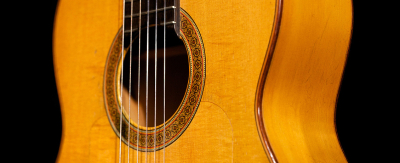
As for the woods “The Engelmann spruce soundboard I used was the best I had. This came from a stand of trees that died from a beetle infestation back in 1948, though the wood wasn’t harvested until 2006. It’s incredible stuff. Extremely light and strong, the first time I used it I was fooled by its qualities and wound up over-building with it. Now, whenever I use it (I have a few sets left) I treat it as I would a good hard piece of German spruce (about 1.75mm thick max). The result is an incredibly powerful guitar.”

2 条评论