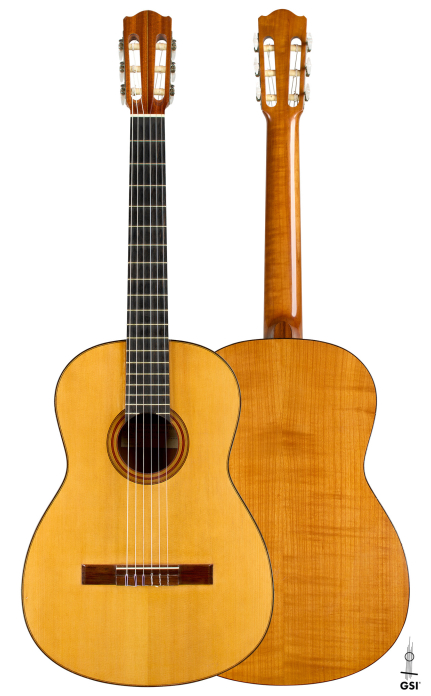
1968 Pietro Gallinotti SP/CH
| 年 | 1968 |
| トップ | スプルース |
| バック&サイド | チェリー |
| スケールの長さ | 650 mm |
| ナット幅 | 50 mm |
| 仕上げ | French Polish |
| 状態 | 素晴らしい |
| 国 | イタリア |
| Exchange | ExchangePlus |
| Luthier | Pietro Gallinotti |
$7,000.00


ピエトロ・ガリノッティ、イル・マエストロ・デッラ・キタッラ
説明
 Image: Archivio liuteria Grimaldi
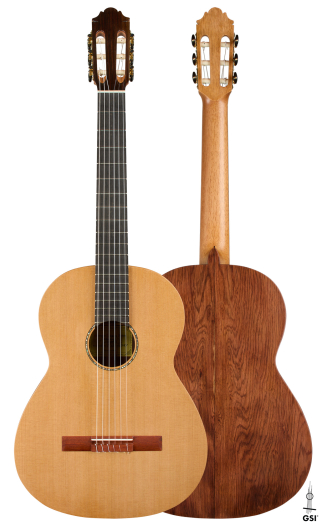
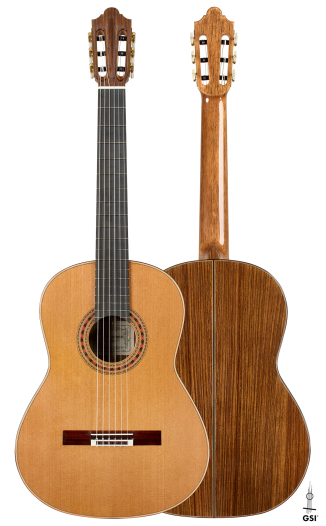
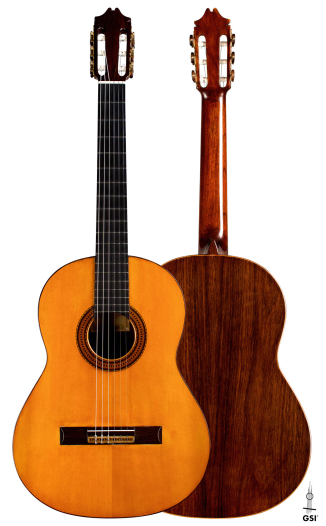
この1968年製ピエトロ・ガリノッティは、イタリアのソレロ(アレッサンドリア)で製作されたクラシックギターで、スプルース材のトップと、フレイム・ピエモンテ・チェリー材のバックとサイドが特徴です。イタリアのギター製作の創始者の一人であるガリノッティ自身が1960年代に製作したモデルの中でも、非常に希少で美しく保存された逸品です。
ピエトロ・ガリノッティ:イタリアのギター製作のパイオニア
イタリア国外ではあまり知られていないものの、ピエトロ・ガリノッティはイタリアのギター製作史における偉大な先駆者の一人であり、イタリア国内では国民的英雄、ギター界の至宝とみなされている。彼のギターがイタリア国外に姿を現すことは稀で、今回が25年以上ぶりの発見となるため、まさに貴重な逸品であり、ガリノッティの作品が国際的に評価されるべきものであることを改めて証明している。また、多くの人々にとって大きな関心事となっているのが、ガリノッティが「シダートップの発明者は誰か」という歴史的探求における現在の先駆者であることである。
1968年製ガリノッティ(彼自身のモデル)
私たちの友人であり同僚でもあるイタリアの弦楽器製作者マリオ・グリマルディは、おそらくガリノッティの最大の擁護者と言えるでしょう。彼はガリノッティの伝記作家であり、ピエトロの息子カルロ(ピエトロの唯一の弟子であり助手でもあった)と親交を深めたことで、ピエトロの多くの道具や材料、そして製作方法に関する知見を得ることができました。マリオによれば、このギターが製作された時期は、ガリノッティにとって最も幸せな時期の一つだったそうです。1940年代と1950年代にジュリアン・ゴメス・ラミレス、 フランシスコ・シンプリシオ、 サントス・エルナンデスのモデルを試作した後、彼はこれらの影響を統合し、1960年代に独自のモデルを開発しました。1968年製のこのギターもその一例です。
状態と素材:フレイムド・ピエモンテ・チェリー
このギターは驚くほど良好な状態です。ひび割れや修理跡はなく、摩耗もほとんどありません。シンプルな作りで、リングロゼッタと控えめな装飾が施されています。トップ、バック、ヘッドストックのパーフリングには薄いメープルの化粧板が使われているだけです。使用されている素材は美しく、バックとサイドにはイタリアのピエモンテ地方産の珍しいフレイムチェリーが使われています(ちなみに、これはグァダニーニ兄弟がロマンティックギターにも使用したのと同じ木材です)。ネックとヘッドストックは一枚板の木材(こちらもチェリー材)で、ヘッドの前面にはマホガニーの化粧板が貼られています。
サウンド:トーレスや初期マドリード楽派を彷彿とさせる
音色と演奏性において、このギターはトーレスの軽量サイプレスギターや初期のマドリード派の製作者たちのギターを彷彿とさせます。豊かで、力強く、非常に自然で、温かみのある「木質」な音色は、ほんの少し触れただけでギターから溢れ出します。古いスペイン製ギターが持つすべての特質、すなわち優れたダイナミクス、豊かな音色、レスポンスの良さ、そして美しい音色を備えています。さらに、驚くほどの音量と響きも持ち合わせており、21世紀の現代のプレイヤーをも十分に満足させるでしょう。
全体的に見てこれは素晴らしい作品であり、このメーカーの作品の中でも最高傑作と言えるでしょう。今後、このような作品がもっと増えることを期待しています。これは、このメーカーの作品を知る上で、実に印象的な「入門編」と言えるでしょう。
背景
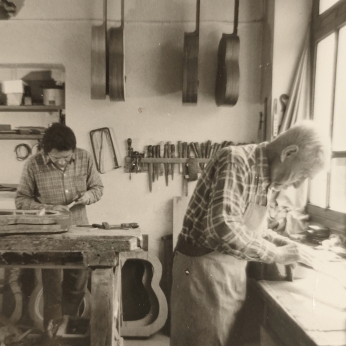 Image: Archivio liuteria Grimaldi
Pietro Gallinotti (1885–1979), Luthier of Solero
Pietro Gallinotti (1885–1979) is one of the great pioneers of Italian guitar making. He lived and worked in Solero, a small town near Alessandria in Piedmont, where he built guitars (as well as violins) under a label that proudly reads "Premiata Liuteria" – award-winning lutherie. His son Carlo was his only student and assistant. Although relatively unknown outside of Italy, Gallinotti is regarded there as a national treasure of the guitar world, and his instruments were owned and played by guitarists such as Carlo Ernesto Salio, Alberto Mautino and Bruno Giuffredi – and also played by Alirio Díaz.
The First Cedar Top? Turin, 1952
In 1952 Gallinotti won first prize at a guitar-making competition in Turin with a guitar whose four-piece soundboard was made of western red cedar (thuja plicata). That guitar predates by roughly ten years the famous cedar-top instruments from the José Ramírez III workshop in Madrid, which are traditionally credited as the first to use this wood for the top. The discovery was made by Italian luthier and Gallinotti biographer Mario Grimaldi, who examined the 1952 guitar for a 2007 exhibition in Solero and later found matching cedar billets among the materials from Gallinotti's workshop – read the full story in our blog post Secrets of Lutherie: The Cedar Soundboard, an Italian Invention. Gallinotti experimented in other ways too, including a long-scale guitar in 1953, years before longer scales became common.
From Spanish Influences to His Own Model
In the 1940s and 1950s Gallinotti experimented with models by Julián Gómez Ramírez, Francisco Simplicio and Santos Hernández. In the 1960s he synthesized these influences into a model of his own – the period that Mario Grimaldi considers one of the happiest of Gallinotti's life.
Mario Grimaldi and the Gallinotti Legacy
Mario Grimaldi is arguably the largest champion of Gallinotti's work. After befriending Pietro's son Carlo, he obtained many of Pietro's molds, tools and materials, along with insight into his construction method. Together with Mario Dell'Ara, Mario wrote the catalogues for the Gallinotti exhibitions in Savigliano (2006) and Solero (2007) and the book "Pietro Gallinotti, Luthier of Solero".