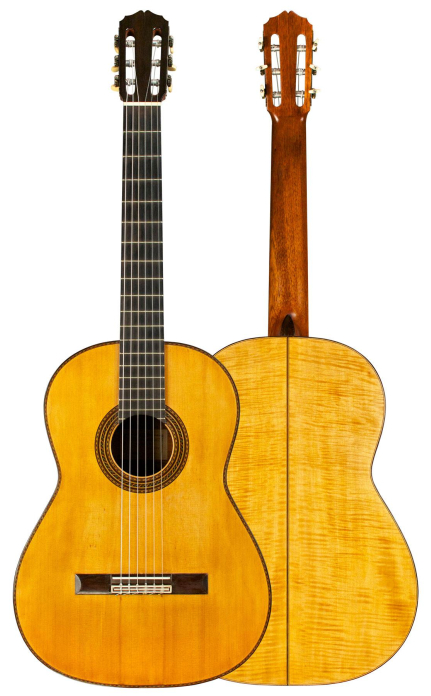
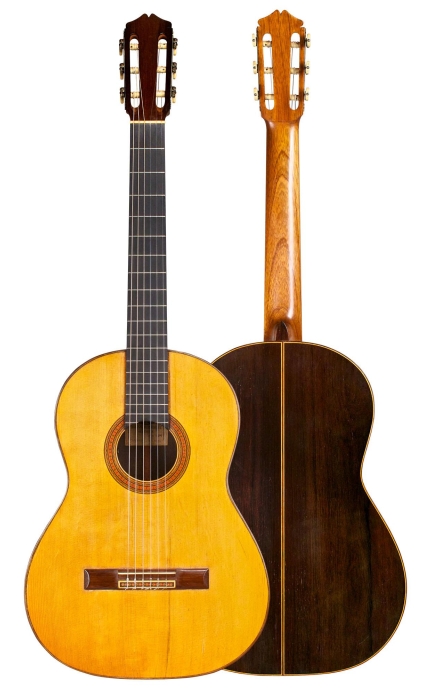
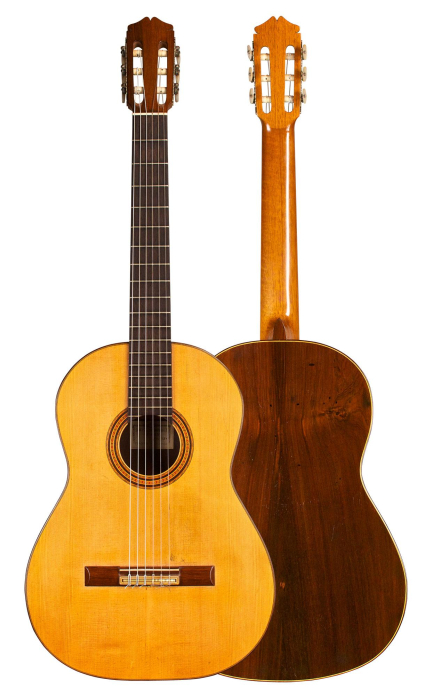
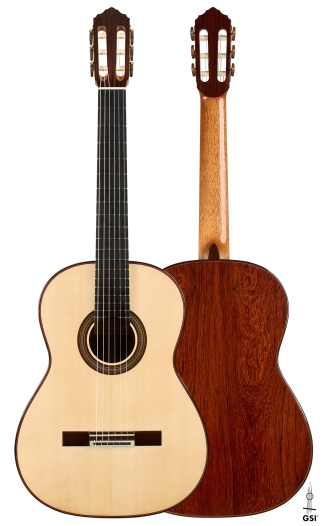
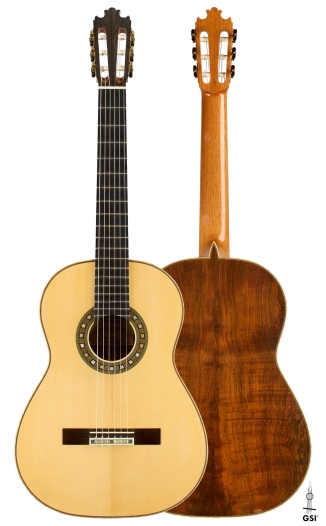
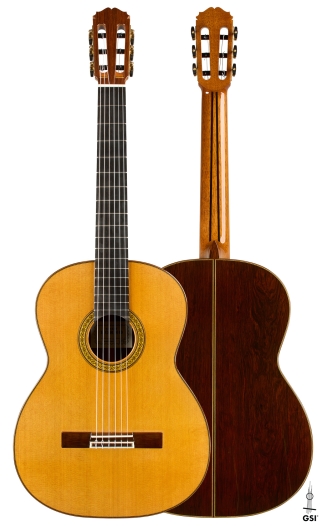
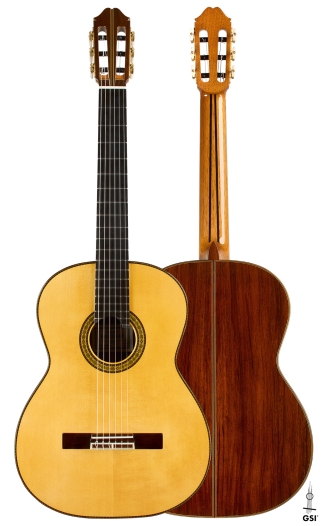
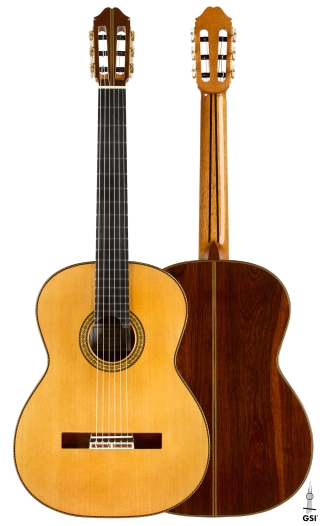
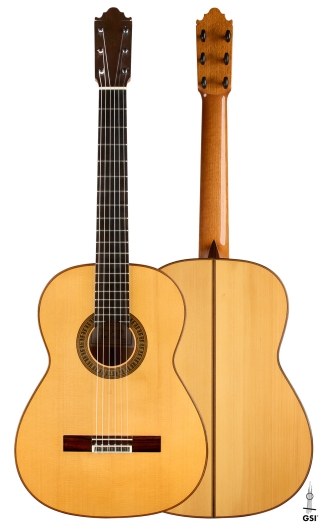
Santos Hernández (1874–1943) was a Madrid guitar maker and one of the most important luthiers in the history of the guitar, alongside Antonio de Torres and Hermann Hauser I. He built the famous 1912 Manuel Ramírez guitar played by Andrés Segovia, and from 1918 ran his own workshop in Madrid – for most of those years on Calle de la Aduana, a meeting place for the great classical and flamenco players of his day.
At a Glance
- Born: 1874, Madrid
- Died: March 8, 1943, Madrid
- Trained: from 1886 in Madrid, and above all in the Manuel Ramírez workshop, where he became foreman
- Own workshop: from 1918 – Plaza de Nicolás Salmerón 8, then Calle de la Aduana 27 and later Aduana 23, Madrid
- Labels: never numbered; year written by hand, often signed
- Famous guitar: the 1912 Manuel Ramírez of Andrés Segovia, now in the Metropolitan Museum of Art, New York
- Classical players: Andrés Segovia, Regino Sainz de la Maza, Eduardo Abreu, Daniel Fortea, Miguel Llobet, Rosario Huidobro, Luisa Walker, the Romero family
- Flamenco players: Ramón Montoya, Sabicas, Luis Molina
Santos Hernández and Segovia's 1912 Manuel Ramírez
A Spanish luthier, Santos Hernández (1874–1943), together with Antonio de Torres and Hermann Hauser I, is undoubtedly one of the most important guitar makers in history. His exceptional skills were recognized quite early in his career when he became known as the builder of the Manuel Ramírez guitar of 1912 that was owned and played by Andrés Segovia – this very guitar currently resides in the Metropolitan Museum of Art in New York, right next to Segovia's 1937 Hauser I. Hernández's guitars were also played by other well-known guitarists, including Regino Sainz de la Maza (for whom the Concierto de Aranjuez was written), Eduardo Abreu, and the Romero family.
From Gold Thread to the Guitar
Santos was born in Madrid and spent his whole life there, apart from five years of military service in Africa. As a boy of twelve he was a gold worker, making the silver and gold trimmings for bullfighters' suits, but in 1886 he changed trades: a relative who built guitars took him on to learn the craft, and he later worked for Ortega, a maker from Granada with a shop in Madrid. After his military service, Manuel Ramírez – one of the great masters of the time, and the man Santos always called his true teacher – sought him out and took him into his workshop, where he became foreman and where the 1912 guitar for Segovia was made. Santos was famously secretive about his work, and only two interviews with him are known.
His Own Workshop on Calle de la Aduana, Madrid
Manuel Ramírez died in 1916, and for a while Santos went on completing guitars for his widow under the "Viuda de Manuel Ramírez" label. Two years later, in 1918, he set up his own shop. It was a small workshop, with instruments waiting for repair, molds and gouges on the tables and sets of wood hanging from a wire near the ceiling to dry, and the walls covered with signed photographs of the great guitarists who played his instruments. This workshop became a place for social gatherings attended by the most established classical guitarists, including Andrés Segovia, Daniel Fortea and Miguel Llobet, as well as flamenco players – Ramón Montoya, Sabicas and Luis Molina.
After Santos' death in 1943 the Aduana shop carried on for a time under his widow, Matilde, and guitars were still sold there in the early 1950s; Marcelo Barbero completed some of the unfinished Santos guitars in these years (see our "Viuda de Santos Hernández" guitar).
Santos Hernández's Labels
Santos never numbered his guitars; he wrote the year on the label by hand and often signed it too. His earliest known label, in a 1903 guitar he built for himself while still working for Manuel Ramírez, simply reads "Santos Hernández, Constructor de Guitarras, Madrid". A 1919 label gives the address Plaza de Nicolás Salmerón 8. Most of his printed labels – one with a lyre at the top, another with a border of crosses – read "Santos Hernández, Luthier, Madrid, Aduana 27", while late ones, such as on a 1941 guitar, give Aduana 23, the shop where he was photographed with his wife around 1935. On at least one guitar, a 1925, his signature is written on the underside of the soundboard instead. After his death the shop sold guitars labeled "Viuda de Santos Hernández, Guitarrería, Aduana 23, Madrid".
The Santos Hernández Sound
Players for the past 100 years have valued Santos Hernández's guitars for their charming, introverted quality of tone and their traditional sound. Today Santos is one of the elite makers of the historical pantheon – along with Torres and Hauser I – in terms of collectibility and historical importance.
The Romero family has been especially close to his guitars. Celedonio Romero gave his son Pepe Romero a 1919 Santos early in his career, letting him choose one from several in his collection – a guitar that later shaped the work of the luthier Pepe Romero Jr.
Santos Hernández Guitars at GSI
Many Santos Hernández guitars have passed through our doors over the years. You'll find guitars currently in stock by clicking the "Guitars In Stock" button in the header of this page as well as earlier examples in our Museum by clicking the "Guitars In Museum" button.
Frequently Asked Questions
Who was Santos Hernández?
A Madrid guitar maker (1874–1943), trained in the Manuel Ramírez workshop, who opened his own shop in 1918 and worked for most of his life on Calle de la Aduana.
When did Santos Hernández open his own workshop?
In 1918, two years after the death of Manuel Ramírez.
Did Santos Hernández number his guitars?
No – his labels carry the year, written by hand, and often his signature, but no number.
Did Santos Hernández build Segovia's guitar?
Yes – he built the 1912 Manuel Ramírez guitar played by Andrés Segovia, now in the Metropolitan Museum of Art in New York.
Who played Santos Hernández guitars?
Classical players such as Segovia, Regino Sainz de la Maza, Eduardo Abreu and the Romero family, and flamenco players such as Ramón Montoya, Sabicas and Luis Molina.