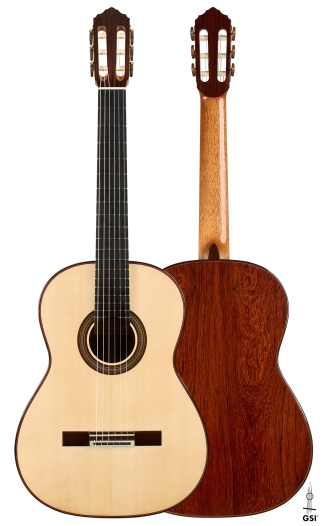
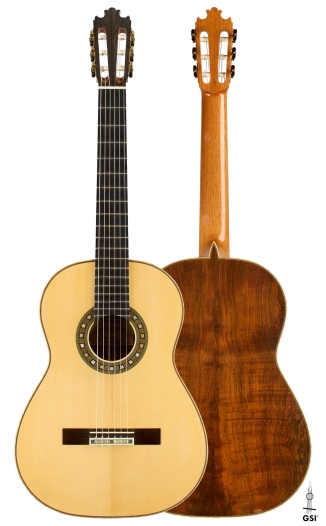
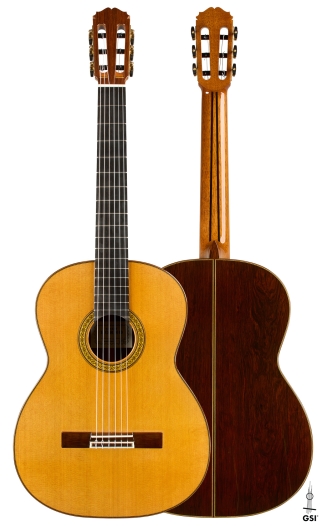
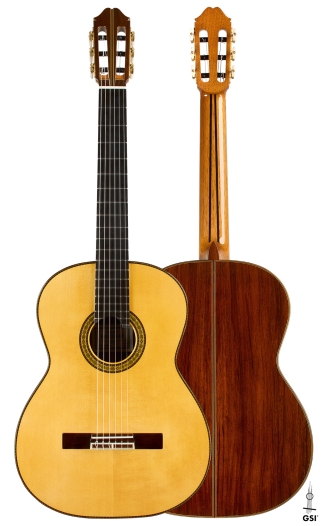
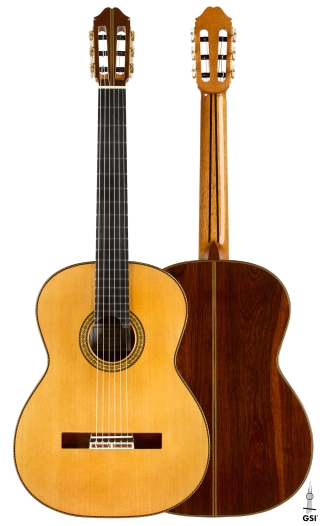
John Gilbert (1922–2012) was an American classical guitar maker from California, a former Hewlett-Packard machinist whose engineering approach – above all his "pin bridge" – made his guitars the choice of a whole generation of concert guitarists.
At a Glance
- Born: 1922
- Died: February 23, 2012, Woodside, California
- Trained: Self-taught; first instrument in 1965
- Background: Machinist for Hewlett-Packard
- Innovations: The Gilbert pin bridge; Gilbert tuners
- Played by: David Russell, Raphaella Smits, David Tanenbaum, Marc Teicholz, David Leisner, Fred Hand
- Successor: His son, William Gilbert
An Engineer at the Guitar Bench
John Gilbert is remembered as one of the more successful and popular of the "innovative" makers of his time. His instruments were played by an entire generation of guitarists, including David Russell, Raphaella Smits, David Tanenbaum, Marc Teicholz, David Leisner, Fred Hand and many others. His approach to guitar making was largely shaped by his engineering background – he had been a machinist for Hewlett-Packard – which meant not only extremely precise craftsmanship, but also innovative ideas about sound production: he had a special, very controlled and exacting system that took into account the dimensions, weight and stiffness of his materials. He built his first instrument in 1965, self-taught.
The Gilbert Pin Bridge
His most famous innovation was the "pin bridge". Instead of a traditional bone saddle, where all six strings share part of its space, Gilbert used a system of six metal pins that support the strings individually, maximizing the transmission of each note independently of the others for greater separation and independence between voices. Being able to adjust the action of each string individually is also an advantage for many players looking for a customized setup. His guitars also carry his own Gilbert tuners, famous for their tough, industrial look and their durability.
A Neutral Voice – and a Father-and-Son Workshop
Gilbert's aim was a guitar with a "neutral" response, letting the artistry of the player decide the color and dynamic possibilities of each performance. From around 1990 his son, William Gilbert, worked with him – labels from the 1990s are signed by both – and William later built guitars under his own name. John Gilbert died on February 23, 2012, at his home in Woodside, California.
John Gilbert Guitars at GSI
Several John Gilbert guitars have passed through our doors over the years, including one from the Russell Cleveland collection. You'll find guitars currently in stock by clicking the "Guitars In Stock" button in the header of this page as well as earlier examples in our Museum by clicking the "Guitars In Museum" button.
Frequently Asked Questions
Who was John Gilbert?
An American classical guitar maker (1922–2012) from California, a former Hewlett-Packard machinist known for his precise, innovative guitars and his pin bridge.
What is a Gilbert pin bridge?
A bridge in which each string rests on its own metal pin instead of a shared bone saddle, for clearer separation between notes and individually adjustable action.
Who played John Gilbert guitars?
A whole generation of concert guitarists, including David Russell, Raphaella Smits, David Tanenbaum, Marc Teicholz, David Leisner and Fred Hand.