


Coming Soon: Vladimir Druzhinin's Guitar + Gudelev Premieres a New Piece by Rudnev (Free Sheet Music!)
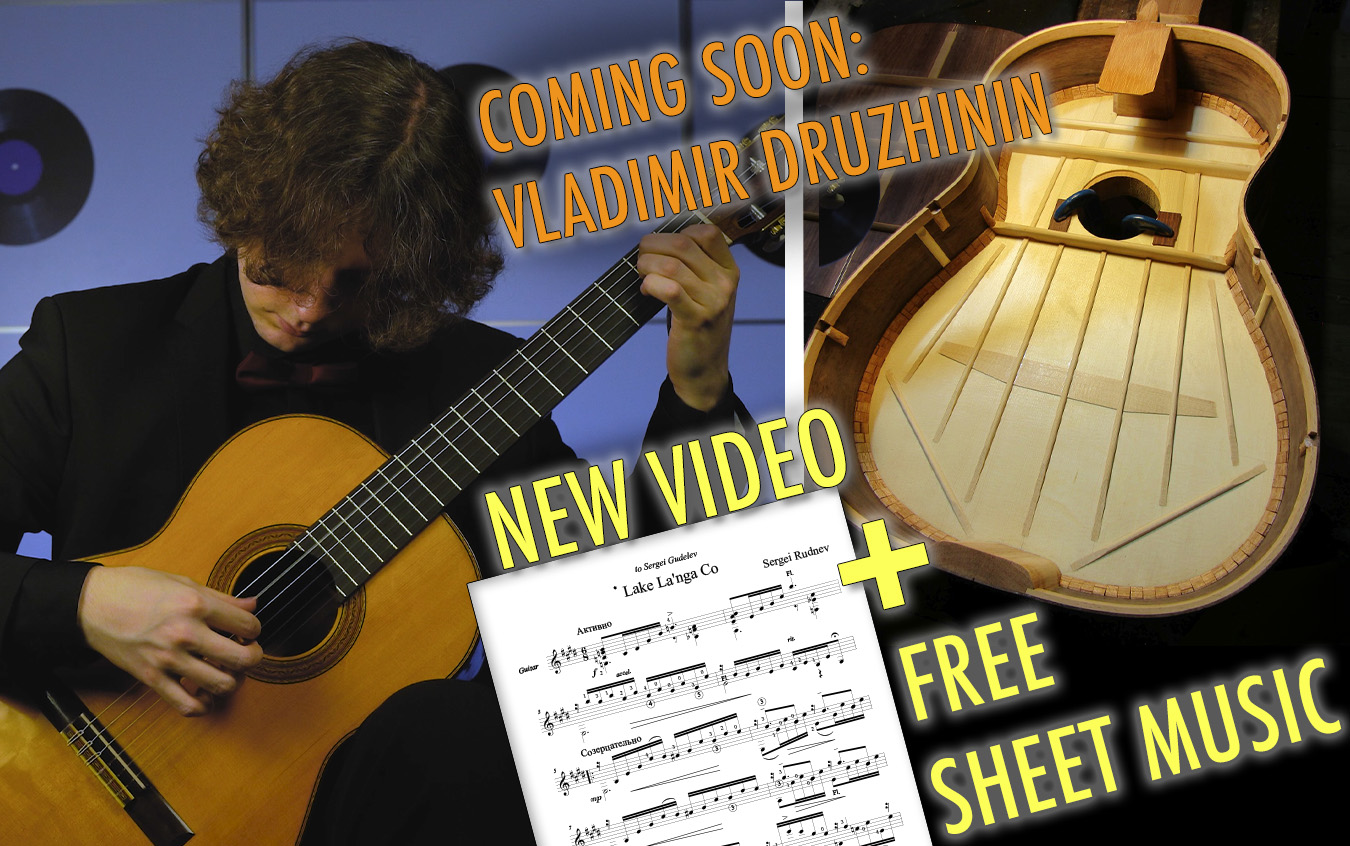 We’re excited to share a first look at something very special arriving soon at GSI.
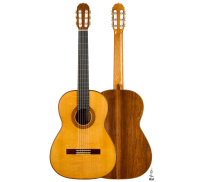
A New Vladimir Druzhinin “Special” Model
Luthier Vladimir Druzhinin has just completed a new instrument for GSI. This guitar is the second of three “special” models in an exclusive series, making it a rare and highly anticipated addition.
This series marks an important milestone in Vladimir's work and reflects a deep exploration of the shared principles behind stringed instrument making. It was shaped by his work with his mentor Timofey Tkach (1966-2026), who passed on his knowledge and guided Vladimir in the study of his violin-making school he had developed a long time ago. Tkach was convinced that the art of lutherie should be based on the knowledge suitable to build any acoustic stringed instrument, such as the lute, harp, guitar, violin etc. However, violins and guitars were always the most cherished. Vladimir says:
...Undoubtedly the classical guitar and the violin are two most perfect and complex achievements of the human mind in means of efficiency and balance, sound qualities, not to mention the artistic side: plasticity, logic, proportion and similarity of lines, arches, etc.
Drawing on both classical guitar and violin traditions and following Tkach's philosophy, Vladimir approaches guitar making as a discipline grounded in a universal understanding of lutherie. He adds:
...The idea of single School is quite natural as all these instruments are based on the same physical principles of sound formation. At the same time guitar and violin are very different in means of approach to structural design. The guitar is more a piece of engineering, it consists of flat plates, reinforced by braces and bars, etc. Violin is very "simple": no structural design at all. No straight lines or plates. 2 arched sculptures, bass bar and a soundpost. The task of balancing is solved in a more engineering, scientific way for guitar. With the violin, the only thing you can do is just knock and listen (there is a rational basement and theory behind this process of course too, not to mention the logic of cutting the arches, etc.). Finally, both approaches are to some extent applicable for both instruments, which allows to achieve the finest nuances and precision...
Last summer, it took Vladimir three months to explore the classical Violin school and build the violin. Additionally, it took three extra months between building guitars to develop the ground and oil varnishing technology based on the traditional 17th-century techniques. Then adapting these violin-making techniques in guitar making was a fantastic experience, especially inspring when he worked side-by-side with Timofey.
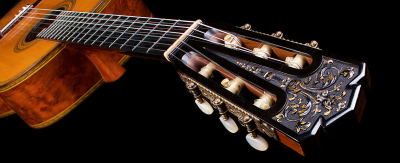
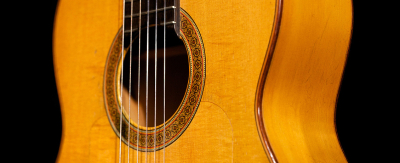
Uniting these schools resulted in an important milestone in Vladimir's guitar making, and to celebrate this (and also his 15-years in lutherie) he came up with this “Special” model. It features a reworked body shape and building method, classical-style inlays, and a select hazelfichte spruce top. The use of a violin-inspired protein ground and spruce treatment gives the guitar a warm amber tone, enhances the contrast of the wood grain, and creates a vivid visual depth that shifts subtly with changes in light and viewing angle.


Premiere Video: Sergei Rudnev – Lake La’nga Co
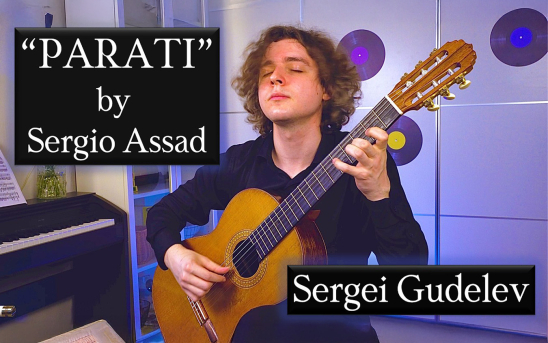
To celebrate this new guitar, acclaimed guitarist Sergei Gudelev has recorded a new piece by composer Sergei Rudnev. Perhaps it's best to learn more about this piece directly from Rudnev:
Tibet, with its mysticism and enigmatic teachings, had a strong influence on me at the time. Back then, I was practicing martial arts and reading a lot about that distant, mountainous country - especially Mystiques et Magiciens du Tibet by Alexandra David-Néel. This Frenchwoman, who left a comfortable life in Paris at nearly 50 (!), set off on a journey through Tibet as an objective researcher of its unique culture. Her dream was to reach Lhasa, the main Tibetan city. At the time, almost nothing was known about it, and it was nearly impossible for outsiders to get there, and women were strictly forbidden from entering, under penalty of death. So Néel disguised herself in men’s clothing... I recommend reading her books, where she describes what she witnessed with her own eyes. It was incredible.
However, at that time, I was primarily interested in the philosophy of Tibetan teachings and their principles. One of them is virtue, which has a strong influence on one’s actions in life and health, residing in both the physical and subtle bodies. According to this philosophy, good deeds, accumulated over time, create the foundation for a person’s spiritual development and for the so-called golden energy distributed through certain nodes—chakras. Meditation practices lie at the heart of everything here, requiring very secluded places—sites of power and tranquility. Such places are found in the Mount Kailash region. There, at an altitude of over 4,000 meters (over 13,000 feet), lie four lakes with crystal-clear water and, according to Tibetans, distinct and extraordinary energies.
Many years later, I wanted to express the inner state inspired by the incredible beauty of those places. This is how my first play, The Magical Lake Manasarovar, came to be. I have always remembered that these mystical lakes possess distinct qualities and an inner spiritual essence. Today, it is easy to read about these places online, but back in the 1980s, it was almost impossible.
Lake La’nga Co (also known as Mu-Le, Langak, or Rakshastal) is said to be a place of spiritual attainment. It is believed that being there and praying (or meditating) harmonizes a person’s physical and subtle bodies. La’nga Co is associated with the energy of a female deity and is believed to open the fourth heart chakra. If a person has accumulated enough of the virtues I mentioned, they may attain a state of general enlightenment and an understanding of hidden truths. Solitude and silence are essential prerequisites for this!
When creating a musical sketch of Lake La’nga Co, my main goal was to convey its serene tranquility, the mirrored surface of the water, and, of course, a sense of inner love and harmony with the surrounding world... The classical guitar, with its lively sound, proved to be well suited to this task. However, playing it in such a calm and restrained manner is not easy—not to mention the technical demands of the performance.
The piece Lake La’nga Co is dedicated to Sergei Gudelev. He belongs to a new generation of young musicians who undoubtedly follow their own path in art - a constant exploration and self-discovery. This path resonates strongly with the Tibetan philosophy of Bon, which the 14th Dalai Lama referred to as the ‘fifth religion of the future.’ And it's not even about that, it's about the path chosen by a person who came into this world with the goal of further self-improvement.
I really hope you enjoy the piece.
Free Sheet Music Download
It gets even better! Sergei Rudnev has generously shared the sheet music for Lake La’nga Co for free!
Whether you’re looking to explore its meditative atmosphere or take on its technical challenges, this is a wonderful opportunity to engage directly with a brand-new work from one of today’s leading composers for guitar.
Guitar and Violin Duo
In addition to the solo video, Sergei Gudelev has also recorded a duet with violinist Konstantin Kaznacheev. In this video, not only the guitar was built by Vladimir Druzhinin, but also the violin, which he completed in 2025 under the guidance of Timofey Tkach. The video below is dedicated to the loving memory of Timofey.
6 comments