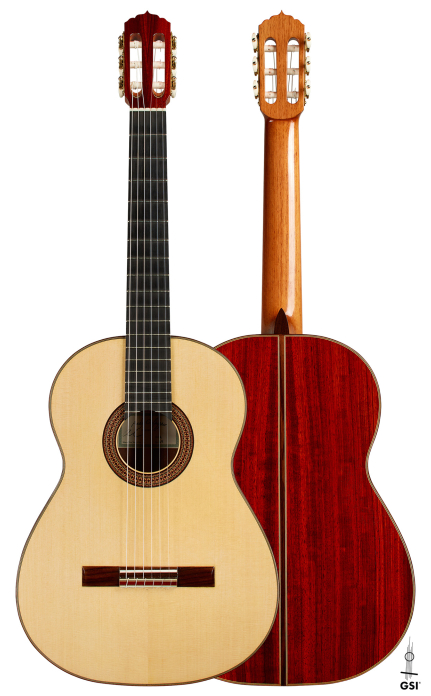
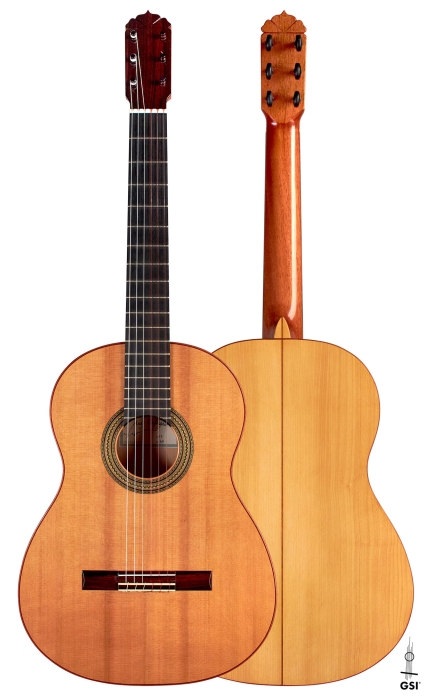
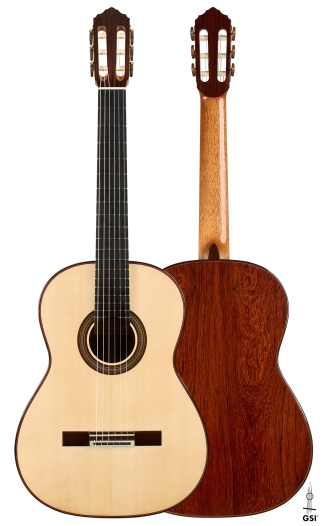
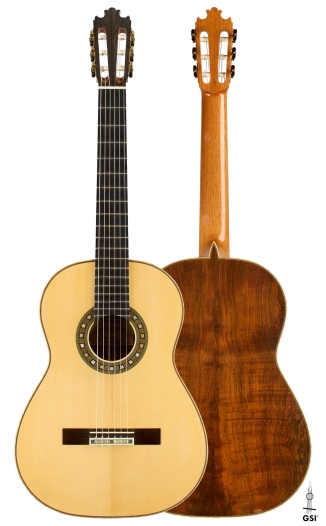
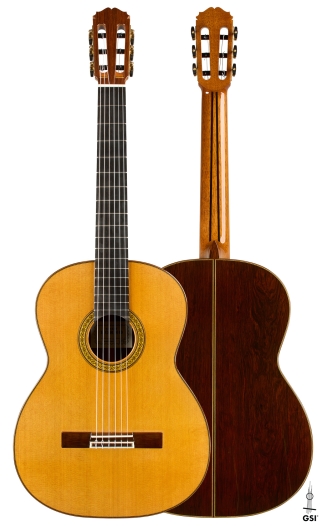
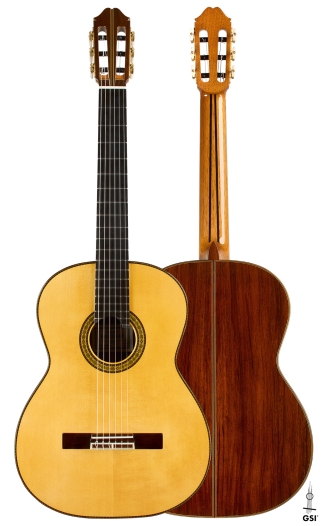
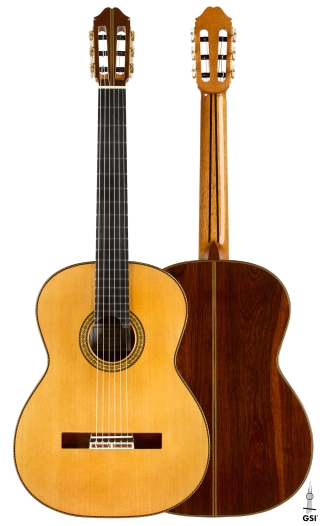
Andy Culpepper is an American classical and flamenco guitar maker based in Ithaca, New York. A guitarist himself, trained by luthier Richard Cogger, he builds traditional Spanish-style guitars by hand in the line of Antonio de Torres, with an "open bar" bracing system and a French-polished finish. GSI is the only dealer in the USA that carries Andy's guitars.
At a Glance
- Nationality: American
- Workshop: Ithaca, New York
- Teacher: Richard Cogger
- Builds: Classical and flamenco guitars
- Bracing: "Open bar" fan bracing (classical)
- Finish: French polish (shellac), applied by hand
- Milestones: No. 100 in 2018; 15 years of guitar making in 2026
- US dealer: GSI (only US dealer)
Interview: Luthier Insights
From the Delta Blues to Flamenco
Andy Culpepper grew up in a musical family with two brothers who are both accomplished musicians. He fell in love with the guitar as a teenager, shifting his focus from playing the Delta blues to playing classical music, and after discovering flamenco he was hooked on the latter two styles for life. He even studied flamenco in Spain and has since done a good amount of performing – solo, accompanying and for dance.
Apprenticeship with Richard Cogger
After studying music composition at the University of the Arts and then moving back to the Ithaca area in New York, Andy had a fortuitous encounter with local classical guitar maker Richard Cogger. Originally interested only in making a single guitar for himself for performances, Andy found himself hooked once again – this time by the art of lutherie. He spent his first couple of years as an apprentice in Cogger's shop and produced 26 instruments while learning a very scientific and analytical approach to guitar making. He then set up his own workshop in Ithaca, where he continues to build a large output of classical and flamenco guitars.
Torres, the "Open Bar" and Building by Hand

Andy believes that the best guitars are still modeled on the designs and ideas of Antonio de Torres (1817–1892), and admires him for his constant experimenting. The "open bar" system of top bracing, where the outer fan struts pass through openings in the harmonic bars, is a key design element in Andy's classical guitars, giving an extremely responsive, clear, even and beautiful tone that can envelop the listener in a kind of "surround sound".
While well versed in modern guitar-making theory, Andy prefers to work intuitively, flexing and tapping the wood with his thumbs to gauge the potential of each piece – a rich sensory memory that guides his choice of materials and the voicing of each guitar. He uses very few power tools: the neck is joined to the top first, the sides are slotted into the heel block on the solera and glued to the top with individual tentalones, and the back closes the box. Andy plays every guitar "in the white", refining the voice by sanding the top if needed, before French polishing it with shellac applied by hand with a muñeca.
Andy Culpepper Guitars at GSI
Over the years Andy has built a wide range of classical and flamenco guitars for GSI – from flamenco blancas with pegs inspired by Felipe Conde, Marcelo Barbero and Gerundino, to classical guitars after a 1935 Santos Hernández, a "Starry Night" guitar inspired by Van Gogh, and a "15th Anniversary" guitar celebrating 15 years of guitar making in 2026. His guitars are known for their power, clarity and easy playability, and they are versatile enough that many of his classicals can turn flamenco when pushed.
FAQ
Where is Andy Culpepper's workshop?
In Ithaca, New York.
Who taught Andy Culpepper guitar making?
Ithaca luthier Richard Cogger, in whose shop Andy apprenticed for a couple of years and built 26 instruments.
Does Andy Culpepper build flamenco guitars?
Yes – both classical and flamenco guitars, including flamenco blancas with mechanical pegs.
Where can I buy an Andy Culpepper guitar?
GSI is the only dealer in the USA that carries Andy's guitars.
Many of Andy's guitars have passed through our doors over the years. You'll find guitars currently in stock by clicking the "Guitars In Stock" button in the header of this page as well as earlier examples in our Museum by clicking the "Guitars In Museum" button.