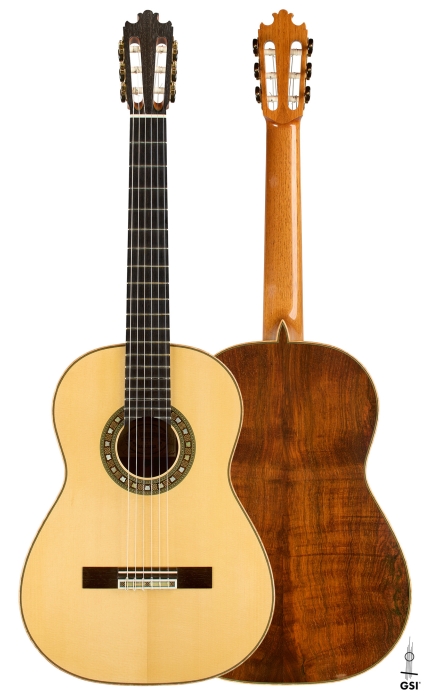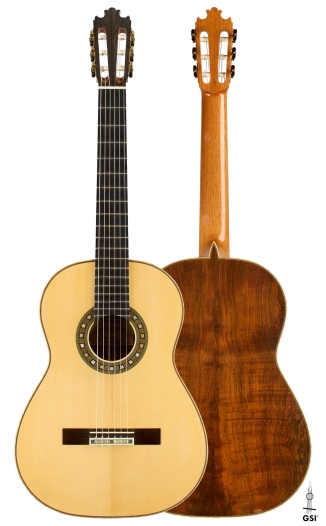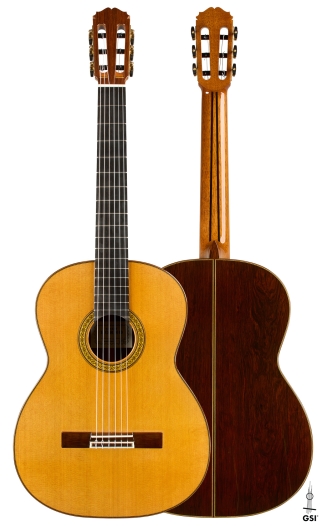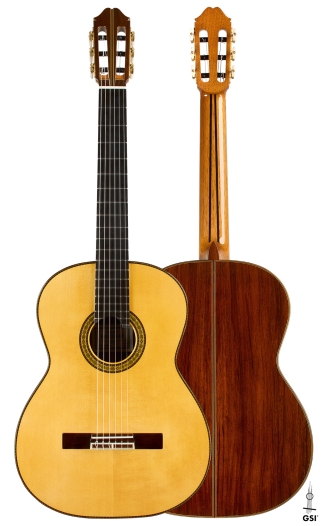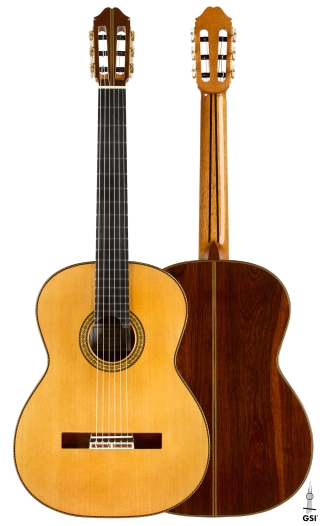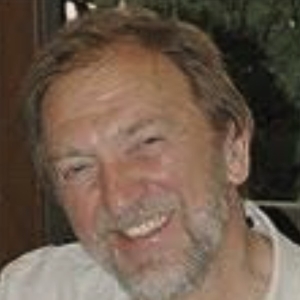
Géza Burghardt is the top builder of traditional classical guitars to emerge from Hungary. Trained in Budapest and deeply influenced by José Romanillos, he has worked in Vancouver, Canada, since 1988, and since the mid-1990s in his own workshop on Granville Island, building guitars in the Spanish tradition of Antonio de Torres – entirely by hand and French polished.
At a Glance
- Origin: Hungary
- Master’s certificate: Budapest, 1981
- Key influence: José Romanillos (met in 1983)
- In Canada since: April 1988
- Workshop: Granville Island, Vancouver, Canada
- Guitars: Classical guitars in the Spanish tradition
- Finish: French polish only
- Also: Violins, cellos, double basses and restoration
From Boat Building to the Guitar
Géza learned his craft from the ground up. At fourteen he began a three-year apprenticeship as a pattern maker, where everything was done by hand, and he later became a professional boat builder in Budapest, making racing shells, kayaks and canoes and running his own boat workshop. A lifelong guitarist – first in a rock band, then playing folk music – he turned his skills to restoring guitars and, with the encouragement of local makers, to building classical guitars. In 1981 he earned his master’s certificate in Budapest and opened his own shop.
Meeting José Romanillos
The turning point came in 1983, when Géza represented Hungary at an international guitar festival there and met José Romanillos. Romanillos later visited him at home in Budapest, and from that meeting Géza took ideas that made his guitars better – among them the Spanish V-joint between neck and head, which he learned from Romanillos’s own description and which every Burghardt guitar has, cut entirely by hand. The friendship lasted for decades: in 2002 Géza built a “Grand Concert” for Romanillos’s 70th birthday, with an engraved silver plaque thanking the maestro for his influence and inspiration, and Pepe Romero Sr. played it at the celebration in Sigüenza, Spain.
A New Start in Vancouver
In 1984 Géza, his wife Tini and their daughter left Hungary. After about four years in an Austrian immigration camp, the family arrived in Vancouver in April 1988, with very little money and almost no English. Within days he was working at Ward Music, where he set up and ran the string repair shop, and he also taught guitar making part-time at Douglas College. In the mid-1990s, shortly after becoming a Canadian citizen, he opened his own workshop on Granville Island, which he and Tini built themselves. There he has restored instruments for the Vancouver Symphony Orchestra and other orchestras, built violins, cellos and double basses alongside his guitars, and mentored a number of Vancouver luthiers.
Guitars in the Spanish Tradition
Géza’s guitars follow the Spanish tradition of Torres and Romanillos: hand-planed tops, hand-carved necks, and inlays and bindings cut by hand, with each rosette made individually – on his “Grand Concert” model the mosaic pays tribute to Torres’s famous “Cumbre” guitar (FE 08). He has never sprayed a finish; every guitar is French polished, and his French polish is considered among the finest in British Columbia. He has also built Hauser-style guitars, such as a 2012 “1943 Hauser” based on Jeffrey Elliott’s plans of a 1943 Hermann Hauser I, with a top from the wood supply of Edgar Mönch.
Frequently Asked Questions
Where does Géza Burghardt build his guitars?
In his workshop on Granville Island in Vancouver, Canada, which he opened in the mid-1990s. Before emigrating in 1984 he worked in Budapest, Hungary.
Who influenced Géza Burghardt?
Above all José Romanillos, whom he met in 1983, and through him the Spanish tradition of Antonio de Torres.
What finish does he use?
French polish only – he has never sprayed a finish on his instruments.
Are Burghardt guitars available at GSI?
Burghardt guitars rarely appear on the second-hand market. The guitars we currently offer, and those we have offered in the past, are listed below.