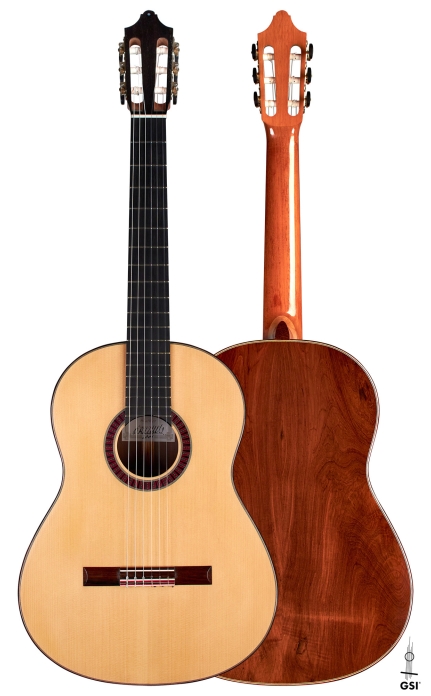
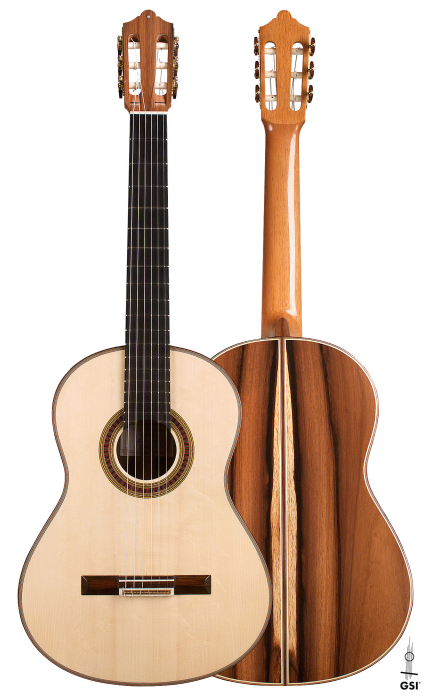
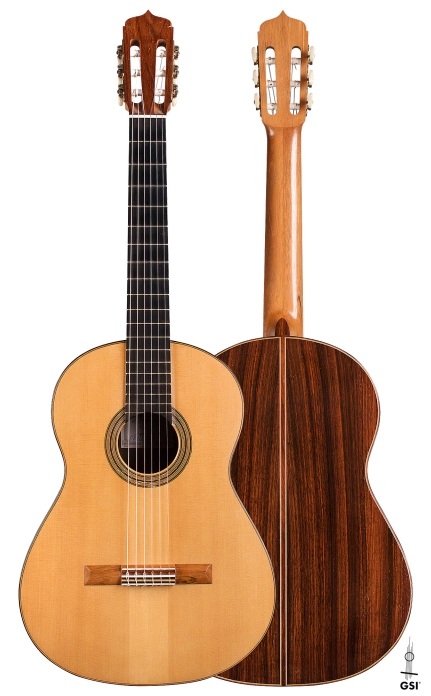
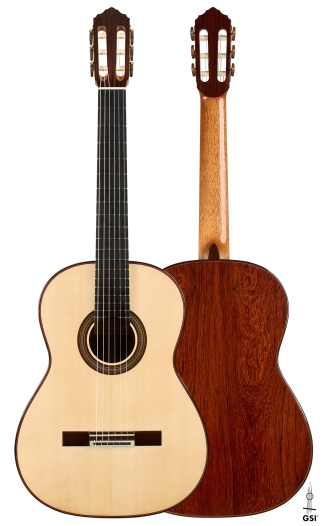
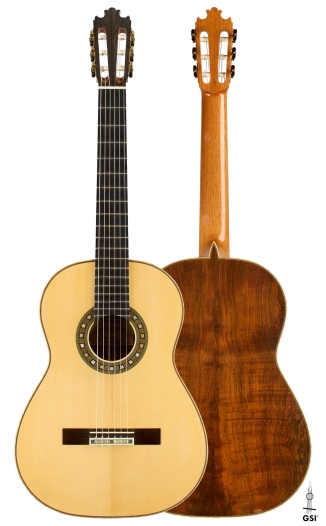
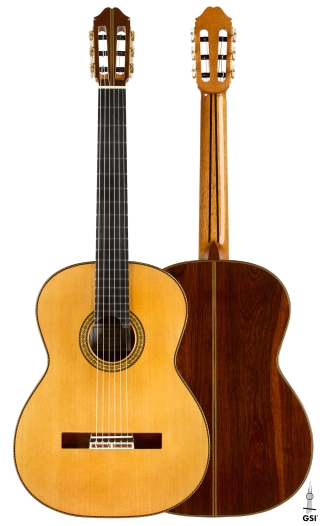
2016 Otto Vowinkel CD/CSAR
| Year | 2016 |
| Top | Cedar |
| Back & Sides | CSA Rosewood |
| Scale Length | 650 mm |
| Nut width | 52 mm |
| Finish | French Polish |
| Country | Netherlands |
| Luthier | Otto Vowinkel |
This guitar is no longer available in our inventory. If it interests you, click the ”notify me when available” button to be notified in the event that we re-acquire this guitar for re-sale.
Description
This 2016 Otto Vowinkel is a concert classical guitar with a cedar top and CSA rosewood back and sides, made by hand in his workshop in Amsterdam, the Netherlands – a guitar that reminds us a bit of Fleta.
A Lightweight Concert Guitar from Amsterdam
With some new and improved design features at the time, it was among the lightest guitars we had seen from Otto, the result, most likely, of a slightly more compact body and efficient use of materials. It is incredibly easy to play, ultra-responsive and very powerful.
Cedar and Dramatic Rosewood
The extremely dramatic, aged rosewood of the back and sides is a wonderful complement to the great workmanship.
Details from Amsterdam
Otto’s unique rosette design features herringbone in the purfling surrounding the mosaic (the motif found in the flag of the city of Amsterdam). The headstock takes its shape from the Amsterdam building that houses Otto’s workshop. The MOP dot at the top is a “winch”, like those on the city’s canal houses – a hook and pulley for hoisting furniture and goods up through the large windows, since the staircases inside are so narrow and steep (see photo). Purely aesthetic, yes – but charming “extra” details that tie the guitar to its place of origin.
Sound and Finish
The finish is shellac, applied with great care by the traditional French polish method, for a beautiful luster. Tuners are Graf. Huge volume with little right-hand effort – thanks to the slightly more compact body – and a plump and lively tone, very lyrical and beautiful at the same time. In our opinion at the time, it was his best-sounding model so far. This particular guitar reminds us a bit of Fleta – a very dense, full and rich sound in every note, yet with ample clarity and separation between voices. A very impressive instrument all around.
Who Plays Vowinkel Guitars
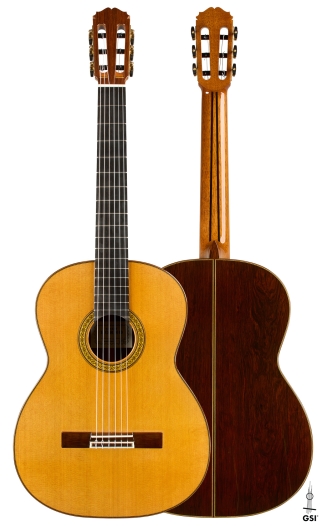
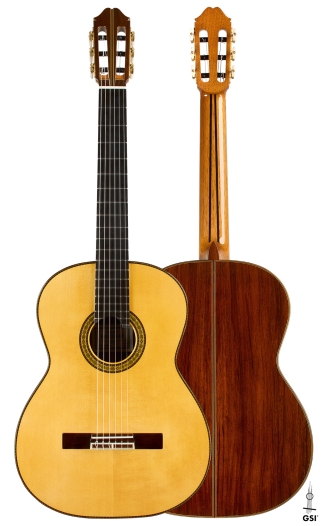
Denis Azabagic, Esther Steenbergen and the Amsterdam Guitar Trio are among the concert and recording artists who have played Vowinkel guitars. In concert, Ben Verdery has played one of Otto’s baritone guitars. Tariq Harb – winner of the 2011 Barrios World Wide Web Competition and the 2011 Montreal International Classical Guitar Competition – is one of several competition winners who play them, along with Chia-Wei Lin, a Taiwanese guitarist who took 1st prize in Singapore, and Sanel Redzic, a young Bosnian guitarist who won in Vienna and Oberhausen with a cedar Vowinkel.
Background
Otto Vowinkel: Classical Guitar Maker in Amsterdam
Otto Vowinkel grew up in a family of tailors in the old center of Amsterdam. He came to the guitar as a player, and in 1984 – with no teacher, a few basic tools and Irving Sloane’s book Classical Guitar Construction – he built his first guitar in the attic of his house. He learned by showing each new guitar to every guitarist he could find and building the next one with their comments in mind.
Traditional Spanish Building and French Polish
In 1989 Otto met his future wife, the Dutch guitarist Esther Steenbergen, and the Andalusia-based Dutch maker Alex van der Horst (“Alejandro”, 1959–2009), with whom he worked regularly and shared his ideas about the ideal guitar: a flexible tone, a quick response, and quality of sound as the carrier of volume. Otto builds in the traditional way and is a specialist in French polish, on which he now gives lectures and workshops. His rosettes carry the colors of the flag of Amsterdam.
Concert Guitars and Student Models
Besides his concert classical guitars, Otto makes flamenco guitars, quart guitars and fifth-bass (baritone) guitars. He has also designed student models that are handmade in small workshops in Spain under his supervision. You can read more in our article on Otto Vowinkel.