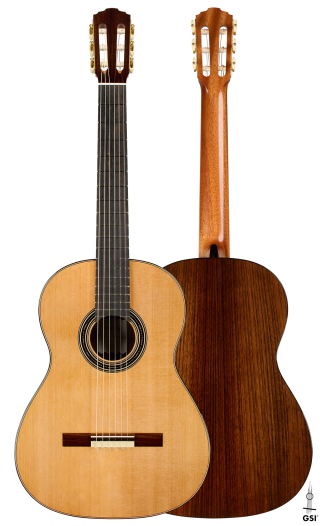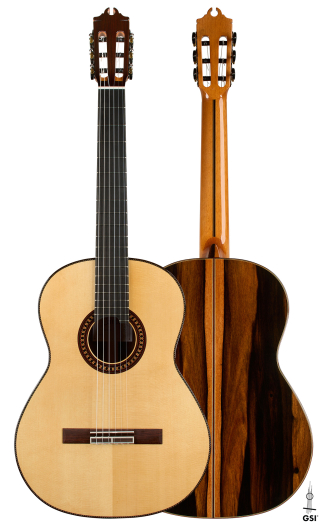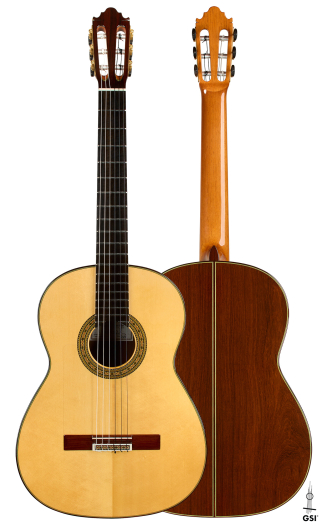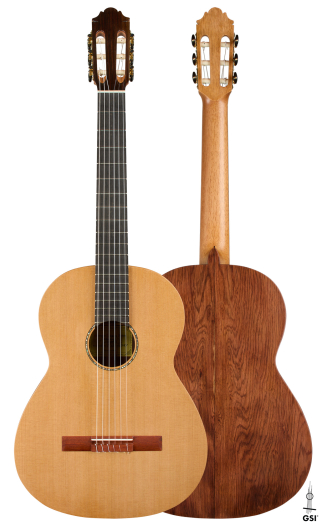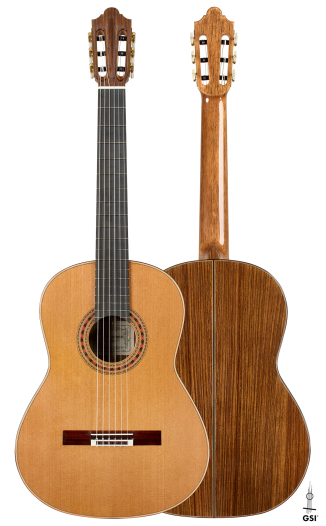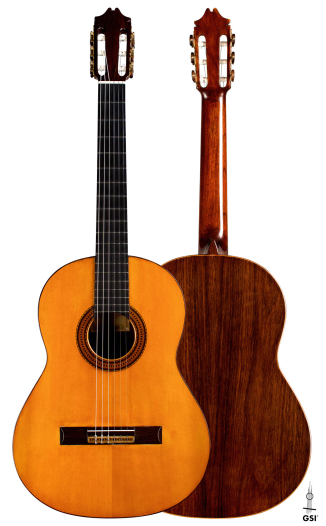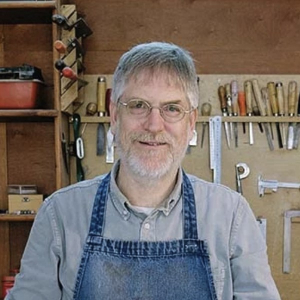
John Ray is a Canadian-born classical guitar maker based in Granada, Spain, known for his meticulous replicas of Antonio de Torres guitars. Born in 1965 in Edmonton, he moved to Andalucía in 1989, learned from Granada makers including Antonio Marín Montero, and found his key teacher in Rolf Eichinger.
John Ray at a Glance
- Born: 1965; grew up in Edmonton, Alberta, Canada
- Workshop: Granada, Spain (in Andalucía since 1989)
- Key teacher: Rolf Eichinger (from 1999)
- Also helped by: José Ángel Chacón Tenllado, Jonathan Hinves, Antonio Marín Montero
- Known for: replicas of Antonio de Torres guitars, including SE 153 (1892)
- Guitarists: Javier Riba, Evaristo Valenti, Carles Trepat, Víctor Bravo, Paola Requena, George Papathanasiou, Tita Avendaño
From Edmonton, Canada, to Andalucía
John Ray (born 1965) grew up in Edmonton, Alberta, Canada. After finishing a linguistics degree in Montréal in 1988, he returned to Edmonton to work as a cook and then a house painter. His passion for the guitar (as a player) pushed him to seek some way to enter the world of the guitar. On the advice of a guitar teacher in Montréal, he left Canada in 1989, determined to learn guitar construction from the great makers in the homeland and birthplace of the modern Spanish guitar – Andalucía, Spain. Teaching English provided enough income to pursue both guitar making (his first guitar was built on his kitchen table!) and the perfect tapa to accompany the occasional glass of wine. But what he thought would be achievable in a year took 10 years to accomplish, and even then there was so much more to learn.
Rolf Eichinger and the Granada Guitar Makers
Those in Granada who helped open the doors for John were many (including José Ángel Chacón Tenllado, Jonathan Hinves and even Antonio Marín), but his key teacher was the late Rolf Eichinger, who in 1999 took John in and helped him establish the fundamentals of guitar construction and the approach necessary for the eventual mastery of his craft. John cites this relationship as the most critical, and feels that his career as a professional guitar maker became secure with the assistance and attention Rolf provided.
Some of the musicians who have helped guide John in his quest to make a better guitar are Javier Riba, Evaristo Valenti, Carles Trepat, Víctor Bravo and Paola Requena – all from Spain – George Papathanasiou of Greece and Tita Avendaño of Chile. There is also a group of exciting younger guitar makers in Granada with whom John often meets to exchange ideas.
Studying Torres, Santos Hernández and the Historic Guitars
The guitar collections of Casa Luthier and of Ángel Luis Cañete have given John the opportunity to study older, historical instruments. As his reputation for repair and restoration has grown, more instruments needing work have been entrusted to him, giving him the opportunity to study in greater detail instruments by such makers as Torres, Laprevotte, Barbero, Lorca, Pagés, Vicente Arias and Santos Hernández, among others. In John's own words: "I strongly feel that my most important asset is being privy to a living tradition that is centuries old. My study of historic guitars and my attempts to reproduce them have also taught me much."
His Torres replicas are based on originals he has personally inspected, photographed and measured, such as the 1892 Torres SE 153. As John has told us, "I believe that in order to approach the sound of antique guitars (good ones of course) we need to take into account the aging that the wood has undergone since the instrument was built. Wood loses some of its mass and becomes drier and lighter after 100+ years. In my opinion the thicknesses must be reduced slightly if we wish to get that sound we are looking for."
Traditional Methods, Consistent Results
Today John uses well-aged timbers, hot hide glue, very traditional methods and the accumulated knowledge of those who have gone before to make responsive, very comfortable instruments which respond to every nuance of the musician's performance. He feels that once a maker is able to build a guitar which is an adequate tool for a demanding musician, the rest of the task is to develop the personality of his work, make something unique, and maintain and improve the level of his work. An important aspect of a great maker is that the instruments be reliably consistent from one to the next, and we can say that this is true of John Ray's work.
John Ray Guitars at GSI
Many John Ray guitars have passed through our doors over the years, from flamenco guitars to his Torres models. You'll find guitars currently in stock by clicking the "Guitars In Stock" button in the header of this page as well as earlier examples in our Museum by clicking the "Guitars In Museum" button.
Frequently Asked Questions
Where does John Ray build his guitars?
In Granada, Spain, where he has lived and worked since moving to Andalucía from Canada in 1989.
Who was John Ray's teacher?
His key teacher was the late Rolf Eichinger, from 1999; José Ángel Chacón Tenllado, Jonathan Hinves and Antonio Marín Montero also helped him.
Does John Ray make Torres replicas?
Yes – among them his "1892 Torres", based on Torres SE 153, which he inspected, photographed and measured himself.