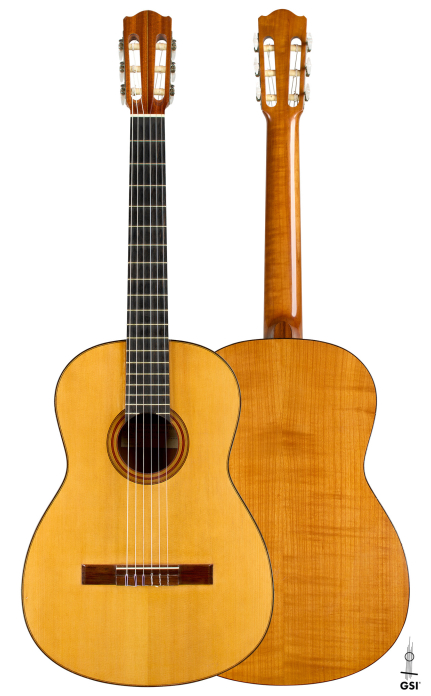
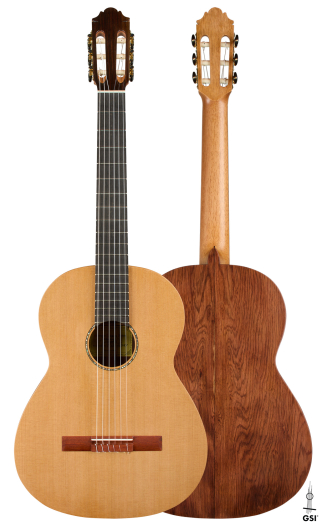
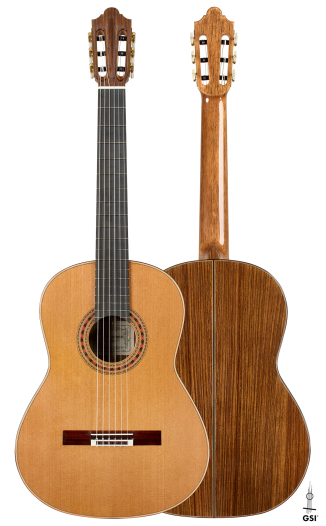
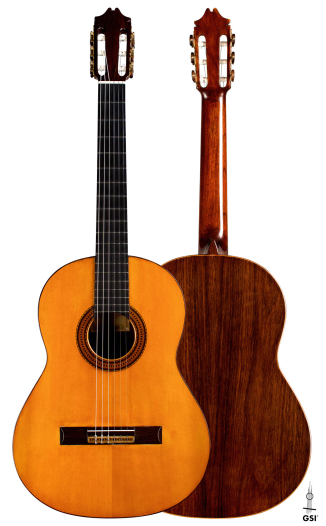
1968 Pietro Gallinotti SP/CH
| Year | 1968 |
| Top | Spruce |
| Back & Sides | Cherry |
| Scale Length | 650 mm |
| Nut width | 50 mm |
| Finish | French Polish |
| Condition | Excellent |
| Country | Italy |
| Exchange | ExchangePlus |
| Luthier | Pietro Gallinotti |
$7,000.00
Applicable sales tax and shipping charges will be added at checkout.
Details


Pietro Gallinotti, il maestro della chitarra
Description
 Image: Archivio liuteria Grimaldi
This 1968 Pietro Gallinotti is a classical guitar with a spruce top and flamed Piedmont cherry back and sides, made in Solero (Alessandria), Italy – a rare, beautifully preserved example of his own 1960s model by one of the founding figures of Italian guitar making.
Pietro Gallinotti: An Italian Guitar-Making Pioneer
Although relatively unknown outside of Italy, Pietro Gallinotti is one of the great pioneers in Italian guitar making history, and within Italy he is considered a national hero and treasure in the guitar community. His guitars rarely appear outside Italy – this is our first in over a quarter century, so a very rare find indeed, and it confirms that Gallinotti's work deserves to be recognized on the international stage. Of great interest to many, Gallinotti is also the current forerunner in the "who invented the cedar top" historical quest.
A 1968 Gallinotti from His Own Model
Our friend and colleague, Italian luthier Mario Grimaldi, is arguably the largest champion of Gallinotti – he's his biographer, and after befriending Pietro's son Carlo (also Pietro's only student and assistant) he was able to obtain many of Pietro's tools and materials as well as insight into his construction method. Mario tells us that the period in which this guitar was built was one of Gallinotti's happiest. After experimenting with models by Julián Gómez Ramírez, Francisco Simplicio and Santos Hernández in the 1940s and 1950s, he synthesized these influences and developed his own model in the 1960s, as is the case with this guitar from 1968.
Condition and Materials: Flamed Piedmont Cherry
This guitar is in amazing condition – no cracks or repairs and very little wear. It is simply made, with a ring rosette and modest decoration – only thin maple veneers for the top, back and headstock purflings. The materials are beautiful, including rarely seen flamed cherry from the Piedmont region of Italy for the back and sides (of interest, this is the same wood the Guadagninis also used for their Romantic guitars). The neck and headstock are of one single piece of wood (also cherry), with a mahogany veneer on the front of the head.
Sound: Reminiscent of Torres and the Early Madrid School
For sound and playability, this is very reminiscent of the lightweight cypress guitars of Torres or of the makers from the early Madrid school – boasting a full, wholesome, robust, very natural and "woody" quality of tone which jumps right out of the guitar with the slightest touch. It has all the qualities of an old Spanish guitar – great dynamics, tonal colors, responsiveness and beauty of tone. It also has surprising volume and projection – plenty to satisfy a modern player in the 21st century.
Overall this is a gem, and must be what we can only imagine to be a top example from this maker's output. We hope to see more of these in the future – this is really quite an impressive "introduction" (to us) of this maker's work.
Background
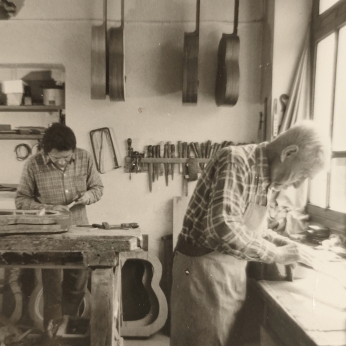 Image: Archivio liuteria Grimaldi
Pietro Gallinotti (1885–1979), Luthier of Solero
Pietro Gallinotti (1885–1979) is one of the great pioneers of Italian guitar making. He lived and worked in Solero, a small town near Alessandria in Piedmont, where he built guitars (as well as violins) under a label that proudly reads "Premiata Liuteria" – award-winning lutherie. His son Carlo was his only student and assistant. Although relatively unknown outside of Italy, Gallinotti is regarded there as a national treasure of the guitar world, and his instruments were owned and played by guitarists such as Carlo Ernesto Salio, Alberto Mautino and Bruno Giuffredi – and also played by Alirio Díaz.
The First Cedar Top? Turin, 1952
In 1952 Gallinotti won first prize at a guitar-making competition in Turin with a guitar whose four-piece soundboard was made of western red cedar (thuja plicata). That guitar predates by roughly ten years the famous cedar-top instruments from the José Ramírez III workshop in Madrid, which are traditionally credited as the first to use this wood for the top. The discovery was made by Italian luthier and Gallinotti biographer Mario Grimaldi, who examined the 1952 guitar for a 2007 exhibition in Solero and later found matching cedar billets among the materials from Gallinotti's workshop – read the full story in our blog post Secrets of Lutherie: The Cedar Soundboard, an Italian Invention. Gallinotti experimented in other ways too, including a long-scale guitar in 1953, years before longer scales became common.
From Spanish Influences to His Own Model
In the 1940s and 1950s Gallinotti experimented with models by Julián Gómez Ramírez, Francisco Simplicio and Santos Hernández. In the 1960s he synthesized these influences into a model of his own – the period that Mario Grimaldi considers one of the happiest of Gallinotti's life.
Mario Grimaldi and the Gallinotti Legacy
Mario Grimaldi is arguably the largest champion of Gallinotti's work. After befriending Pietro's son Carlo, he obtained many of Pietro's molds, tools and materials, along with insight into his construction method. Together with Mario Dell'Ara, Mario wrote the catalogues for the Gallinotti exhibitions in Savigliano (2006) and Solero (2007) and the book "Pietro Gallinotti, Luthier of Solero".