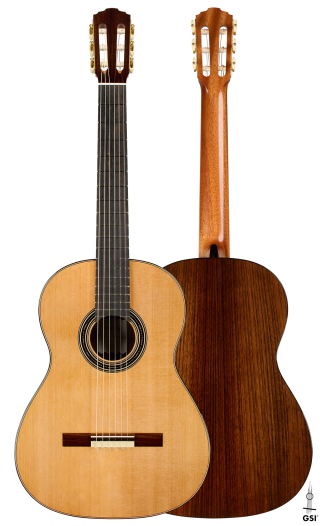
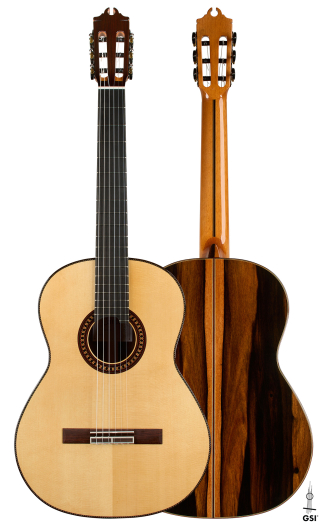
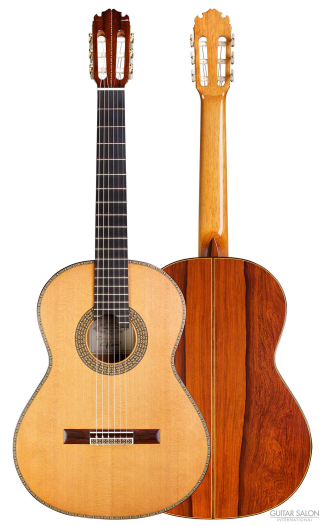
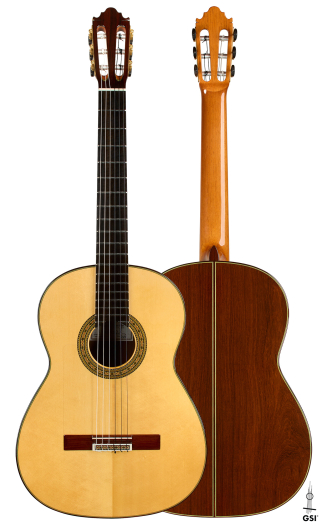
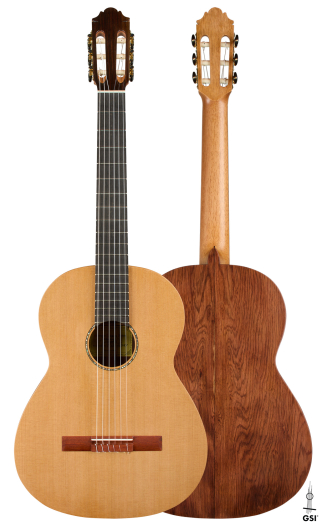
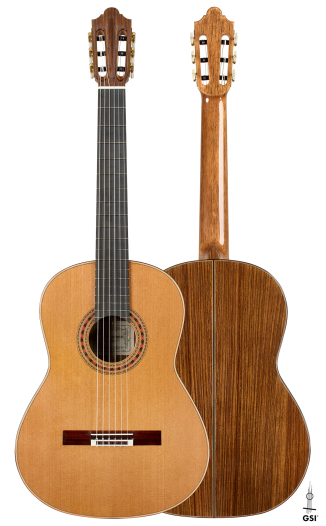
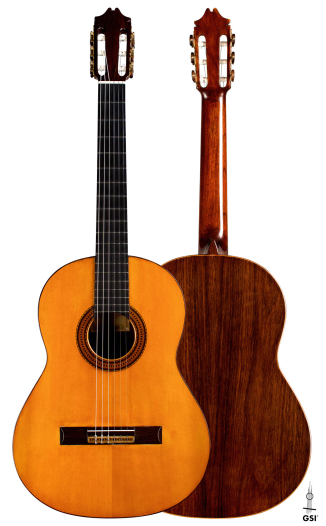
1981 José Romanillos "La España" SP/IN
| Year | 1981 |
| Top | Spruce |
| Back & Sides | Indian Rosewood |
| Scale Length | 650 mm |
| Nut width | 51 mm |
| Finish | French Polish |
| Top Construction | Traditional |
| Bracing | Seven fans w/bridge patch, open harmonic bar |
| Body resonance | F# |
| Tuners | Rodgers |
| Weight | 3.3 lbs/1,497 grams |
| Condition | Excellent |
| Country | England |
| Case | Roger A. Bamford (black hardshell) |
| Exchange | ExchangePlus |
| Luthier | José Luis Romanillos |
 Monthly payment plans available


Davide Picci performs 2nd Mvt. from Sonata No.4 by Dusan Bogdanovic on a 1981 Jose Romanillos guitar

Alan Mearns performs his arrangement of "Sarabande" BWV 1007 by J.S. Bach on a 1981 Jose Romanillos

Manuel Toucinho performs 'The Arts and the Hours' by Jean-Philippe Rameau on a 1981 Romanillos

1981 Jose Romanillos “La España” SP/IN AVAILABLE NOW at guitarsalon.com
Description
 This 1981 José Romanillos "La España" is a classical guitar with a spruce top and Indian rosewood back and sides, made in Semley, Wiltshire, England – guitar No. 594, from the same "5" series as Julian Bream's Romanillos guitars.
All the Qualities of an Exceptional Romanillos
This instrument has all the qualities of an exceptional Romanillos – in short, a sweet and lyrical tone with excellent separation. The volume is excellent and yet it's almost "noiseless" – string noise and nail noise are absorbed and not amplified, allowing the notes themselves to sound unhindered. All in all, this is a remarkable musical instrument.
Moorish Arches: the Classic Romanillos Look
The guitar has the classic Romanillos aesthetic – the Moorish arches in the headshape and in the mosaic of the rosette. The instrument is a bit on the smaller side.
No. 594 and the "5" Series, Based on a 1930 Hauser I
Notably, it is numbered 594, meaning it's the 94th guitar built in the "5" series – guitars Romanillos built that were structurally based on Sérgio Abreu's 1930 Hauser I. The first 3 Romanillos guitars in this series, from 1973, went famously first to Julian Bream (#501), Sérgio Abreu (#502) and his brother Eduardo Abreu (#503). Bream would also later own another Romanillos built in 1981, just 2 guitars before this one (#592 "La Lechuza")! This instrument therefore represents (in great style and amazing sound) that for which Romanillos is most famous. This is a top example from this maker – there may be equals but nothing finer.
One Owner, Cared for by Jeffrey Elliott
It has had only one owner to date, who used this instrument for recording and concertizing – including a CD of Bach, Giuliani and Ponce that is included with this guitar (notably, in the 1973 masterclasses in Madrid, Andrés Segovia awarded this player a full scholarship to study at the conservatory in Santiago de Compostela, and in the years following he received multiple degrees and accolades over the course of his performing career). While under his stewardship, he had Jeffrey Elliott handle the guitar's maintenance over the years, which included minor gluing work, fret and setup adjustments, finish touch-up (all original finish is still on the guitar) and the repair of a crack on the upper bout (bass side) with a patch underneath – an area that has no impact on the sound.
Overall this is highly desirable for either performer or collector – this is a masterpiece from one of the top luthiers of the 20th century.