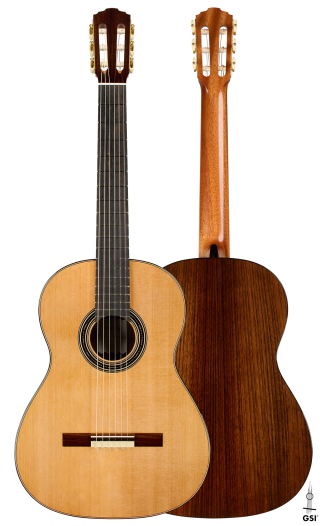
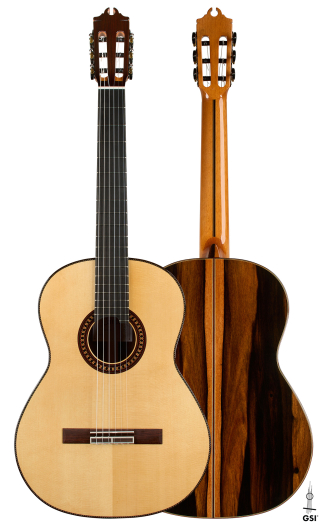
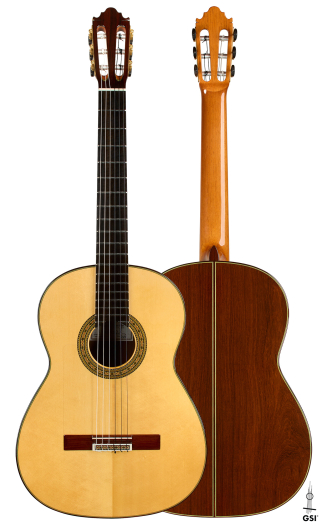
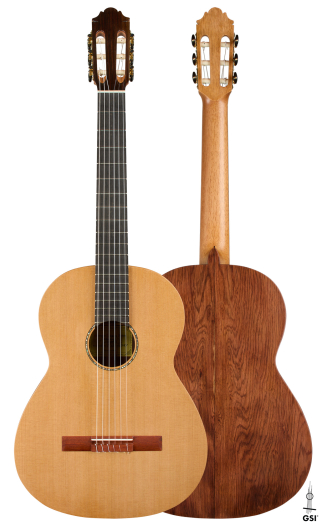
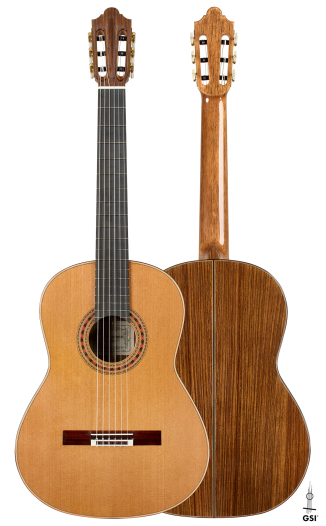
2026 Thomas Dauge SP/AR
| Year | 2026 |
| Top | Spruce |
| Back & Sides | African Rosewood |
| Scale Length | 650 mm |
| Nut width | 52 mm |
| Finish | French Polish |
| Condition | New |
| Country | France |
| Exchange | ExchangePlus |
| Luthier | Thomas Dauge |
$18,000.00
Applicable sales tax and shipping charges will be added at checkout.
Details


Description
 This 2026 Thomas Dauge is a classical guitar with a spruce top and African rosewood back and sides, built near Bordeaux by one of the new generation of French makers - GSI is his exclusive dealer in the USA.
Spanish Masters Meet the French School
This guitar combines aspects of the old Spanish masters (who inspired the beginning of Thomas' guitar-making journey) with several elements that have now come to define the French school, especially its younger generation. In particular, it has a sturdier, stiffer (and slightly heavier) box, achieved by adding a series of mahogany strips along the interior of the sides (similar to Dominique Field's approach) and by using 3 tall horizontal back braces and two longitudinal braces in addition to a wide and thick center brace. One immediate effect of this design is to direct more of the guitar's vibration to the soundboard, which both improves volume and influences the character of the sound.
Bridge Placement and Bracing
Another interesting detail is that Thomas (like Daniel Friederich) has moved the bridge proportionally closer to the soundhole. This allows him to place the 12th fret a few millimeters above the neck-to-body joint, for noticeably improved playability in that part of the neck, as well as making enough space on the fingerboard for a full 19th fret under all 6 strings. This bridge placement is supported by his bracing system - a modified 7-fan system with a long, thin bridge patch - and by his take on the Spanish-style "treble stiffener": instead of just one slanted brace below the lower harmonic bar, there is an additional brace below the 3 treble fans, shortening their lengths from both ends.
Sound: Husky, Overtone-Rich and Clear
The resulting sound quality is absolutely amazing - it has a big (almost "husky"), overtone-rich firmness in every note. Rather than producing partials that scatter uncontrollably and "blur out" the fundamental of each note, the overtone content is packed densely and evenly within every note across the register, retaining great clarity to each fundamental. This hearty and thick sound makes playing legato a breeze, thanks to the excellent sustain and clear separation. It also has great dynamic range and responds beautifully to the slightest adjustments in hand position and attack. Sound- and playability-wise, this is a strong concert guitar that could be played in any professional setting, solo or ensemble, in any venue regardless of size. On top of all this, it is meticulously built with great class and style from well-selected and well-cut materials - a guitar that combines great lyrical beauty with a big, robust sound to satisfy the needs of any modern concert and recording artist.