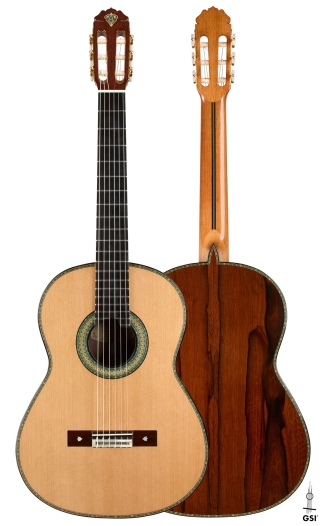
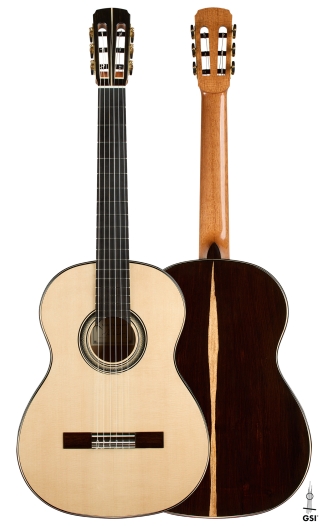
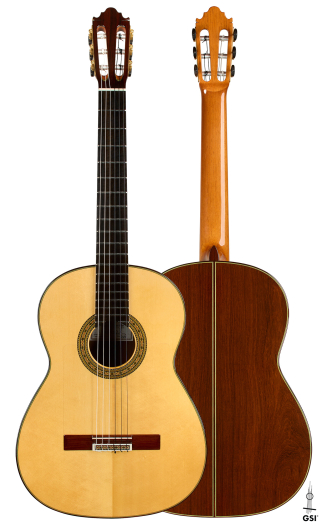
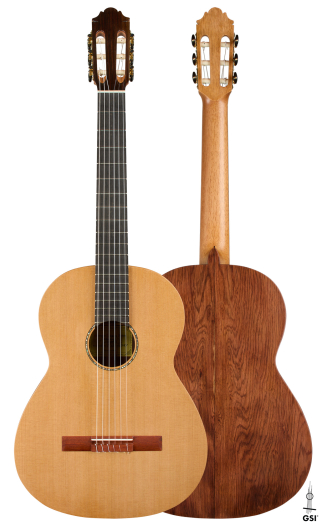
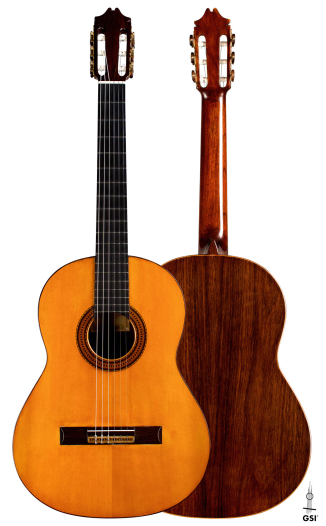
Daniel Friederich (1932–2020) was a French classical guitar maker in Paris and one of the most respected and influential luthiers in the world. Influenced by Robert Bouchet, he won top prizes at Liège in 1967, and his guitars were played by the Romeros, Manuel Barrueco, Julian Bream and Scott Tennant. GSI was his exclusive worldwide dealer for new guitars until he retired in 2014.
At a Glance
- Born: January 16, 1932, Paris
- Died: November 4, 2020, Paris
- Workshop: Paris, full-time from 1960
- First guitar: 1955, a copy of a Francisco Simplicio
- Prizes: Liège, 1967: silver medal for sound, gold for craftsmanship
- Influences: Robert Bouchet, Ignacio Fleta, the Barcelona makers
- Played by: the Romeros, Manuel Barrueco, Julian Bream, Scott Tennant, Roberto Aussel, Eduardo Fernández, Álvaro Pierri, David Tanenbaum
- GSI: his exclusive worldwide dealer for new guitars until he retired in 2014
One of the Most Influential Luthiers in the World

Daniel Friederich was influenced by the legendary French luthier Robert Bouchet and established himself as one of the most respected and influential luthiers in the world. In 1960, he became a full-time maker in his Paris workshop. Over the years, his technical experiments, combined with his experience and acute construction methods, led to a precise and well-balanced instrument, possessing great power and richness.
The elegant and graceful body shape, allied with the distinctive headstock featuring a raised central design, makes Friederich guitars easily recognizable. They are known for their unsurpassed aesthetic as well as their beautiful and magisterial quality of tone.
Daniel Friederich in His Own Words
"I was born on January 16, 1932 in Paris. I built my first classical guitar in 1955 because I was learning to play the guitar and my teacher, Christian Aubin, said that I needed a better instrument. I realized that I could not possibly afford to buy a good guitar so I decided to make one for myself. It was a very simple copy of a guitar by Francisco Simplicio.
Aubin helped me; he had already made a copy of his own Torres, and had spoken to Robert Bouchet about the construction method. I completed fifteen guitars before I showed one to Bouchet in 1960. In 1967, I anonymously entered a competition in which the jury included both Fleta and Bouchet. I was awarded a silver medal for the sound of my guitar and a gold one for the craftsmanship.
My earlier guitars were relatively simple, pleasant to play, and the sound was quite explosive. Since about 1973, I have increased the weight and the guitars have more sustain, and a richer, sweeter sound, but they are still easy to play. (On the whole, modern guitars seem more difficult to play than those made thirty to fifty years ago, although they do give more vigor, contrast, color, sustain, and have more timbral and dynamic possibilities.)
Between 1960 and 1970, I built two main models:
1) The 'Concert' model, with a serial number on the label. This was the most expensive and advanced, with carved head, specially designed machine heads, high quality wood, and purfling.
2) The 'Recital' and 'Arpège' models, less expensive with no serial number on the label, with more standard (or experimental) fan strutting and machine heads, good quality wood. The 'Arpège' model has no inlay work on the bridge, the purfling is less elaborate but the general design of these models is the same.
Since 1970, I have been making only 'Concert' guitars with a serial number and year of making on the label.
When a guitar is finished, my ear quickly tells me if the result is successful. The guitar works as a complete harmonic unit and all its elements must be combined, like in a painting. There are no great secrets, but there are a hundred components and a hundred parameters to master, to respect and to control. It will still be art for a long time, in spite of laboratory experiments.
It takes me more than two hundred hours to build one guitar. To make a career as a luthier, one must be fired by a total and enduring passion for it. One needs to study the various aspects of acoustics and musical theory. Above all, one must educate the inner ear and develop an acute ability to listen, as each note of the guitar is a great chord with the superimposed harmonics forming each sound."
The 1967 Liège Competition
The competition Friederich describes was the legendary Liège (Belgium) contest of 1967, where all instruments had to be submitted anonymously, with no label, to a jury that included Robert Bouchet and Ignacio Fleta. His prizes there set him on the world stage – and the very guitar that won them later came to GSI.
Simplicio, Fleta and the Barcelona Makers
Friederich was always very fond of the Barcelona makers – he was a good friend of, and greatly influenced by, Ignacio Fleta. He also liked to point out that he was born on January 16, 1932, just two days after Francisco Simplicio died, and he always felt connected to him in an almost "mystical" way, even though they never met. He owned a 1930 Simplicio from 1988 until it came to GSI.
Daniel Friederich and GSI
GSI was proud to be Daniel Friederich's exclusive worldwide dealer for his new guitars until he retired in 2014, and for over 20 years we received one guitar a year from him. Daniel Friederich passed away in Paris on November 4, 2020, at the age of 88 – read our tribute. His work spanned more than six decades, and his guitars remain among the most desirable and collectible instruments in the world, along with those of Bouchet, Hauser and Torres.
Daniel Friederich in Orfeo Magazine
 Daniel Friederich in Orfeo Magazine
The French classical guitar magazine Orfeo paid a beautiful homage to this great luthier. In addition to some beautiful photos the issue includes a copy of Friederich's early catalog, a discussion of his many experiments and the detailed logs he kept of each guitar he built, as well as an article on the cabinetmakers of the Faubourg Saint-Antoine (where Friederich got his start as a woodworker) and much more. Click here to see the full issue of Orfeo.
Daniel Friederich Guitars at GSI
Many Daniel Friederich guitars have passed through our doors over the years. You'll find guitars currently in stock by clicking the "Guitars In Stock" button in the header of this page as well as earlier examples in our Museum by clicking the "Guitars In Museum" button.
Frequently Asked Questions
Who was Daniel Friederich?
A French classical guitar maker (1932–2020) in Paris, influenced by Robert Bouchet, and one of the most respected luthiers of his time.
When did Daniel Friederich retire?
In 2014. Until then GSI was his exclusive worldwide dealer for new guitars, receiving one guitar a year for over 20 years.
Who played Daniel Friederich guitars?
The Romeros, Manuel Barrueco, Julian Bream, Scott Tennant, Roberto Aussel, Eduardo Fernández, Álvaro Pierri and David Tanenbaum, among many others.