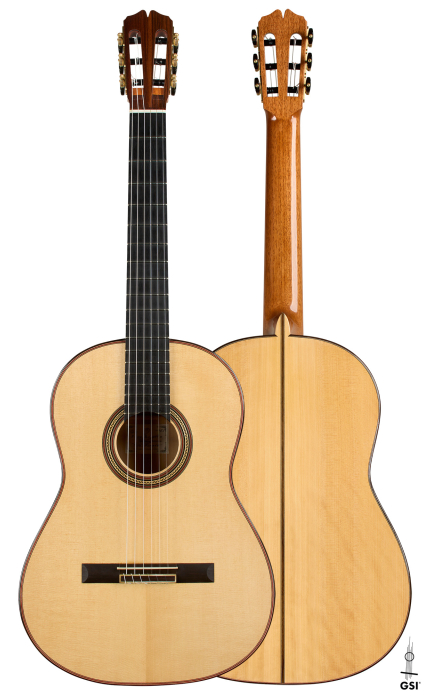
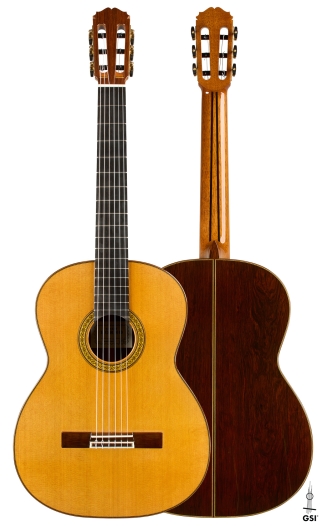
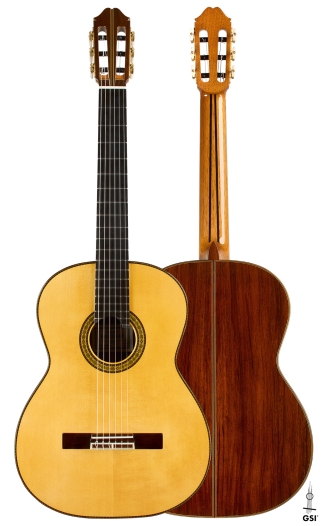
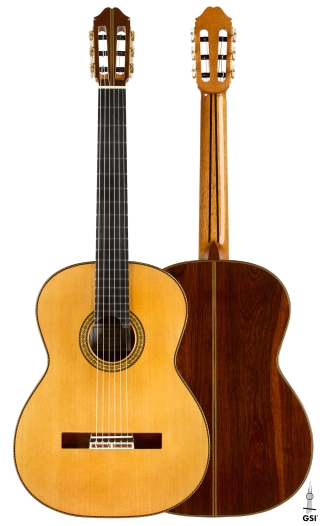
2020 Pepe Romero "Blanca" w/pegs No. 325 SP/CY
| Year | 2020 |
| Top | Spruce |
| Back & Sides | Cypress |
| Scale Length | 650 mm |
| Nut width | 52 mm |
| Finish | French Polish |
| Country | USA |
| Luthier | Pepe Romero Jr. |
This guitar is no longer available in our inventory. If it interests you, click the ”notify me when available” button to be notified in the event that we re-acquire this guitar for re-sale.


Background
A Guitar Maker in the Romero Family
Pepe Romero Jr. is the son of the great guitarist Pepe Romero and the grandson of Celedonio Romero, patriarch of the Romero guitar dynasty. He grew up playing the extraordinary guitars of his father's collection – Antonio de Torres, Domingo Esteso, Santos Hernández, Hermann Hauser and Miguel Rodríguez – and as a boy of 12 or 13 he fell in love with woodworking. His grandfather encouraged him to become a guitar maker; Celedonio died before Pepe's first guitar was finished, so every Pepe Romero Jr. guitar carries the words "Dedicada a Celedonio Romero" on its label. When a new guitar is done, his father and uncles are often the first to play it.
Traphagen, Rodríguez, Romanillos, Contreras and Blöchinger
Pepe built his first guitar in 1996 in the workshop of Dake Traphagen, meaning it to be the only one – until he strung it up and knew he had found his vocation. In Córdoba he spent many hours with Miguel Rodríguez talking about guitar construction, and the same summer took a course with José Romanillos; in the late 1990s he spent two summers in Madrid with Pablo Contreras (Manuel Contreras II), and from 2000 he studied every summer in Germany with Edmund Blöchinger, with whom he spent more time than with anyone else. For his guitars Nos. 17 to 170 he used the Rodríguez bracing pattern – five fans and a treble bar – and then a reverse fan, an idea he took from Miguel Rodríguez Jr.: first with seven braces and, from No. 230, with five.
The San Diego Workshop
Pepe builds in San Diego, California; by late 2026 he had reached guitar No. 440, and his waiting list is about four years. Since 2010 he has also built ukuleles, and he designed the Romero Creations and Guitarras Romero lines, made for him in Vietnam and in China, as well as his own strings, made by La Bella. Besides the Romero family, his guitars have been played by Paco de Lucía and Scott Tennant, among many others. GSI is Pepe Romero Jr.'s only dealer in the USA.
Pepe Romero Jr. in Orfeo Magazine
Orfeo Magazine No. 10 (Autumn 2017), "Special USA – West Coast Road Trip", visits Pepe in San Diego – from his first guitar and his teachers to his reverse-fan bracing and his father's guitar collection. Read it online, or find it in the print edition of issues 6–10.