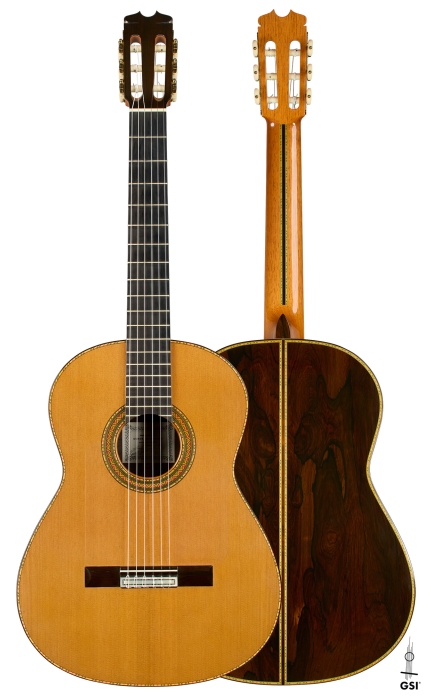
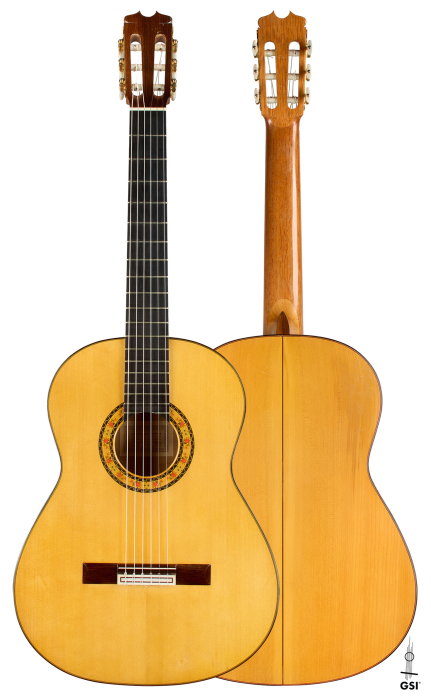
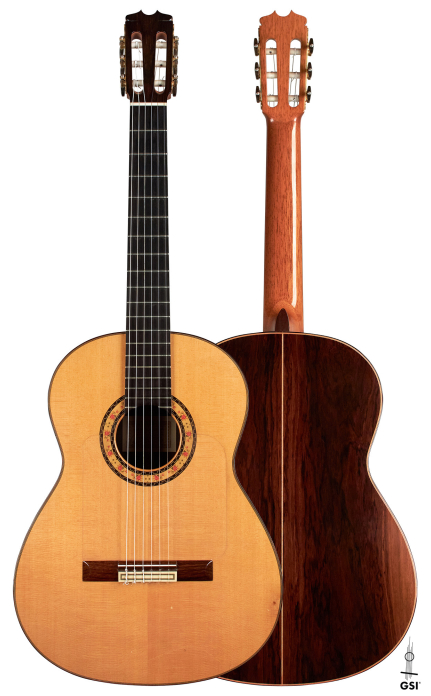
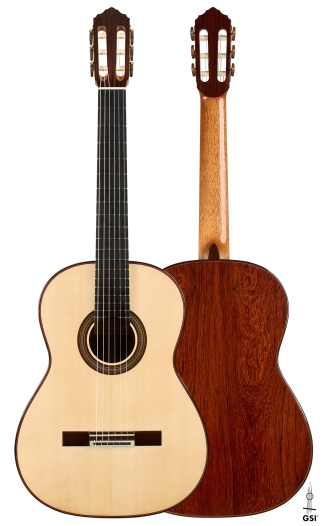
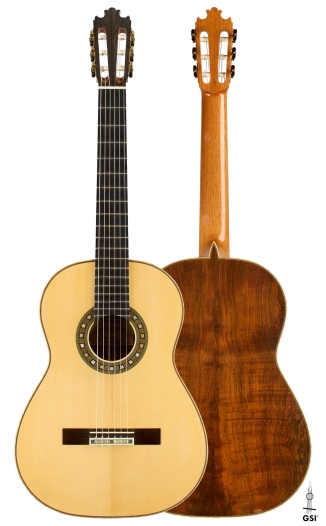
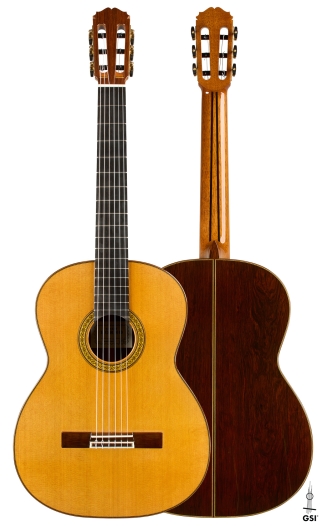
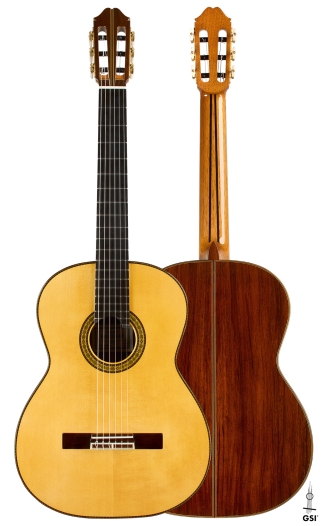
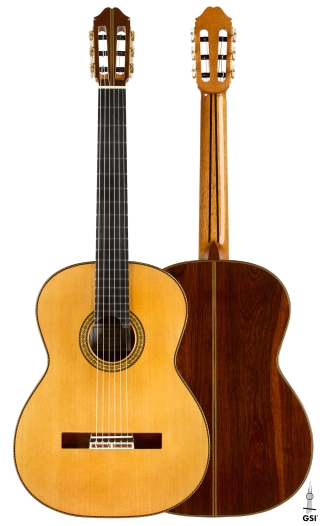
Conde Hermanos is the Madrid flamenco guitar workshop of the brothers Faustino and Mariano Conde, nephews and successors of Domingo Esteso. From Calle Gravina 7 and later Felipe V, 2, their guitars became the standard of the flamenco world – played by Niño Ricardo, Sabicas, Melchor de Marchena and, for nearly his entire career, Paco de Lucía.
At a Glance
- Founders: Faustino Conde (d. 1988) and Mariano Conde (d. 1989), nephews of Domingo Esteso
- Workshops: Calle Gravina 7, Madrid (Esteso's shop); Felipe V, 2, Madrid (from 1980)
- Labels: "Viuda y Sobrinos de Esteso"; "Sobrinos de Domingo Esteso / Conde Hermanos"; "Hermanos Conde / Sobrinos de Esteso"
- Signature: the "Media Luna" (half-moon) headstock
- Played by: Niño Ricardo, Sabicas, Melchor de Marchena, Mario Escudero, Paco de Lucía, Moraíto, Gerardo Núñez, Tomatito, Al Di Meola, John McLaughlin
- Today: the Felipe V shop has closed; Mariano's sons work separately – Felipe Conde under his own name in Madrid
Two Instruments Take Shape
The story of the Conde Hermanos workshop dates back to the early 20th century. For the first time, a breach began to appear in the world of guitar building, and two distinct instruments were taking shape. These instruments evolved into what we today know as the classical and flamenco guitar. Several of the luthiers that worked in the workshop of Manuel Ramírez proved instrumental in the development of these two different instruments. Among them was a man by the name of Domingo Esteso.
Domingo Esteso and Gravina 7
Domingo Esteso was trained at the workshop of Manuel Ramírez, along with Santos Hernández, Modesto Borreguero and Enrique García. He then branched off and established his own workshop at the now-famous address of Gravina 7, in Madrid, Spain. His nephews joined him there as apprentices – Faustino Conde in 1926 and Mariano Conde in 1929.
From "Sobrinos de Esteso" to "Conde Hermanos"
In 1937 Domingo Esteso passed away, leaving the workshop to his two nephews. To preserve the tradition as well as the prestige of the family name, the guitars built after his death bore the label "Viuda y Sobrinos de Esteso" (Esteso's Widow and Nephews). The word "Viuda" (Widow) appeared first as a form of respect for Mrs. Esteso. When she passed away at the end of 1959, the label was modified once more, and this time it read "Sobrinos de Domingo Esteso" (Esteso's Nephews); under this, in small print, was the surname "Conde Hermanos" (Conde Brothers). Thus, the now-famous name appeared in the world of the flamenco guitar for the first time. The brothers also used the label "Hermanos Conde / Sobrinos de Esteso", and the "Media Luna" headstock, introduced in 1953, became the symbol of their top guitars.
Played by the Great Flamenco Guitarists
The reputation of the Conde Brothers steadily grew, and their instruments became highly sought after the world over. Their guitars were used by the likes of Regino Sáinz de la Maza, Melchor de Marchena, Esteban de Sanlúcar, Mario Escudero, Sabicas, Niño Ricardo, Paco de Lucía and Juan Martín. Not only that, but players from other parts of the world used their guitars as well, among them Al Di Meola, John McLaughlin, Bob Dylan, Leonard Cohen, Toquinho, Tonino and Alirio Díaz.
Felipe V and the Next Generation
In 1980 Mariano Conde opened a second workshop at Felipe V, 2, in Madrid, where he worked with his two sons, Felipe and Mariano Jr. – while still working in conjunction with the shop at Gravina 7. With the passing of Faustino in 1988, the Felipe V shop carried on independently, and after Mariano's death in 1989 his sons took over, proudly carrying on the tradition of their forefathers. The quality and reputation of their guitars became such that in 1991 the Spanish Royal House acquired one of their guitars to give as a gift to the Heir to the Crown of the Japanese Imperial House during an official visit. Among the later players of Conde guitars are Enrique de Melchor, Cañizares, Moraíto, Óscar Herrero, Angelo Gilardino, Roberto Morón, Rafael Riqueni, Gerardo Núñez, Lenny Kravitz and David Byrne. The Felipe V shop has since closed, and the two brothers now work separately, each carrying the family tradition forward – Felipe Conde under his own name since 2010. Felipe's son, Felipe Conde Crespo (Felipe Jr.), has had his own workshop in Madrid since 2022.
Conde Hermanos Guitars at GSI
Many Conde Hermanos guitars have passed through our doors over the years. You'll find guitars currently in stock by clicking the "Guitars In Stock" button in the header of this page as well as earlier examples in our Museum by clicking the "Guitars In Museum" button. To see some of the great players on their Condes, click here.
Frequently Asked Questions
Who were the Conde Hermanos?
The brothers Faustino and Mariano Conde, nephews and successors of Domingo Esteso, who built flamenco and classical guitars in Madrid at Gravina 7 and later Felipe V, 2.
Why are Conde guitars so famous in flamenco?
For generations they have been played by more top flamenco guitarists than any other make – above all Paco de Lucía, for nearly his entire career.
What does a Conde guitar sound like?
Dry, "woody" and very firm, keeping its clarity and punch even at the extreme limits of speed in picado, tremolo and rasgueado.
Who carries on the Conde tradition today?
The Felipe V shop has closed, and Mariano's sons, Felipe and Mariano Jr., now work separately. Felipe Conde has built under his own name in Madrid since 2010, and his son Felipe Conde Crespo has had his own workshop there since 2022.