Guitar Salon International
+1 (310) 586.1100 | +1 (877) 771.4321
Museum
Classical Guitars
Classical Guitars
Flamenco Guitars
Flamenco Guitars
Cleveland Collection
Luthiers
Luthiers
Your Cart

Your shopping cart is empty!

Sub-Total: $0.00
Total: $0.00
Edit cart
Checkout
Museum

1876 Francisco González SP/MP

Year 1876
Top Spruce
Back & Sides Maple
Scale Length 643 mm
Nut width 49 mm
Finish French Polish
Country Spain
Luthier Francisco González

This guitar is no longer available in our inventory. If it interests you, click the ”notify me when available” button to be notified in the event that we re-acquire this guitar for re-sale.

Inquire
See more from Francisco González

Videos

1876 Francisco González SP/MP

Domenico Scarlatti's "Sonata K.380, L.23" performed by Mircea Gogoncea on an 1876 Francisco Gonzalez

1876 Francisco González SP/MP

Marc Teicholz - Assad Concerto (1876 Francisco Gonzalez)

Description

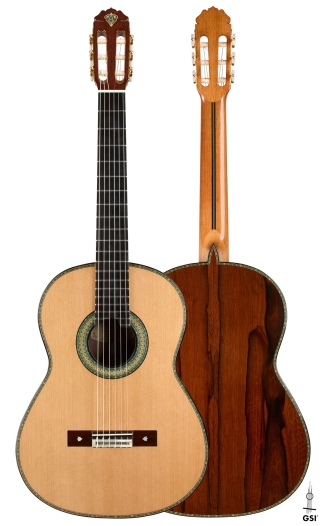
This 1876 Francisco González is a spruce and maple guitar from Madrid, from the Russell Cleveland collection – a rare, remarkably well-preserved instrument by the teacher of José Ramírez I.

The 1876 Label

The round label of his “Guitarrería Universal” at Carrera de San Jerónimo, 15, Madrid, proudly lists his first-class medal from the 1867 Paris Exposition and his “sistema especial”, and is dated 1876 by hand. This particular guitar not only survives to the present day – it flourishes in the present day!

Original Condition

Apart from a few minor repairs, the instrument is in extremely well-preserved condition and retains all original elements – thicknesses of woods, finish, even the tuning machines, which curiously are shaped to accommodate the sloping line of the bottom of the head shape (which, by the way, one can see in the instruments of José Ramírez throughout all generations, even to the present).

Sound

The bold look of the guitar, with its ultra-wide rosette, high waistline in the plantilla and mustache bridge, is only matched by the boldness of its sound. Sound-wise the guitar is nothing short of spectacular, with a huge bottom end that would rival any design that has come after. Although the basses are huge, they are transparent to the upper notes and do not crowd out the brilliant, crystalline trebles – the guitar therefore retains an unusually perfect balance, even amid the richness of the bass notes. In this guitar, it is easy to see the allure that José Ramírez I must have admired and wished to capture. Mircea Gogoncea (Scarlatti) and Marc Teicholz (Assad Concerto) play it in the videos above.

From the Russell Cleveland Collection

This guitar comes from the Russell Cleveland collection. It is by every standard a rare, historical, well-preserved and, for all matters, great sounding and playing guitar by one of the most important and influential 19th-century Spanish builders.

Background

Francisco González of Madrid

Nineteenth-century Madrid builder Francisco González (1820–1879) was a near exact contemporary of Antonio de Torres but built in his own style – in particular, as he states on his label, his instruments are built in “a new and elegant design with a special system” (…una nueva y elegante forma y construidos por un sistema especial suyo…). González was very celebrated in his own day – he was the winner of several prizes and medals in various exhibitions during his lifetime, among them a first-class medal at the 1867 Exposition Universelle in Paris – and one of his guitars is on display at the Paris Conservatoire.

Teacher of the Ramírez Brothers

González is known to have been the teacher of both José Ramírez I and his brother Manuel Ramírez. Indeed, it was José I’s loyalty to González and the “sistema” and Manuel’s conversion to the Torres design that was the source of the ideological split between the two Ramírez brothers that forced them to break their partnership and instead set up competing shops in Madrid. His daughter Concepción also learned the trade from him and worked in the shop alongside José Ramírez I.

From González to Casa González

González’s reputation in his own day strongly suggests that he must have been a prolific builder; however, much like Vicente Arias, very few of his instruments survive to the present day. After his death in 1879, his work was carried on by his son-in-law Enrique Romans Papell, at first under the name “Viuda e Hijos de Francisco González” and after 1901 as “Casa González”, which remained active into the 1940s.

Guitars by Francisco González