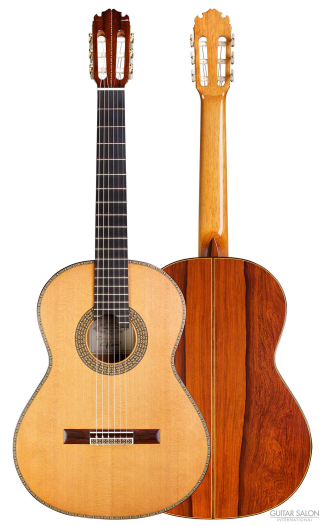
1903 Enrique García No. 13 SP/MH
| Year | 1903 |
| Top | Spruce |
| Back & Sides | Mahogany |
| Scale Length | 645 mm |
| Nut width | 50 mm |
| Finish | French Polish |
| Country | Spain |
| Luthier | Enrique García |
This guitar is no longer available in our inventory. If it interests you, click the ”notify me when available” button to be notified in the event that we re-acquire this guitar for re-sale.


Lovro Peretić performs "Intermezzo Op. 117, No. 1" by Johannes Brahms (Guitar: 1903 Enrique Garcia)
Background
Enrique García: From the Ramírez Workshop to Barcelona
Enrique García was born in Madrid in 1868. Although he was the son of a guitar maker, Juan García, in 1883 he began an apprenticeship with either Manuel Ramírez or José Ramírez I (or likely both), and continued to work in Madrid for many years. In 1893 his guitars won first prize at the Chicago World's Fair – García was evidently very proud of this achievement, as he represented it in pictorial form on his labels after receiving the award. In 1895 he left Ramírez and Madrid for Barcelona, where he set up his own workshop as an independent builder.
Founder of the Barcelona School of Guitar Making
García is considered to be the founder of the "Barcelona school", or "Catalan" style of guitar making. His style influenced subsequent generations of Barcelona makers including Francisco Simplicio and Miguel Simplicio, Enrique Sanfeliu, Enrique Coll and Ignacio Fleta. Perhaps the most important hallmark of his style is the increased stiffness in his soundboards – his guitars commonly featured 8 asymmetrical fans instead of the traditional 7 (years later, Ignacio Fleta would increase the number of fans to 9).
An International Reputation
García was arguably the most sought-after and famous maker at the turn of the century (1900). His reputation very early on was truly international, largely thanks to Domingo Prat and Francisco Tárrega, who both played his guitars. By 1912 he was exporting many of his instruments, primarily to South America, where a thriving and very important guitar scene, based mainly in Buenos Aires, Argentina and Montevideo, Uruguay, was forming. His guitars have always been prized by performers and collectors for their intimate charm and unique style.
Books on Enrique García
The bilingual (French and English) monograph "Enrique García 1868-1922: Constructor de Barcelona" by Jacques Vincenti and Alberto Martínez – 216 pages, with the plan of García No. 123 – is the most complete record of his life, his labels and workshops, the Chicago prize and the guitars of Prat and Tárrega: