1921 Santos Hernández SP/MP
| Year | 1921 |
| Top | Spruce |
| Back & Sides | Maple |
| Scale Length | 650 mm |
| Nut width | 52 mm |
| Finish | French Polish |
| Country | Spain |
| Luthier | Santos Hernández |
This guitar is no longer available in our inventory. If it interests you, click the ”notify me when available” button to be notified in the event that we re-acquire this guitar for re-sale.


Mendelssohn 'Venetian Boat Song' and 'Canzonetta' played by Marc Teicholz
Description

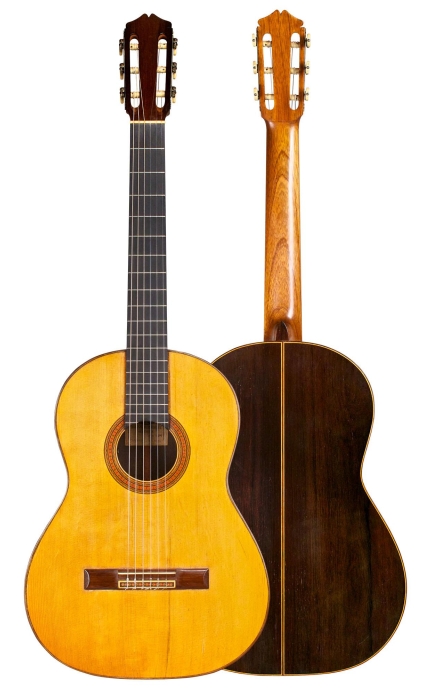
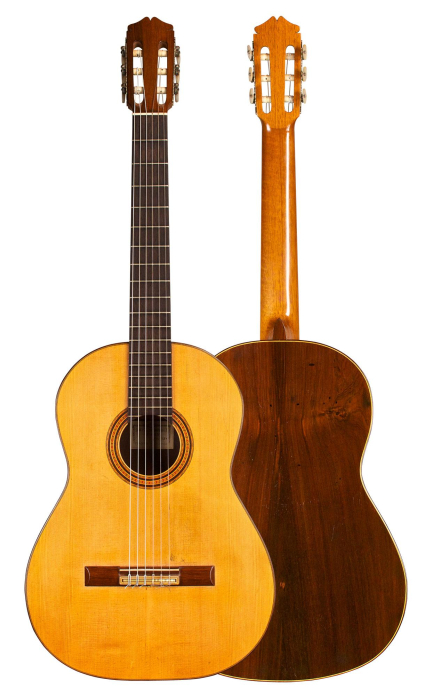
This 1921 Santos Hernández is a spruce and maple classical guitar made in Madrid – the most original and well-preserved Santos we have seen in many years, and one of the 18 guitars of Marc Teicholz's CD "Valseana".
In the video above, Marc Teicholz plays Mendelssohn's "Venetian Boat Song" and "Canzonetta" on this guitar at his "Valseana Live" concert at GSI.
Red and Green Rope Purfling
This particular guitar, built in 1921, is a gorgeous example of Santos' work, with beautiful materials and superb craftsmanship. The guitar features some finer decorative elements, including a lovely alternating red-green motif found in the rope-patterned purfling, which frames the rosette and encloses the binding. This is the most original and well-preserved Santos we have seen in many, many years – condition is exceptional for a guitar of this vintage.
Tone, and Marc Teicholz's "Valseana"
Of course the most intriguing quality of this instrument is its tone – warm yet clear, balanced and focused. This instrument is a wonderful example of Santos at his absolute best, and it was featured on Marc Teicholz's great CD Valseana – it is the guitar of Roland Dyens' "Valse en Skaï" (track 2).