1928 Francisco Simplicio No. 185 SP/CSAR
| Year | 1928 |
| Top | Spruce |
| Back & Sides | CSA Rosewood |
| Scale Length | 650 mm |
| Nut width | 52 mm |
| Finish | French Polish |
| Country | Spain |
| Luthier | Francisco Simplicio |
This guitar is no longer available in our inventory. If it interests you, click the ”notify me when available” button to be notified in the event that we re-acquire this guitar for re-sale.
Description

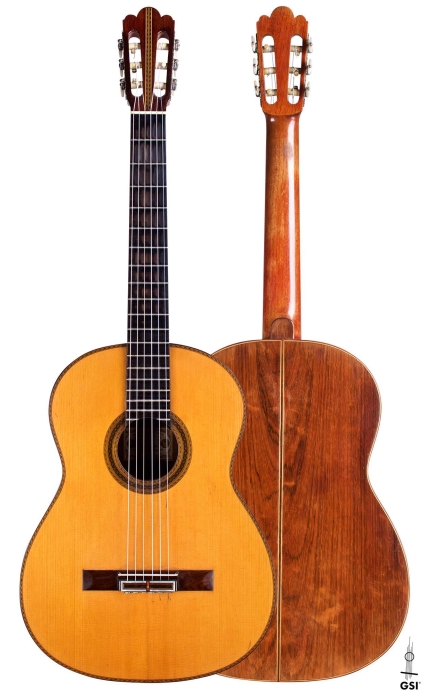
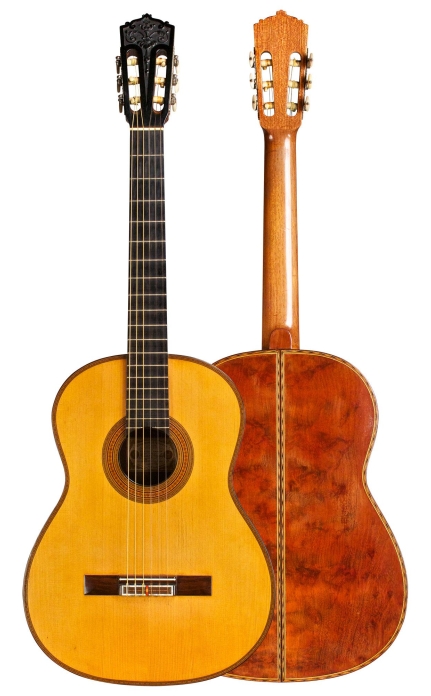
This 1928 Francisco Simplicio is a spruce and CSA rosewood classical guitar from Barcelona, No. 185 – never refinished, and among the better-sounding Simplicios we've ever heard.
No. 185, Never Refinished
The ornate purfling and rosette detailing are immediately recognizable features of Simplicio's work. Instead of one of his engraved headstocks, the head is inlaid in the three-lobed shape he inherited from García. Condition is excellent, with some very old, stable and very conservative repairs. Despite its age, it has never been re-finished.
A Simplicio That Sounds Like a Santos
The sound is particularly magnificent – charming and deep, with a big bottom-end and lyrical trebles. This is among the better-sounding Simplicios we've ever heard, and although one would rarely make this comparison – it sounds and feels much more like a great Santos or Esteso than a typical García or Simplicio. Overall, a highly desirable guitar from this famous builder.
Orfeo article on Simplicio – the French guitar magazine Orfeo devoted a feature to Francisco and Miguel Simplicio in its first issue.
Background
Francisco Simplicio: Enrique García's Only Pupil
Francisco Simplicio (1874–1932) was brought up in Barcelona and was a cabinet-maker before he turned to guitar making in the workshop of Enrique García, the founder of the Barcelona school. He joined García in 1918, and the guitars of García's last years were built by the two of them together. When García died in 1922, Simplicio took over the premises at Paseo de San Juan 110, and his labels proudly state that he was García's "successor and only pupil" – "Suc. y único discípulo de Enrique García" – with García's Chicago 1893 medals.
Carved Headstocks and Art Nouveau Ornament
Simplicio was known not only for the beautiful tone of his instruments, but also for his exquisite workmanship and use of extravagant ornamentation. The ornate purfling and rosette detailing are immediately recognizable features of his work, as are the heavily and beautifully engraved headstocks, very much in the Art Nouveau taste of Barcelona at the time. His standard head was based on the Torres pattern, he often fitted a "tornavoz" (a conical tube attached to the soundhole), and in 1929 he won a gold medal at the World's Fair in Barcelona. He died in January 1932 and his son Miguel carried on the workshop.

The Simplicio Sound
The famous 'sound' of Simplicio is perhaps the most unique of the great makers of the twentieth century – it has a very "old-world" charm, and players of these guitars often remark how they are transported psychologically to another world when playing a Simplicio. His guitars left their mark on later makers such as Ignacio Fleta and Daniel Friederich, and they are sought after by collectors because despite their age they continue to play well.