Guitar Salon International
+1 (310) 586.1100 | +1 (877) 771.4321
Museum
Classical Guitars
Classical Guitars
Flamenco Guitars
Flamenco Guitars
Cleveland Collection
Luthiers
Luthiers
Your Cart

Your shopping cart is empty!

Sub-Total: $0.00
Total: $0.00
Edit cart
Checkout
Museum

1929 Francisco Simplicio No. 262 SP/MH

Year 1929
Top Spruce
Back & Sides Mahogany
Scale Length 650 mm
Nut width 50 mm
Finish French Polish
Country Spain
Luthier Francisco Simplicio

This guitar is no longer available in our inventory. If it interests you, click the ”notify me when available” button to be notified in the event that we re-acquire this guitar for re-sale.

Inquire
See more from Francisco Simplicio

Videos

1929 Francisco Simplicio No. 262 SP/MH

Henri Salvador's "Syracuse" Played by Ashley Lucero on a 1929 Francisco Simplicio Classical Guitar

Description

Cover of Orfeo Magazine No. 1 with its feature on Francisco Simplicio

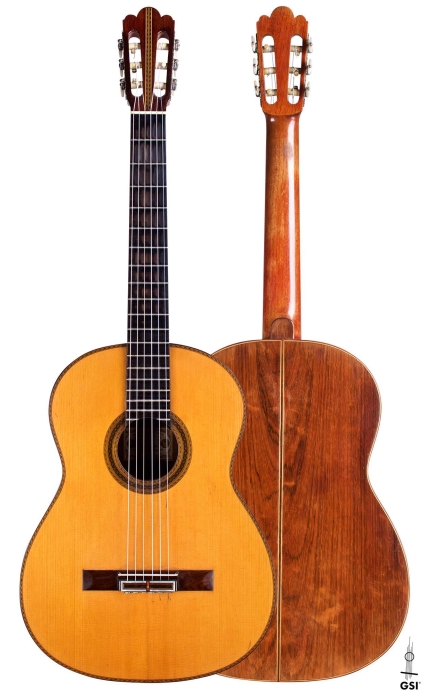
This 1929 Francisco Simplicio is a spruce and mahogany classical guitar from Barcelona, No. 262, with its structural and sonic integrity perfectly intact.

In the video above, Ashley Lucero plays Henri Salvador's "Syracuse" (arranged by Roland Dyens) on this guitar.

Francisco Simplicio No. 262

The ornate rosette detailing and beautifully engraved headstock are immediately recognizable features of this maker's work, and this guitar is a fine example demonstrating the best of these qualities.

Sound and Condition

The sound is magical: great depth and rich overtone content in every note, from the lowest bass to the highest treble. It has a deep bottom-end and lyrical, harmonically rich and singing trebles, and ample volume to fill any hall. It is in remarkably excellent condition – apart from a filled-in string blemish behind the bridge, there is only 1 crack on the soundboard between the bridge and foot, conservatively repaired with glue and two thin cleats only, as well as two small repaired cracks on the back near the heel. Overall, the structural and sonic integrity of the instrument is perfectly intact – a highly desirable example of his work.

Orfeo article on Simplicio – the French guitar magazine Orfeo devoted a feature to Francisco and Miguel Simplicio in its first issue.

Background

Francisco Simplicio: Enrique García's Only Pupil

Francisco Simplicio (1874–1932) was brought up in Barcelona and was a cabinet-maker before he turned to guitar making in the workshop of Enrique García, the founder of the Barcelona school. He joined García in 1918, and the guitars of García's last years were built by the two of them together. When García died in 1922, Simplicio took over the premises at Paseo de San Juan 110, and his labels proudly state that he was García's "successor and only pupil" – "Suc. y único discípulo de Enrique García" – with García's Chicago 1893 medals.

Carved Headstocks and Art Nouveau Ornament

Simplicio was known not only for the beautiful tone of his instruments, but also for his exquisite workmanship and use of extravagant ornamentation. The ornate purfling and rosette detailing are immediately recognizable features of his work, as are the heavily and beautifully engraved headstocks, very much in the Art Nouveau taste of Barcelona at the time. His standard head was based on the Torres pattern, he often fitted a "tornavoz" (a conical tube attached to the soundhole), and in 1929 he won a gold medal at the World's Fair in Barcelona. He died in January 1932 and his son Miguel carried on the workshop.

The Simplicio Sound

The famous 'sound' of Simplicio is perhaps the most unique of the great makers of the twentieth century – it has a very "old-world" charm, and players of these guitars often remark how they are transported psychologically to another world when playing a Simplicio. His guitars left their mark on later makers such as Ignacio Fleta and Daniel Friederich, and they are sought after by collectors because despite their age they continue to play well.

Guitars by Francisco Simplicio