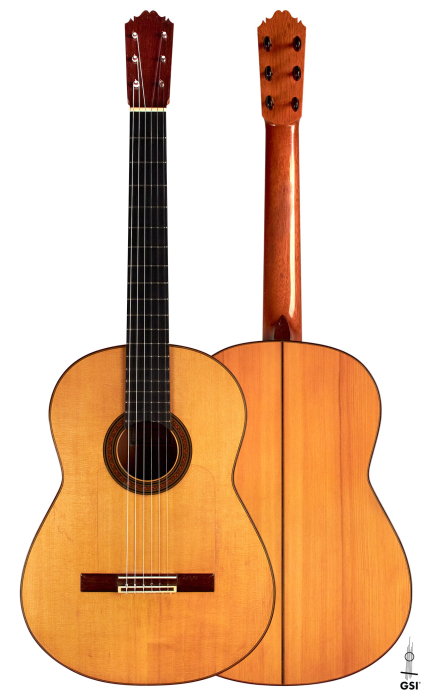
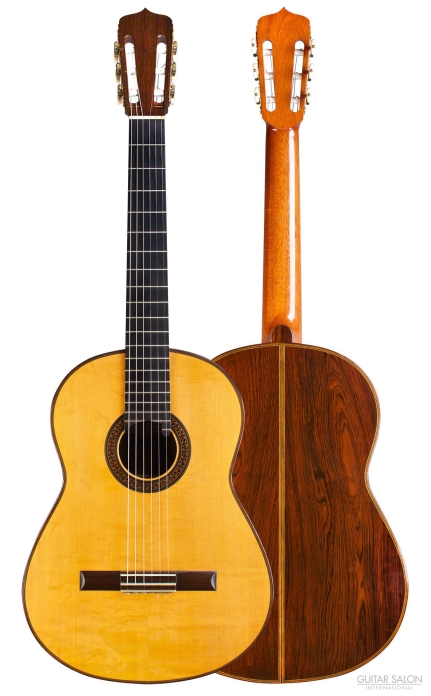
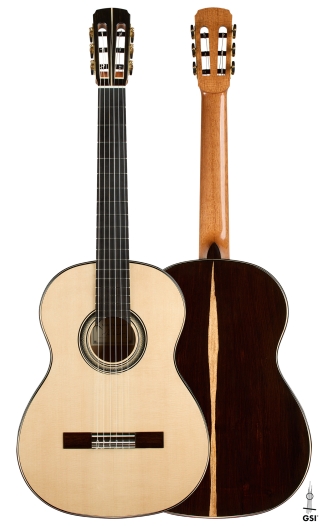
1980 David Rubio SP/CSAR
| Year | 1980 |
| Top | Spruce |
| Back & Sides | CSA Rosewood |
| Scale Length | 650 mm |
| Nut width | 51 mm |
| Finish | French Polish |
| Country | England |
| Luthier | David Rubio |
This guitar is no longer available in our inventory. If it interests you, click the ”notify me when available” button to be notified in the event that we re-acquire this guitar for re-sale.
Description
A 1980 classical guitar by David Rubio, with an aged, dark spruce top and CSA rosewood back and sides, made in Cambridge – the easiest Rubio to play that we have seen.
Floral Rosette and Vintage Rodgers Tuners
It shows Rubio's superior craftsmanship, with gorgeous materials – a stunning set of CSA rosewood and an aged, dark spruce top – a floral rosette, for which he was well known, and Rodgers tuners whose plates have oxidized to an almost vintage look.
A Rodríguez Sound with Hauser Clarity
The sound is huge, thick and fat yet clear – a bit like a great Rodríguez, but with the clarity of a Hauser – with incredible sustain in the higher registers. Of the many Rubios we have seen over the past several decades, this one is by far the easiest to play: it has a 51 mm nut and plays with surprising ease.
Condition
Apart from two small, well-repaired cracks on the lower bout of the back, it is extremely clean and in remarkable condition for its age. A player's dream, and highly collectible.

Background
David Rubio: From Flamenco Guitarist to Master Instrument Maker
David Rubio (1934–2000) is arguably the most important guitar maker to emerge from England, and the founding father of the English school. Born David Spink and raised in London, he studied medicine at Trinity College Dublin, then left for Spain, where he earned his living as a flamenco guitarist accompanying singers and dancers – and picked up the nickname "Rubio" for his red beard. A touring flamenco company brought him to New York, where, from what he had seen in the guitar shops of Spain, he taught himself to build guitars under the name "Jose" Rubio. Within a few years Julian Bream was playing his instruments.

Guitars, Lutes, Harpsichords and Violins
Rubio returned to England in 1967 and, from workshops near Oxford and, from 1979, in Cambridge, built a remarkably wide range of instruments: guitars and lutes, harpsichords, baroque and modern violins, violas and cellos. In the late 1960s and 1970s he trained three young makers in his methods – Kazuo Sato, Edward B. Jones and Paul Fischer – who built guitars of his design marked with their initials. Late in his life he developed a radical 8-string guitar, the "Brahms" model, with Paul Galbraith. He died in Cambridge on October 21, 2000, leaving more than a thousand instruments.