Guitar Salon International
+1 (310) 586.1100 | +1 (877) 771.4321
Museum
Classical Guitars
Classical Guitars
Flamenco Guitars
Flamenco Guitars
Cleveland Collection
Luthiers
Luthiers
Your Cart

Your shopping cart is empty!

Sub-Total: $0,00
Total: $0,00
Edit cart
Checkout
Museum

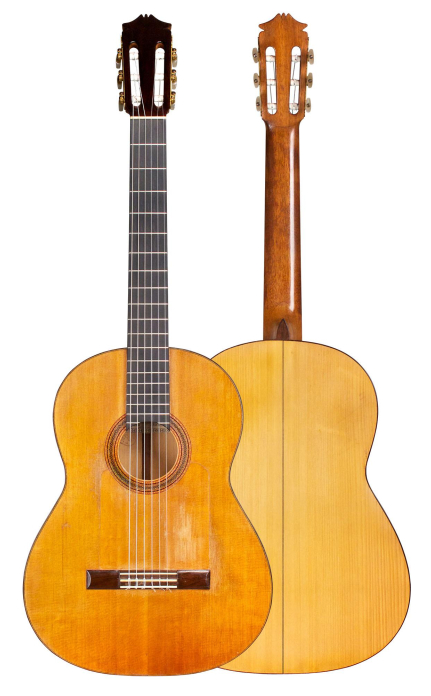
1950 Marcelo Barbero SP/CY (ex Manolo Sanlúcar)

Year 1950
Top Spruce
Back & Sides Cypress
Scale Length 670 mm
Nut width 52 mm
Finish French Polish
Country Spain
Luthier Marcelo Barbero

This guitar is no longer available in our inventory. If it interests you, click the ”notify me when available” button to be notified in the event that we re-acquire this guitar for re-sale.

Inquire
See more from Marcelo Barbero

Videos

1950 Marcelo Barbero SP/CY (ex Manolo Sanlúcar)

Sabicas' "Con Garbo Y Salero (Farruca)" performed by Berto Boyd on a 1950 Marcelo Barbero

1950 Marcelo Barbero SP/CY (ex Manolo Sanlúcar)

Juanito Pascual - Colombiana de Bajo Guia (1950 Marcelo Barbero)

1950 Marcelo Barbero SP/CY (ex Manolo Sanlúcar)

Sabicas 'Bulerias' played by Grisha Goryachev

Description

A 1950 flamenco guitar by Marcelo Barbero, with a spruce top and cypress back and sides, completed in the Madrid workshop of Santos Hernández and labeled "Viuda de Santos Hernández" – the guitar Manolo Sanlúcar played at the beginning of his professional career.

In the videos above, Berto Boyd plays his arrangement of Sabicas' "Con Garbo y Salero" (Farruca), Juanito Pascual plays Manolo Sanlúcar's "Colombiana de Bajo Guía" and Grisha Goryachev plays Sabicas' "Bulerías" – all on this guitar.

A "Viuda de Santos Hernández" Guitar Built by Barbero

Although trained in the workshop of José Ramírez II, Barbero's later, mature style was more along the lines of Esteso and Santos. After Santos died, his widow, Matilde, hired Barbero to finish the orders he had left uncompleted. Working in Santos' own workshop at the famous Aduana 23 address, Barbero completed several guitars using Santos' parts and tools. No other maker in history was in this unique position, and it was here that he learned first-hand many of the secrets Santos had kept to himself during his lifetime. This rare flamenco is one of these instruments, which is why it bears the label "Viuda de Santos Hernández".

Ex Manolo Sanlúcar

The guitar was previously owned by the great flamenco guitarist Manolo Sanlúcar – in fact, it was the guitar he played at the very beginning of his professional career.

Sound and Condition

Condition is excellent considering its age: the top is pristine, with only the standard hairline cracks along the sides of the fingerboard, and the back and sides have some cracks which have been expertly repaired. Playability is superb and the sound is extra sweet for a flamenco. Highly collectible and wonderful for performing in recital or recording, this guitar rates in the top class of instruments we have seen.

Background

Marcelo Barbero: The Stradivari of Lavapiés

Marcelo Barbero (c. 1904–1956) is regarded as one of the greatest Spanish guitar makers of the 20th century and, above all, as the archetypal maker of the flamenco guitar. Born in Madrid to a poor family and orphaned as a boy, he learned the trade in the workshop of José Ramírez I and went on working under José Ramírez II. He had a colorful life outside the shop too – boxer, racing cyclist and flamenco singer in the tablaos of Madrid – yet he never played the guitar himself; his designs grew out of his own experience and the constant feedback of the best players of the day.

Completing the Last Guitars of Santos Hernández

After Santos Hernández died in March 1943, his widow, Matilde Ruiz López, called on Barbero to finish the guitars Santos had left uncompleted in his workshop at Aduana 23 – work that kept him busy for about three years and gave him a unique, first-hand look at the methods of the great master. Santos's influence shows in the heads, rosettes and proportions of Barbero's guitars of the 1940s; from around the end of 1948 he developed a model of his own, with a new outline, head, rosette, bracing and bridge.

Barbero's Flamenco Guitars and Legacy

Barbero's own shop was in Lavapiés, the old quarter of Madrid near the flamenco tablaos, and he built only to order, for players in Spain and as far away as England, South America, Germany, Italy and Japan. His most famous guitar, from 1951, was made for Carlos Montoya and ended up with Sabicas, who recorded on it for the albums later issued as "Flamenco Puro". In the 1950s he moved toward a fuller, more austere and almost classical voice, with slightly thicker woods and a thin bar across the top under the bridge. He died on March 6, 1956, mourned in the Madrid press as the "Stradivari of Lavapiés". His only real pupil and successor was Arcángel Fernández, who later trained Barbero's son, Marcelo Barbero Hijo.

Guitars by Marcelo Barbero