Guitar Salon International
+1 (310) 586.1100 | +1 (877) 771.4321
Museum
Classical Guitars
Classical Guitars
Flamenco Guitars
Flamenco Guitars
Cleveland Collection
Luthiers
Luthiers
Your Cart

Your shopping cart is empty!

Sub-Total: $0.00
Total: $0.00
Edit cart
Checkout
Museum

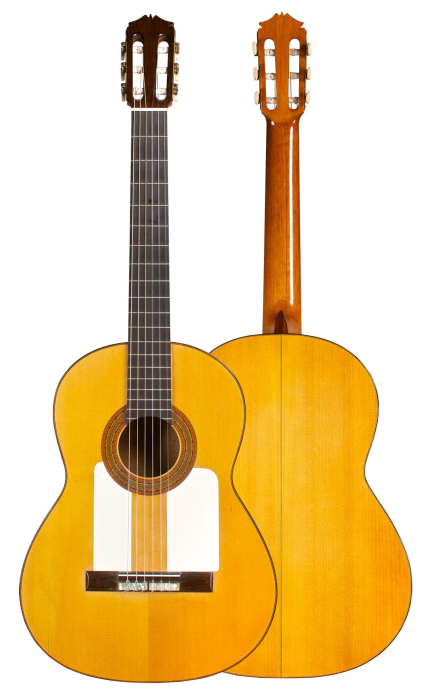
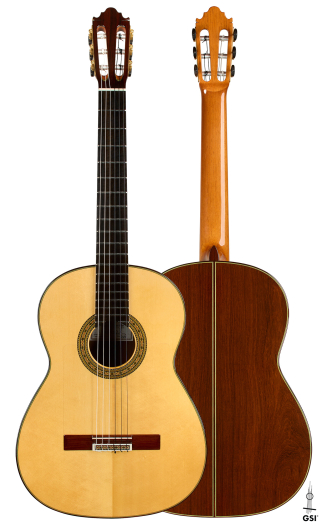
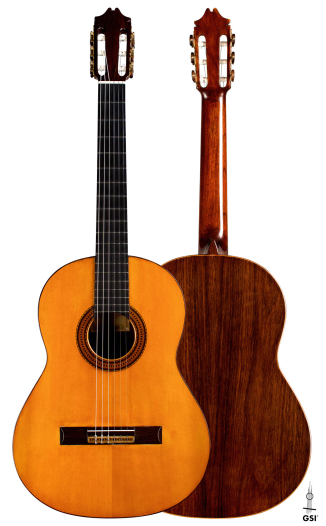
1953 Marcelo Barbero SP/CY

Year 1953
Top Spruce
Back & Sides Cypress
Scale Length 659 mm
Nut width 50.5 mm
Finish French Polish
Country Spain
Luthier Marcelo Barbero

This guitar is no longer available in our inventory. If it interests you, click the ”notify me when available” button to be notified in the event that we re-acquire this guitar for re-sale.

Inquire
See more from Marcelo Barbero

Description

Marcelo Barbero made this flamenco guitar in Madrid in 1953, with a spruce soundboard and cypress back and sides – a cypress flamenco from the last years of his life, when his own model was fully formed.

Barbero's Mature Flamenco Model

By 1953 Barbero had long since moved beyond the Santos pattern to an outline, head and rosette of his own, and this guitar comes from the very peak of that period. It carries his printed and signed label of the early 1950s.

Sound

It is exactly what players today think of as the archetypal flamenco: light as a feather, with a huge sound that comes out like a bullet and answers instantly – and, best of all, a plump, "juicy" and simply beautiful tone. A fantastic example by perhaps the most legendary flamenco maker of the 20th century.


Background

Marcelo Barbero: The Stradivari of Lavapiés

Marcelo Barbero (c. 1904–1956) is regarded as one of the greatest Spanish guitar makers of the 20th century and, above all, as the archetypal maker of the flamenco guitar. Born in Madrid to a poor family and orphaned as a boy, he learned the trade in the workshop of José Ramírez I and went on working under José Ramírez II. He had a colorful life outside the shop too – boxer, racing cyclist and flamenco singer in the tablaos of Madrid – yet he never played the guitar himself; his designs grew out of his own experience and the constant feedback of the best players of the day.

Completing the Last Guitars of Santos Hernández

After Santos Hernández died in March 1943, his widow, Matilde Ruiz López, called on Barbero to finish the guitars Santos had left uncompleted in his workshop at Aduana 23 – work that kept him busy for about three years and gave him a unique, first-hand look at the methods of the great master. Santos's influence shows in the heads, rosettes and proportions of Barbero's guitars of the 1940s; from around the end of 1948 he developed a model of his own, with a new outline, head, rosette, bracing and bridge.

Barbero's Flamenco Guitars and Legacy

Barbero's own shop was in Lavapiés, the old quarter of Madrid near the flamenco tablaos, and he built only to order, for players in Spain and as far away as England, South America, Germany, Italy and Japan. His most famous guitar, from 1951, was made for Carlos Montoya and ended up with Sabicas, who recorded on it for the albums later issued as "Flamenco Puro". In the 1950s he moved toward a fuller, more austere and almost classical voice, with slightly thicker woods and a thin bar across the top under the bridge. He died on March 6, 1956, mourned in the Madrid press as the "Stradivari of Lavapiés". His only real pupil and successor was Arcángel Fernández, who later trained Barbero's son, Marcelo Barbero Hijo.

Guitars by Marcelo Barbero