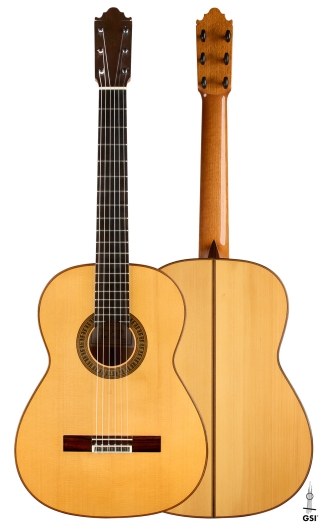
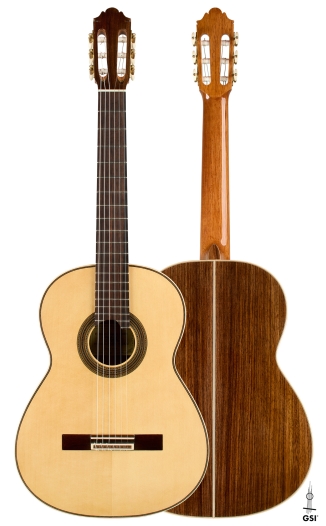
1912 Manuel Ramírez SP/CSAR
| Year | 1912 |
| Top | Spruce |
| Back & Sides | CSA Rosewood |
| Scale Length | 654 mm |
| Nut width | 50 mm |
| Finish | French Polish |
| Country | Spain |
| Luthier | Manuel Ramírez |
This guitar is no longer available in our inventory. If it interests you, click the ”notify me when available” button to be notified in the event that we re-acquire this guitar for re-sale.
Videos
Description
Built in 1912, the same year as Segovia's iconic guitar and very close to it in dimensions, this Manuel Ramírez in spruce and CSA rosewood has a provenance documented back to 1921.
In the video above, Yuri Liberzon plays Manuel Barrueco's transcription of Astor Piazzolla's Tango Etude No. 6 on this guitar.
A Close Cousin of Segovia's 1912 Ramírez
This instrument was built the same year as Segovia's famous 1912 Manuel Ramírez (now in the Metropolitan Museum of Art in New York, along with Segovia's 1937 Hauser I) and appears to be very similar in dimensions and proportions to Segovia's guitar.
A Documented History from Madrid to Chile
It has a well-documented history of its owners and repairs. Our documentation begins in 1921, when a Frenchman named Louis Brillouet Valet bought it from a Madrid music academy; the guitar was presumably commissioned by a member of the academy, but its original documentation was lost when the academy burned in 1936, during the Spanish Civil War. In 1942 Mr. Valet brought the guitar to Chile, where he had been hired as winemaker at the Dusselaut vineyard near Santiago. It passed to his son, Louis Brillouet Carrasco, who in his eighties sold it into the US, where Russell Cleveland acquired it in the early 1990s. Rarely do we have such extensive information about an instrument's history.
Repairs and Sound
It has had several repairs, including a replacement of the back; the original label was saved, mounted on a paper backing and reapplied to the new back. The center brace under the soundboard was replaced (and two were added, for a total of nine fan braces). It was also recently with Yuris Zeltins – one of the last guitars he worked on before he semi-retired – who re-repaired a couple of cracks in the back and sides. The guitar keeps a magnificent quality of sound: feather-light, with incredible volume and instant response, deep basses, sparkling trebles and focused fundamentals – unmistakably Spanish.
From the Russell Cleveland Collection
This guitar comes from the Russell Cleveland collection and is featured on pages 24–25 of the book The Classical Guitar – A Complete History.
Background
Manuel Ramírez (1864–1916): The Madrid Workshop After Torres
The Manuel Ramírez shop was undoubtedly the most important guitar workshop of the early post-Torres era. Brother and former pupil of José Ramírez I, Manuel committed himself to carrying the Torres design into the 20th century, and he gathered the finest builders of his day to do it: Santos Hernández, Domingo Esteso, Modesto Borreguero, Pascual Viudes and, very likely, Enrique García. Together they produced guitars that secured the legacy of Torres for every generation of makers that followed.
Segovia's 1912 Manuel Ramírez
The shop's most famous instrument is the 1912 guitar played by the young Andrés Segovia, built by Santos Hernández and today housed in the Metropolitan Museum of Art in New York, alongside Segovia's 1937 Hermann Hauser I.
The "Viuda de Manuel Ramírez" Label
After Manuel's death in 1916, the workshop went on completing instruments under the label of his widow ("Viuda de Manuel Ramírez"). His craftsmen later founded workshops of their own – Santos Hernández on Calle de la Aduana and Domingo Esteso at Gravina 7 – carrying the shop's sound and standards deep into the 20th century.