



1957 José Ramírez II SP/CY
| Year | 1957 |
| Top | Spruce |
| Back & Sides | Cypress |
| Scale Length | 653 mm |
| Nut width | 51 mm |
| Finish | French Polish |
| Country | Spain |
| Luthier | José Ramírez II |
This guitar is no longer available in our inventory. If it interests you, click the ”notify me when available” button to be notified in the event that we re-acquire this guitar for re-sale.
Description
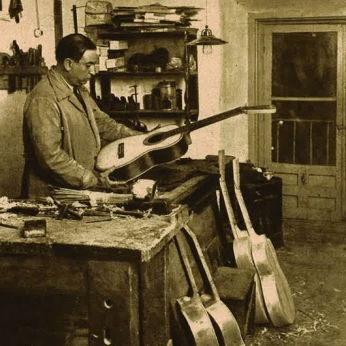
This 1957 José Ramírez II is a spruce and cypress flamenco guitar from Madrid, made the year he died – a very versatile guitar from the Russell Cleveland collection.
The Last Year of José Ramírez II
This guitar was made the year José Ramírez II passed away, and like the 1956 classical (also part of the Cleveland collection) it already shows the growing influence of Manuel Ramírez over the Francisco González-inspired style of his father, José Ramírez I, in the plantilla, internal bracing and even decorative decisions. It has a lightweight build, huge volume (even by 'modern' standards) and almost plays itself with a beautifully shaped neck and easy setup.
A Flamenco That Can Be Caressed
The lightly braced top (only 5 fans) is very quick-responding with bullet-like trebles and raspy basses. Although it barks as a flamenco should, it can be caressed and played almost as a classical – the sound is so relaxed and open that it's a very versatile instrument which could work well in several different kinds of musical settings. Apart from two hairline (and nearly invisible) cracks in the sides, the guitar is in excellent condition. The instruments from this period of Ramírez are very rare and this is an excellent, top example from this era.
Background
José Ramírez II: Twenty Years in South America
José Ramírez II (1885–1957), the eldest son of José Ramírez I, grew up in his father's shop, learning from his father and from journeymen such as his uncle Manuel Ramírez and Enrique García. A guitarist as well as a maker, at 20 he left on what was meant to be a two-year tour of South America – it turned into almost twenty years in Buenos Aires. After his father's death he returned to Madrid, and in 1925 he took over the Ramírez workshop.
The Ramírez Workshop under José II
At this time, the workshop employed four workers: two journeymen, Alfonso Benito and Antonio Gómez, an advanced apprentice, Marcelo Barbero, who years later would become a famous guitar maker, and the varnisher Manuel Rodríguez (nicknamed "Marequi"), whose son Manuel later became a well-known guitar maker himself. In 1929 José II won the Gold Medal at the Ibero-American Exposition in Seville. Under his direction, the workshop produced mostly plain, inexpensive but adequate guitars, particularly after 1936, during the Spanish Civil War, when high quality materials were difficult to obtain. Despite these challenges, Ramírez II was able to fill the economic niche for well-made guitars bearing the name of a famous workshop – instruments very usable for serious musicians in both flamenco and classical genres.
Read More about the Ramírez Family
For more information on Ramírez, be sure to read The Ramírez Family: Masters of the Guitar, or for information on the Ramírez family members, from Amalia Ramírez back to José I, and for some interesting fact-checking on myths and facts about this legendary workshop.






















