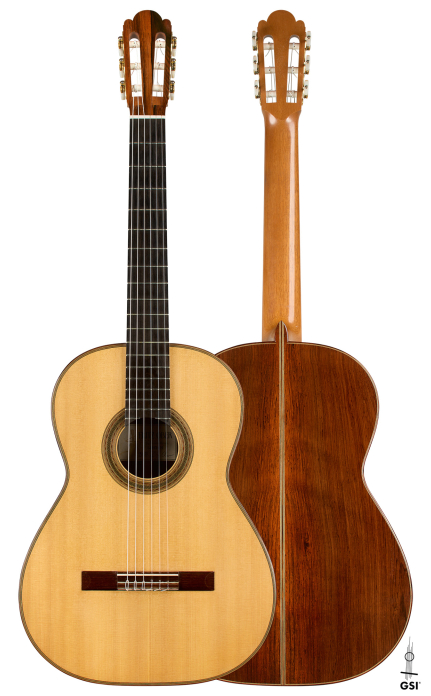
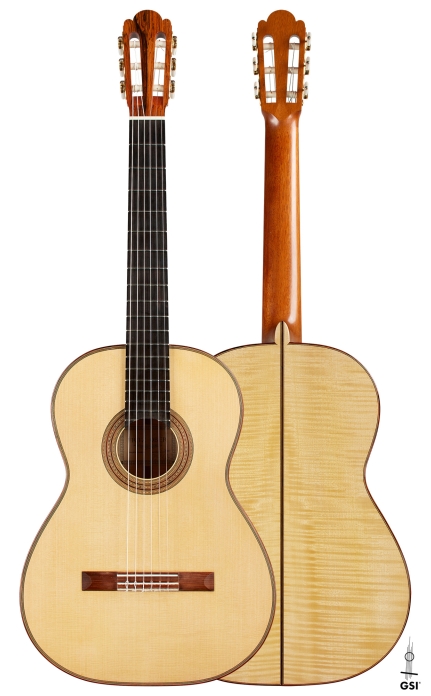
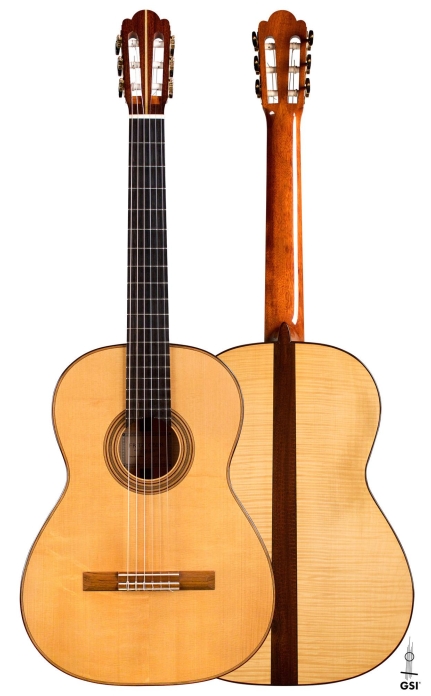
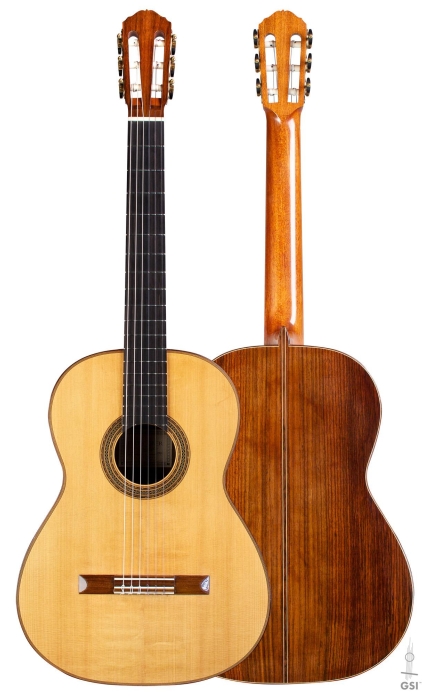
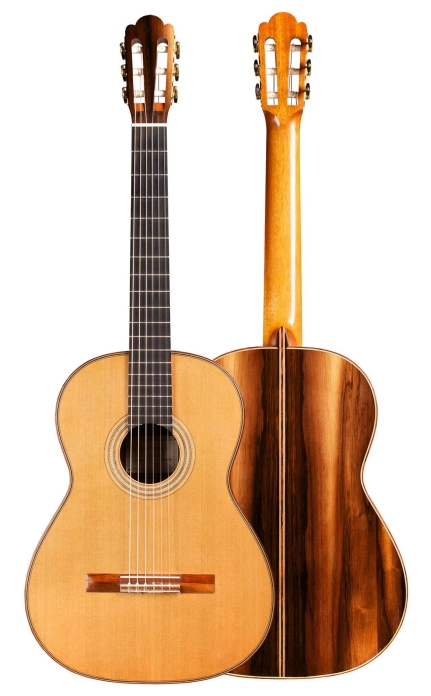
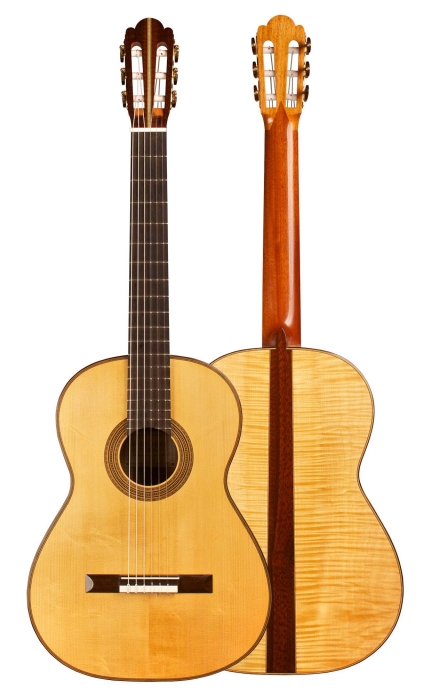
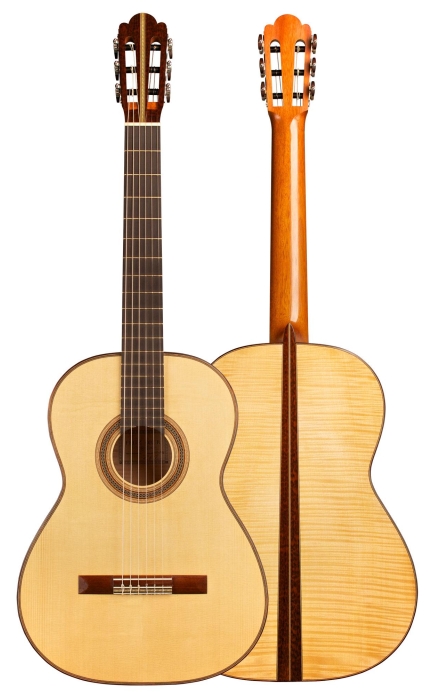
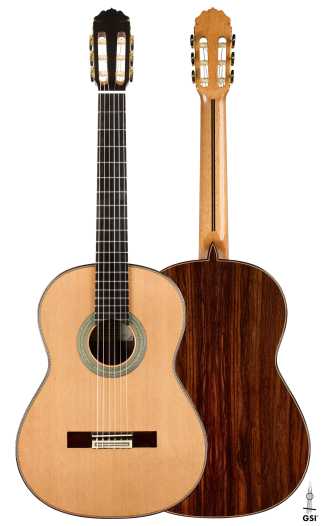
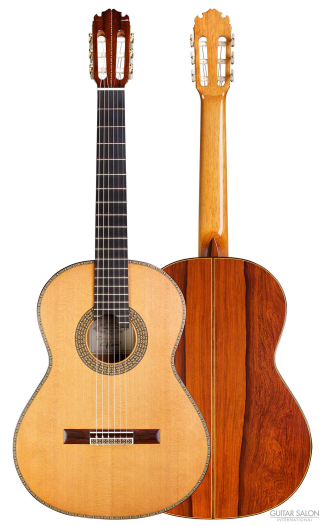
2012 Fritz Ober "La Leona" SP/CY
| Year | 2012 |
| Top | Spruce |
| Back & Sides | Cypress |
| Scale Length | 650 mm |
| Nut width | 52 mm |
| Finish | French Polish |
| Country | Germany |
| Luthier | Fritz Ober |
This guitar is no longer available in our inventory. If it interests you, click the ”notify me when available” button to be notified in the event that we re-acquire this guitar for re-sale.


Falla "Homenaje de Debussy" played by Eva Beneke
Description
 This 2012 Fritz Ober "La Leona" is a spruce and cypress replica of the 1856 Antonio de Torres guitar FE 04, made in Munich, Germany – the first of Fritz's "La Leona" copies to come to GSI.
"La Leona": Torres' Most Famous Guitar
Arguably the most famous of Torres' instruments, "La Leona" (FE 04) is also one of the most admired guitars ever built by anyone in the history of guitar making. Torres completed it in 1856 and immediately it was being used in concert by Julián Arcas (Torres never sold this instrument – he loaned it to Arcas on many occasions, and it was in Torres' possession at his death in 1892). In fact it was during an Arcas concert in 1862 that the young Francisco Tárrega (aged 9 at the time) first heard "La Leona" and became enchanted. Pujol, Prat and Llobet were admirers of this guitar as well. In modern times the instrument has resurfaced, having been recorded beautifully on several occasions by German virtuoso Wulfin Lieske. It is such a compelling instrument that an entire chapter is devoted to it in José Romanillos' great book, "Antonio de Torres, Guitar Maker – His Life & Work".
The Tornavoz and No Lower Harmonic Bar
Several features distinguish the guitar from the rest of Torres' output. It was the first instrument Torres built with a tornavoz – the resulting sound was so "big" (like the roar of a lion) that it earned the name "La Leona" ("The Lioness"). It also has a thin, carved bridge with no saddle, so the strings exit the tie block with no relief or break angle all the way to the nut. The internal structure has a very interesting modification too – the guitar lacks a lower harmonic bar, one of the most important braces for keeping the soundboard from collapsing. Torres ingeniously found a workaround: the tornavoz is supported by two small wooden posts resting against the back, giving the soundboard all the support it needs. This also frees more of the top to resonate and at the same time transmits vibration to the back. The result is astonishing – an instrument vibrating along almost all of its surface, back, sides and soundboard, teeming with energy and liveliness.
Fritz Ober and the Original "La Leona"
In 2006, Fritz Ober first became acquainted with the original "La Leona" when it was brought to him for some minor repair work. The instrument so captivated Fritz that arrangements were made to have it back in his workshop for an entire month to study, document and measure it, primarily for research and for the possible production of a replica (click here to see photos of the original while Fritz had it in his shop). Until then he had avoided making "replicas" of any other instrument, and "La Leona" would be his first (and possibly only) exception – like the great guitar personalities of the past, Fritz was won over by her beauty and seductive qualities.
This instrument is the result of his effort – as near-exact a replica of the original as possible (the only slight modifications are a slightly thicker neck, the inclusion of a saddle, and a headshape that best fits machines – the original had pegs before it was altered to machines). This is our first from Fritz. Those who have seen both the original and this copy (including Wulfin Lieske and David Collett from GSI) are simply amazed at how close Fritz has come in capturing the look and sound of the original.
Sound
The spirit, vitality and charm of the original are to be found in this masterful tribute. Like the original, it has an enormous palette for tonal color, enhanced dynamic range, big basses almost without bottom, and sparkling, singing trebles. It has great clarity across all registers and between voices. Like the original, we expect this instrument by Fritz to captivate those who have the great opportunity to hear or play it.
Orfeo Magazine No. 4: Hauser III, Blöchinger and Ober