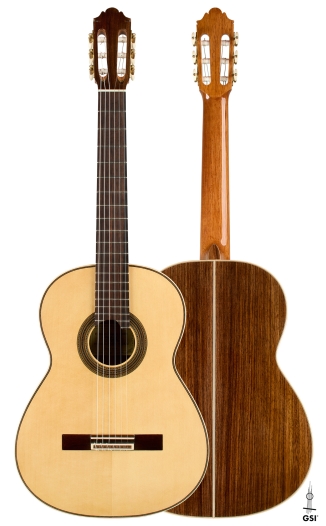
c. 1912 Manuel Ramírez SP/CY
| Year | c. 1912 |
| Top | Spruce |
| Back & Sides | Cypress |
| Scale Length | 645 mm |
| Nut width | 50 mm |
| Finish | French Polish |
| Country | Spain |
| Luthier | Manuel Ramírez |
This guitar is no longer available in our inventory. If it interests you, click the ”notify me when available” button to be notified in the event that we re-acquire this guitar for re-sale.
Videos
Description
An elegantly built Manuel Ramírez from around 1912, with a spruce top, cypress back and sides and mother-of-pearl in the rosette and bridge, from the Russell Cleveland collection.
In the videos above, Eric Henderson plays his own "Prelude (Water)" and Taso Comanescu plays Isaac Albéniz's "Rumores de la Caleta" on this guitar.
Deep Basses, Warm Trebles
This is an elegantly built instrument, with deep basses, plump and warm trebles, and rich textures of sound interwoven with clear, bell-like fundamentals. Its feather-like weight gives it incredible volume and instant response – it's easy to see why so many contemporary luthiers have set out to rediscover this style of build, with a charm that has captivated players and listeners for over a century. The sound is unmistakably Spanish, deep, dark and mysterious.
Herringbone, Rope and Mother-of-Pearl
The guitar is decorated with some of the fancier design elements of the period, including mother-of-pearl in the rosette and bridge. The rosette is flanked on either side by a tight, uniform herringbone pattern, with a rope pattern on the inside right up to the edge of the soundhole. Built in a period when no distinction was made yet between "classical" and "flamenco", it is simply a great "guitar", a fantastic concert and recording instrument in either style.
From the Russell Cleveland Collection
This guitar comes from the Russell Cleveland collection.
Background
Manuel Ramírez (1864–1916): The Madrid Workshop After Torres
The Manuel Ramírez shop was undoubtedly the most important guitar workshop of the early post-Torres era. Brother and former pupil of José Ramírez I, Manuel committed himself to carrying the Torres design into the 20th century, and he gathered the finest builders of his day to do it: Santos Hernández, Domingo Esteso, Modesto Borreguero, Pascual Viudes and, very likely, Enrique García. Together they produced guitars that secured the legacy of Torres for every generation of makers that followed.
Segovia's 1912 Manuel Ramírez
The shop's most famous instrument is the 1912 guitar played by the young Andrés Segovia, built by Santos Hernández and today housed in the Metropolitan Museum of Art in New York, alongside Segovia's 1937 Hermann Hauser I.
The "Viuda de Manuel Ramírez" Label
After Manuel's death in 1916, the workshop went on completing instruments under the label of his widow ("Viuda de Manuel Ramírez"). His craftsmen later founded workshops of their own – Santos Hernández on Calle de la Aduana and Domingo Esteso at Gravina 7 – carrying the shop's sound and standards deep into the 20th century.