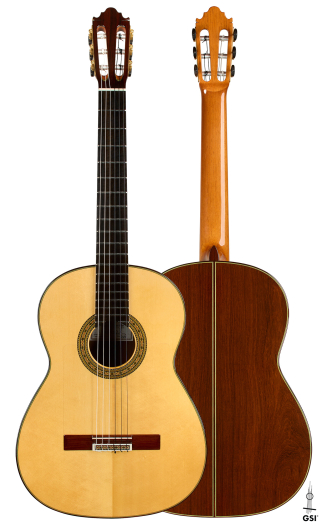
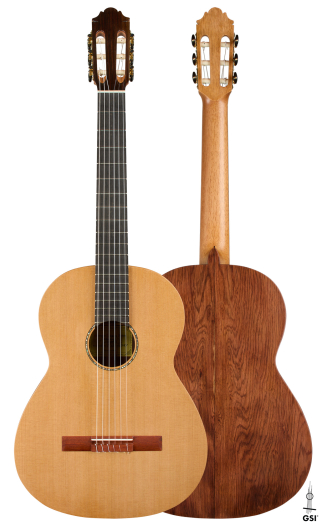
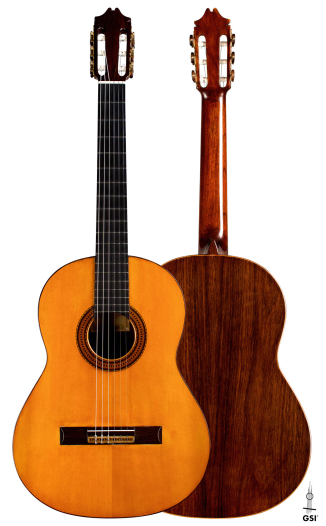
1867 Antonio de Torres "FE 27B" SP/MP
| Year | 1867 |
| Top | Spruce |
| Back & Sides | Maple |
| Scale Length | 650 mm |
| Nut width | 52 mm |
| Finish | French Polish |
| Country | Spain |
| Luthier | Antonio de Torres |
This guitar is no longer available in our inventory. If it interests you, click the ”notify me when available” button to be notified in the event that we re-acquire this guitar for re-sale.


Lawrence Long's "Love Of My Life 'To Birdie Long" by George Sakellariou on an 1867 Antonio de Torres

John Cage's 4’33” performed by Felix Salazar on an 1867 Antonio de Torres SP/MP classical guitar

Assad's 'Seis Brevidadas' and 'Valseana' played by Marc Teicholz on an 1867 Antonio de Torres

"Eleno" (Traditional Folksong) by Miroslav Tadić & Yvette Holzwarth on a 1867 Antonio de Torres
Description

This 1867 Antonio de Torres is a spruce and bird's-eye maple classical guitar from his first epoch in Seville, FE 27B in the Romanillos catalog, repaired in 1915 in the Madrid workshop of Manuel Ramírez.
In the videos above, George Sakellariou plays Lawrence Long's "Love of My Life (To Birdie Long)", Marc Teicholz plays Sérgio Assad's "Seis Brevidades" and "Valseana", Miroslav Tadić and Yvette Holzwarth play the traditional song "Eleno", and Felix Salazar performs John Cage's 4'33" on this guitar.
FE 27B: A Bird's-Eye Maple Torres
This particular instrument is an exquisite example of an incredibly well-preserved bird's-eye maple guitar from the so-called "first epoch" (c. 1850–1870), catalogued as FE 27B by José Romanillos. Its label is the Seville label of those years, "Por D. Antonio de Torres, Sevilla, Calle de la Cerrajería número 32", dated 1867.
A Repair Label from Manuel Ramírez, 1915
Just below it is a second label: "Restauró Manuel Ramírez, constructor de violines y guitarras, Arlabán 10, Madrid, año 1915". So the guitar had some restoration work done in 1915 in the Manuel Ramírez workshop in Madrid, likely to repair some cracks, mainly on the back – a fascinating link between Torres and the Madrid makers who carried his legacy into the 20th century.
Sound
It is hard to put into words how rich and harmonious this guitar sounds, how perfectly the notes balance as they blend together, and how it feels as it vibrates against the player's body. That tremendous experience is only possible with an instrument such as this in one's hands, and it is confirmed by all who see and hear every Torres that comes through our shop – especially one in this kind of very original condition.
More on Antonio de Torres
To learn more about the master of Seville and Almería, read our Antonio de Torres biography, The Torres Sound – an excerpt from José Luis Romanillos's book "Antonio de Torres" – and Pepe Romero on Torres, his interview with Kenny Hill. Also see Orfeo Magazine #9 – The 200th Anniversary of Antonio de Torres.