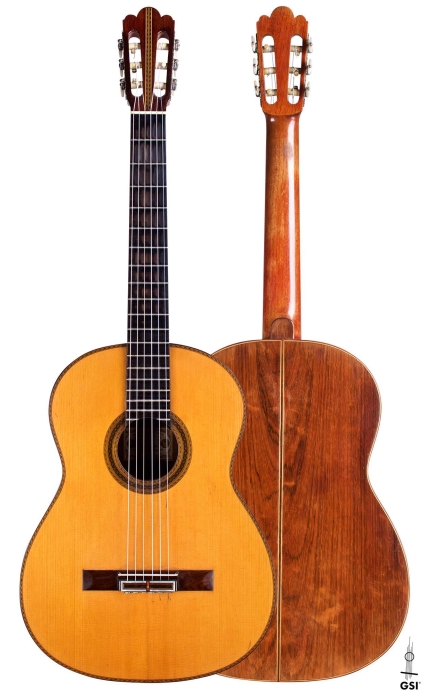
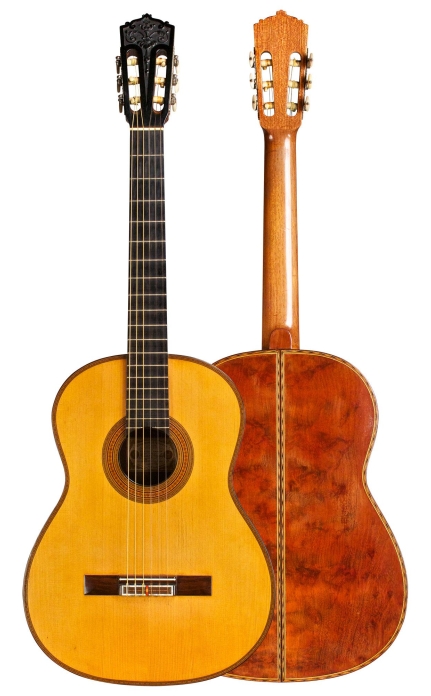
1927 Francisco Simplicio No. 161 SP/MH
| Year | 1927 |
| Top | Spruce |
| Back & Sides | Mahogany |
| Scale Length | 650 mm |
| Nut width | 51 mm |
| Finish | French Polish |
| Country | Spain |
| Luthier | Francisco Simplicio |
This guitar is no longer available in our inventory. If it interests you, click the ”notify me when available” button to be notified in the event that we re-acquire this guitar for re-sale.


Tarrega ‘Vals en re mayor’ - Sondre Hoymer plays 1927 Francisco Simplicio

Loretta - Celil Refik Kaya plays 1927 Simplicio
Description

This 1927 Francisco Simplicio is a spruce and quilted mahogany classical guitar from Barcelona, No. 161 – his most deluxe model, with a gilded carved ebony head and a mahogany tornavoz.
In the videos above, Sondre Hoymer plays Tárrega's "Vals en re mayor" and Celil Refik Kaya plays "Loretta" on this guitar.
Simplicio's Most Deluxe Model
This is Simplicio's most deluxe model, and features a high degree of breathtaking decoration including golden highlights in the carved ebony head, gold engraved German machines with mother-of-pearl oval buttons, and multiple layers of purfling (including rope inlays in the back and side purflings, and mosaics in the top purfling) – all very tastefully and exquisitely done. The materials are striking as well – most notably a set of gorgeous quilted mahogany for the back and sides.
A Wooden Tornavoz
The sound of this Simplicio is particularly magnificent – great depth to every note up the entire register with a big bottom-end and lyrical trebles. This effect is enhanced due to its being fitted with a "tornavoz", a conical tube attached to the soundhole, which adds a sonic boom to the bottom end and gives the trebles a brilliant clarity. Normally these are made of brass, but Simplicio often used wood, as in this case – mahogany.
Condition
The guitar is in almost perfect condition – with only a small amount of playing wear, there is only one repaired top crack. But the nut, saddle and frets are still original, as is the French polish on the entire instrument. Some of the original shellac is still visible on the fingerboard, a popular option in Simplicio's era. Overall, a highly desirable guitar from this famous builder.
Orfeo article on Simplicio – the French guitar magazine Orfeo devoted a feature to Francisco and Miguel Simplicio in its first issue.