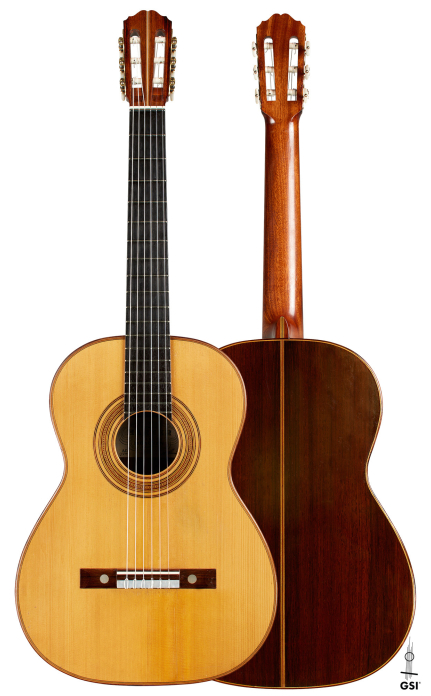
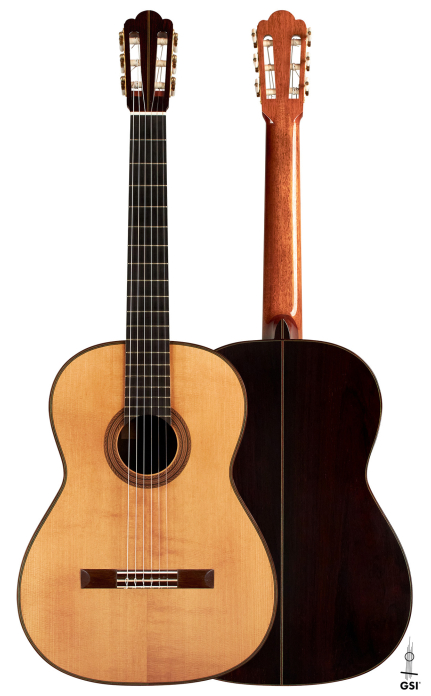
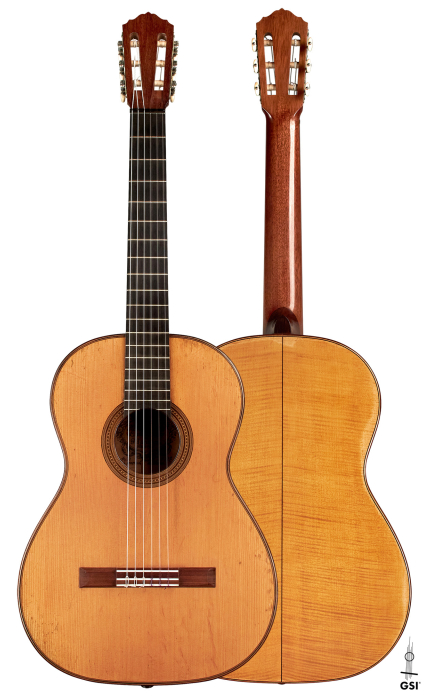
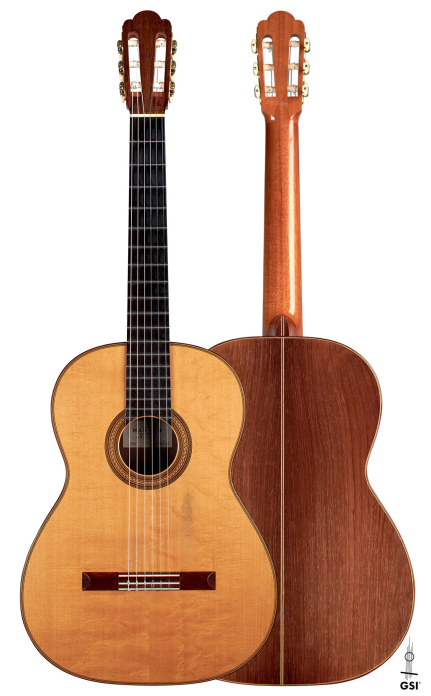
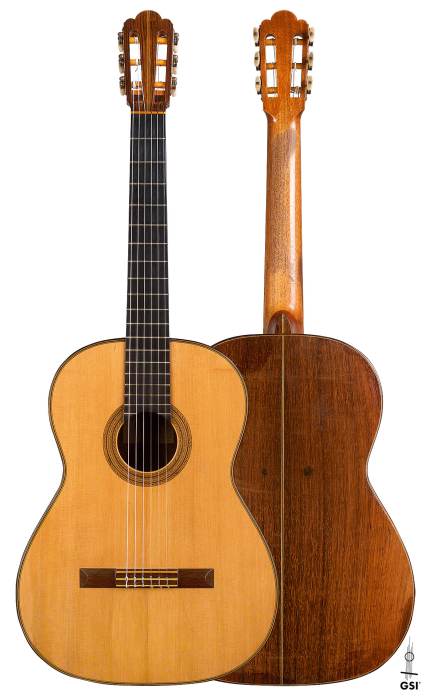
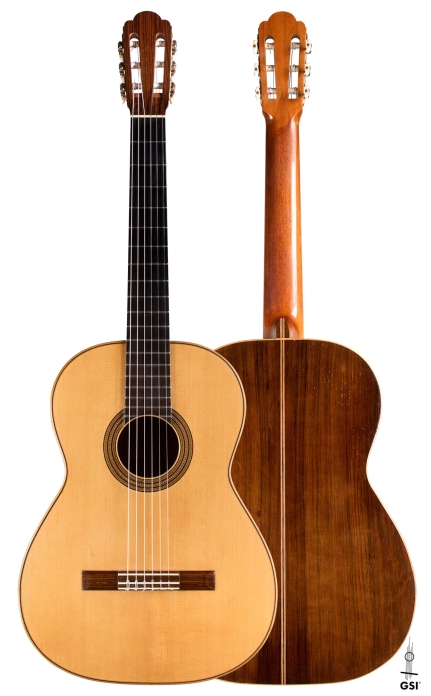
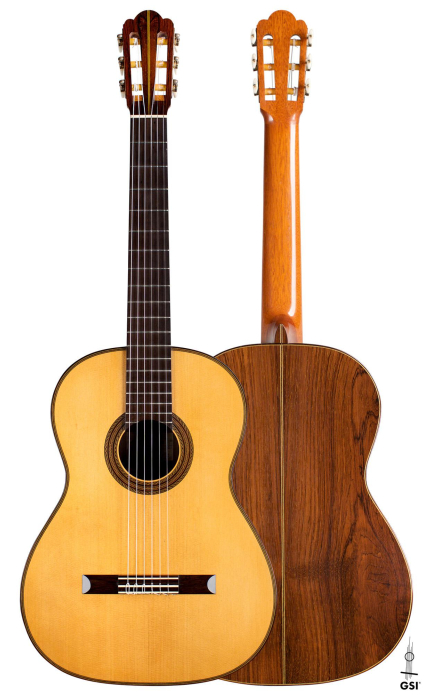
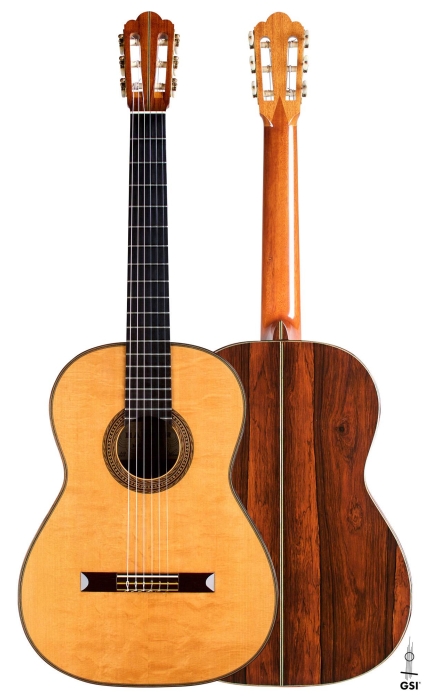
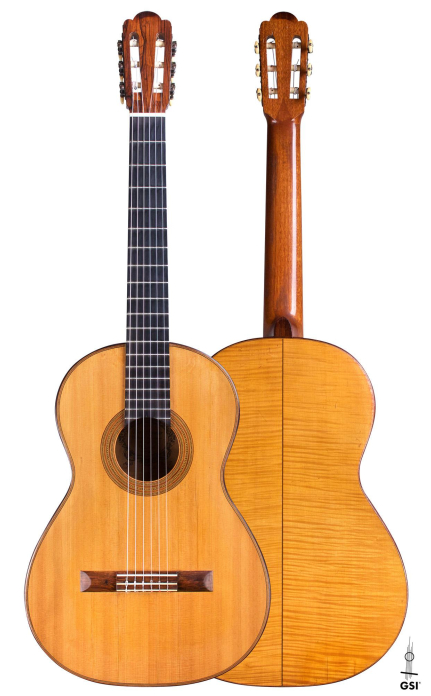
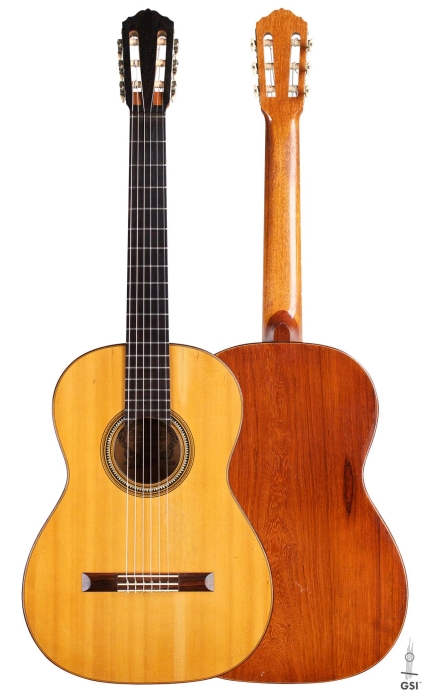
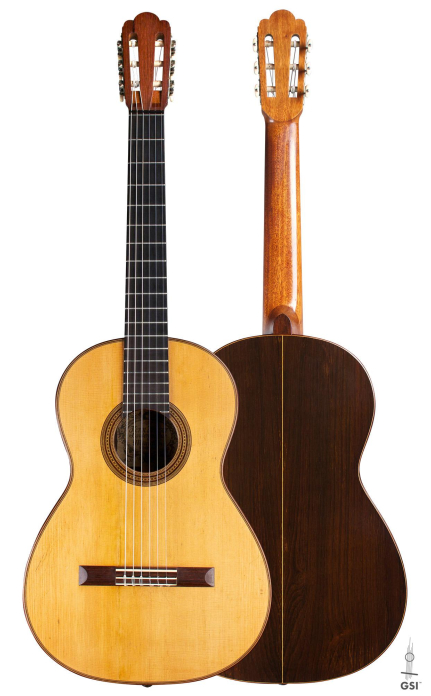
This 1928 Hermann Hauser I classical guitar in spruce and CSA rosewood was owned by Julian Bream from 1950 until 1992 – it still carries the brass "JAB" plate he had made for its headstock, and comes with photos of Bream with the guitar and his own letter of authenticity and provenance.
Torres, Segovia's Ramírez and the Hauser of 1928
By the year this instrument was built, Hermann Hauser was already well acquainted with the work of Antonio de Torres – indeed he had seen and studied Miguel Llobet's 1859 (FE 09), even having drawn a plan of it in 1922, and in 1926 acquired an 1860 Torres (FE 13) from Llobet – two instruments that would have a permanent impact on his style. In 1924 he met Andrés Segovia for the first time and was also able to examine his 1912 Manuel Ramírez (built by Santos Hernández), and again, this instrument had a profound effect on his own work – most famously, the "Manuel Ramírez" head on Segovia's guitar would remain a favorite of Hauser's for over a decade after his first encounter with it, and appear on many of his guitars (including this 1928).
Julian Bream's Hauser: the "JAB" Plate
Speaking of the headstock, Julian Bream (who owned this guitar from 1950 until 1992) was so fond of it, he had a jeweler craft a brass plate with his initials "JAB" (Julian Alexander Bream), which was installed on the top of the head veneer. It is almost certain that this is the Hauser described in his book "A Life on the Road", where Bream says he picked it up for a "fiver"! It is also possible that this guitar was used at his Wigmore Hall debut in 1951, which would make it the guitar that launched his 50-year career – a career that also ended at Wigmore Hall, where GSI president David Collett flew out to attend in 2001, and where Bream was playing a 1940 Hauser, ex Augustine.
Sound: the "Teutonic" Hauser Ahead of Its Time
As for sound, it's remarkably ahead of its time. Hauser was exploring and building various Spanish styles in the 1920s, and his guitars from this period tend to have a more "Spanishy" sound, which should be expected. However, the style of sound that Hauser is most famous for developing – what Julian Bream called the "teutonic sound" (improved balance, clarity, brilliance in the trebles, evenness of sound, sturdy/firm basses) – is fully expressed in this guitar. This sound becomes more commonplace in instruments he built in the mid-1930s and beyond, so it's really astonishing to hear an earlier guitar already fully loaded with these qualities. It is also incredibly powerful, even by modern standards – this is easily in the top percentile of Hauser I guitars we've seen for volume.
Condition and a Very Honest Repair
Condition is excellent for such an old instrument and, as mentioned in Bream's letter, it was restored to its current condition in 1989. One of the notable repairs is the use of a thin piece of cedar for the soundboard splice, a repair that greatly impressed Yuris Zeltins when he saw it many years ago for its blatant attempt to not be camouflaged or hidden, but rather express itself as part of the guitar's history, along with the JAB plate on the head. Very honest and of course extremely well done! It has been kept since this time in performance-ready condition, suitable for the concert stage, recording studio, or simply for a luxurious evening of private playing. Truly a remarkable and rare instrument with a great backstory from one of history's most important luthiers.