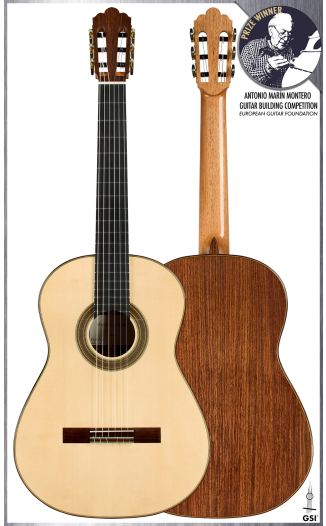
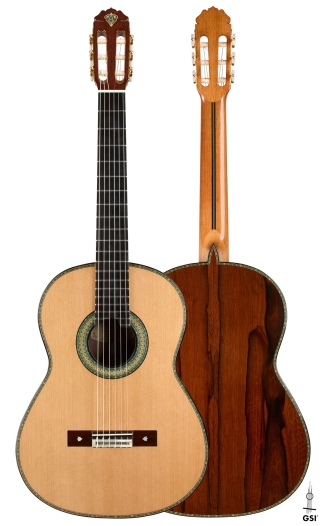
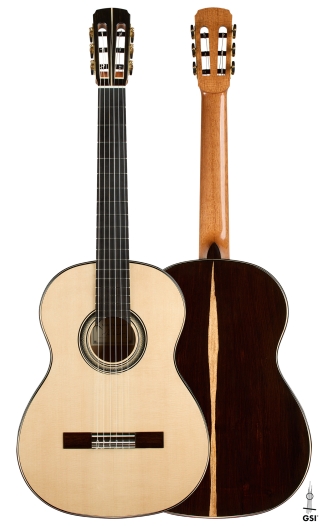
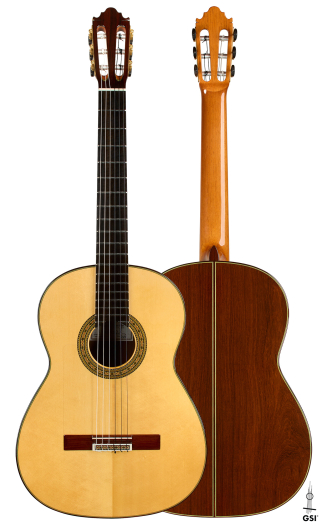
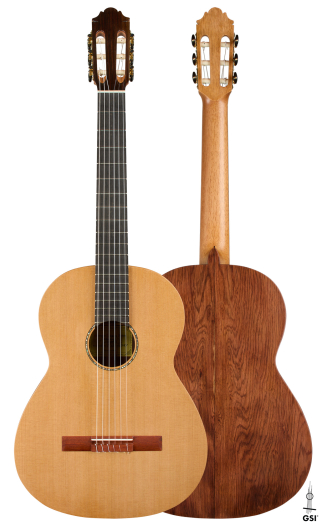
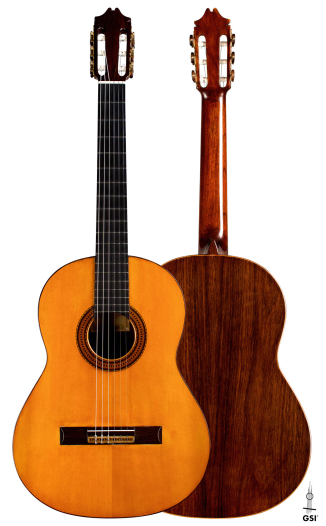
This 1931 Santos Hernández is a spruce and CSA rosewood classical guitar from Madrid, once owned by David Gómez Tárrega, nephew of Francisco Tárrega – in amazing, near-pristine condition.
In the videos above, Max Müller plays the Adagio from Bach's Violin Sonata BWV 1001, the Mela Guitar Quartet plays Debussy's "Arabesque No. 1" on four rare guitars including this one, and Irina Kulikova plays Barrios' "Las Abejas".
Tárrega's Nephew and His Santos
This guitar, built in 1931, was previously owned by the nephew of Francisco Tárrega – David Gómez Tárrega – see below for the translation of a letter from his son, Enrique Gómez Vázquez. It is featured on pages 178-179 of the Orfeo book on Santos Hernandez.
"Collapsing Waves" and a Flamed Mahogany Neck
This guitar is an extremely elegant example of Santos' best work, with beautiful materials and his usual, precise craftsmanship. The rosette features Santos' "collapsing waves" in the mosaic, a variation on the rosette found in his iconic 1912 Manuel Ramírez of Segovia. Condition is amazing – apart from one hairline (invisible) crack under the fingerboard (repaired with glue) the guitar is pristine, with only some minor finish work done over the course of its life. The sound has a rich, deep and almost "pensive" quality supported by a solid fundamental at the center of every note, and a beautiful loose, old-world feel. Playability is a breeze with a very comfortable (and visually stunning – flamed mahogany) neck. Overall a very charming instrument that captures the essence of this great maker.
Translation of the Family Letter (Included with the Guitar)
Biographical sketch of Don David Gómez Tárrega and his Santos Hernández guitar
Belonging to a family that loved music, who played various stringed and percussion instruments, Don David was born in Geldo, a small town in Valencia. His passion led him to study every note and the entire musical range of the great composers. Among which was the great Spanish teacher and composer, known worldwide, Francisco Tárrega, who was his uncle on his mother's side and from whom he also inherited that love for music.
Since his youth, Don David sought in his free moments the opportunity to share his music with family and friends. During this time they formed small ensembles during festivities that went from town to town and brought typical serenades to the region's masses.
Don David, on one of his pilgrimages, came very young to America. Where after many sacrifices and honest work, he formed a family in the city of Durango, Mexico, with Mrs. Lucia Vazquez Tovar, my mother. Don David's brothers, in Spain, found the opportunity to acquire a Santos Hernandez guitar, so desired by my father, sending it to him at their first opportunity. As expected, the surprise and joy was enormous. Since he had achieved his dream of owning such an invaluable instrument and from that moment on it was his favorite one that he liked to play in his most intimate moments.
Don David, after living in the city of Mexico, settled in the city and port of Acapulco. He was a pioneer in the development of this beautiful port, credited with his famous restaurant "Colonial" known internationally and where figures from cinema and politics attended, and where he left his stamp on Spanish food with his traditional Valencian paella.
Don David Gómez Tárrega died at the age of 65, on October 4, 1966. Since then the guitar has been kept by his children Lucia and Enrique as an invaluable keepsake. – Enrique Gómez Vázquez