Guitar Salon International
+1 (310) 586.1100 | +1 (877) 771.4321
Museum
Classical Guitars
Classical Guitars
Flamenco Guitars
Flamenco Guitars
Cleveland Collection
Luthiers
Luthiers
Your Cart

Your shopping cart is empty!

Sub-Total: $0.00
Total: $0.00
Edit cart
Checkout
Museum

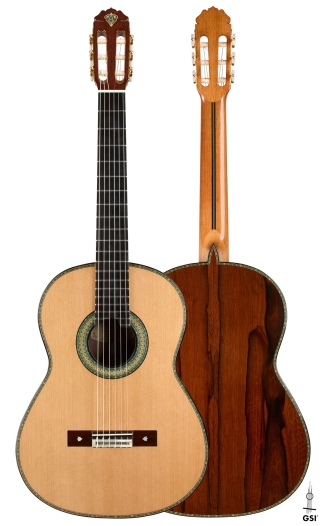
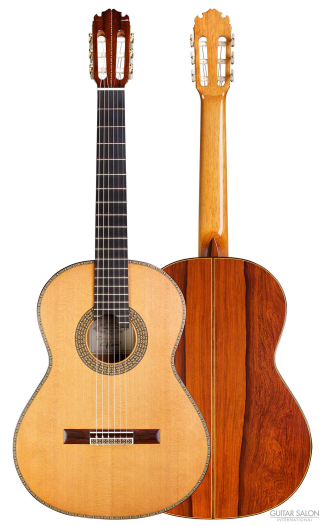
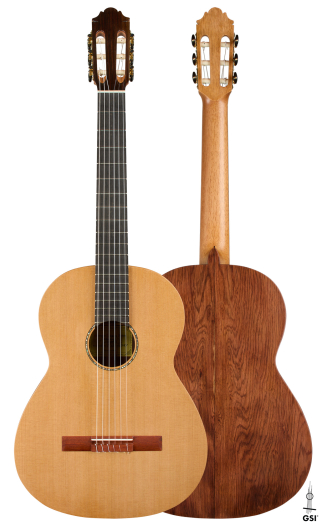
1969 Hermann Hauser II No. 850 CD/CSAR (ex Pepe Romero)

Year 1969
Top Cedar
Back & Sides CSA Rosewood
Scale Length 655 mm
Nut width 51 mm
Finish French Polish
Country Germany
Luthier Hermann Hauser II

This guitar is no longer available in our inventory. If it interests you, click the ”notify me when available” button to be notified in the event that we re-acquire this guitar for re-sale.

Inquire
See more from Hermann Hauser II

Videos

1969 Hermann Hauser II No. 850 CD/CSAR (ex Pepe Romero)

Benjamin Britten's "Nocturnal After John Dowland" played by Chad Ibison on a 1969 Hermann Hauser II

Description

This 1969 Hermann Hauser II No. 850 is a cedar and CSA rosewood classical guitar from Reisbach – one of three "sister guitars" built from the same woods for Segovia and Pepe Romero, and Pepe's own concert guitar for many years.

The Three 1969 "Sister Guitars": Nos. 850, 851 and 852

This magnificent instrument was one of three "sister guitars" built by Hermann Hauser II in 1969, all with the same woods. Pepe Romero would be the first and only owner of No. 852, and No. 851 was built for Andrés Segovia. This guitar, No. 850, was also owned by Pepe Romero for many years. In an accompanying letter included with this instrument, Pepe writes of its history:

"I first played this Hermann Hauser II guitar number 850 in January 1970 on the evening of my first visit to his home in Reisbach, Germany. I played three guitars at that time and I fell in love with all of them. Hermann Hauser II decided to sell me one, which was number 852. I concertized exclusively on this instrument and made some of my favorite recordings – amongst them "Opera Fantasy". Number 850 went to an artist and was played for many years. In the late 90s, he gave it back to Hermann Hauser III who knew I was looking for an instrument with a cedar top like my guitar number 852. He told me I had the opportunity to acquire number 850 which I immediately did. I have played 850 in many of my concerts and I still think that this particular guitar is one of the greatest ever built."

Materials, Sound and Condition

This guitar is an absolutely majestic instrument in every way. The materials used are stunning – the cedar top having been stored ten years prior to the build, and exquisite CSA rosewood for the back and sides coming from Hauser I's supply from the early 1930s. The sound is as amazing as its appearance – lush yet firm and bold, characteristics of the best guitars by this maker. It also has enormous power, which is not typical for this maker.

It is in incredible condition – no prior damage or repairs of any kind, with original finish and even original nut and saddle (which are famous for turning a sort of "mustard yellow" over time). All in, including its incredible provenance, this is in our opinion one of the greatest Hauser IIs we've seen.

Background

Hermann Hauser II: Third Generation of the Hauser Dynasty

Hermann Hauser II (1911–1988) – Hermann Hauser Jr. – is considered to be one of the greatest makers of the twentieth century. Grandson of the luthier Josef Hauser and son of Hermann Hauser I, he learned his craft working alongside his father, and after his father's death in 1952 he carried the family's Torres-based "teutonic" style into the second half of the century from the Hauser workshop in Reisbach, Bavaria. His son Hermann Hauser III (the fourth generation) and granddaughter Kathrin (the fifth) still work there today – see Hermann Hauser III & Kathrin Hauser – with many of the same tools and even woods stocked by the earlier generations.

The Hauser dynasty, now spanning five generations, has produced instruments played by countless concert artists including Andrés Segovia, Julian Bream, the Romeros and many others.

The Hauser II Sound

The sound has the attributes of a great Hauser that have attracted great players from Bream to Segovia to the Romeros and beyond – crystal-clear fundamental tones with almost perfect separation, basses that are steady and precise, and at the same time a lyrical charm and sweetness, particularly in the trebles. At its best, a Hauser II is like a loud and balanced piano, with the warmth of a great Hauser I. Playability is easy, thanks to his slender and very comfortable neck shape.

Books on Hermann Hauser II

Orfeo Magazine No. 4 is devoted to the Hauser dynasty, and a 1960 Hauser II is among the guitars shown in Orfeo's "34 Classical Guitars in Life Size":

Guitars by Hermann Hauser II