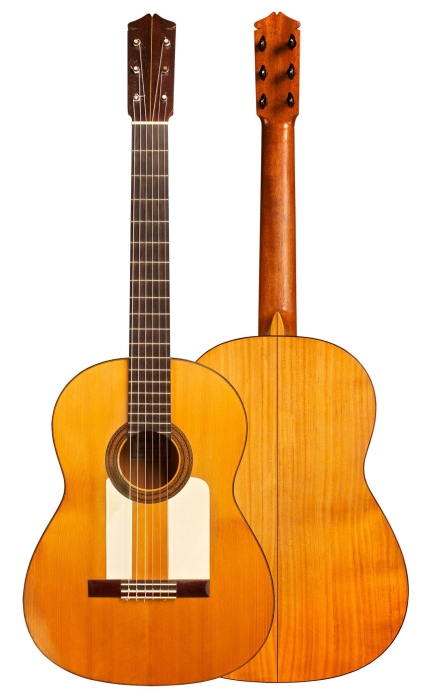
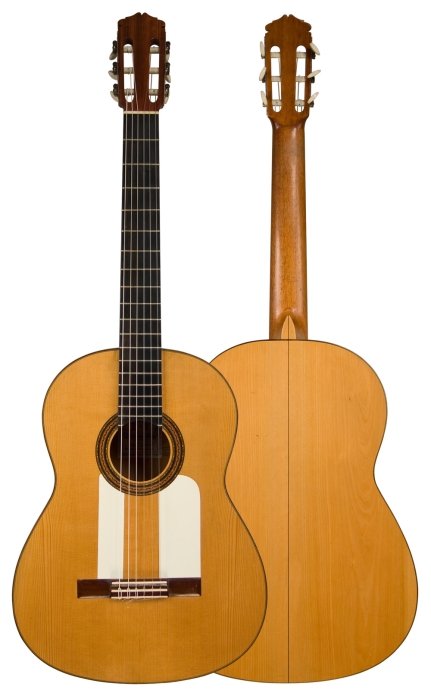
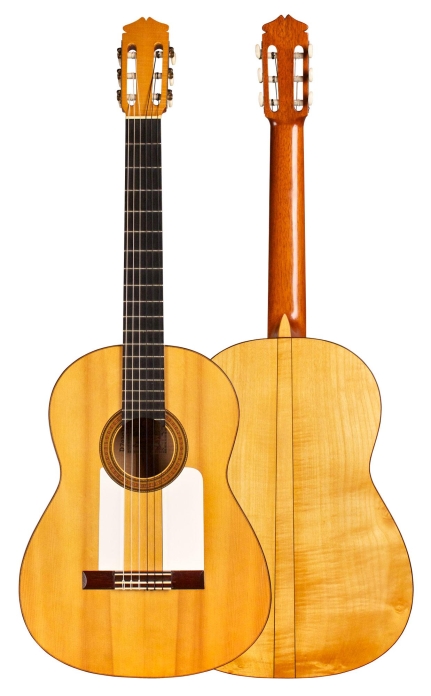
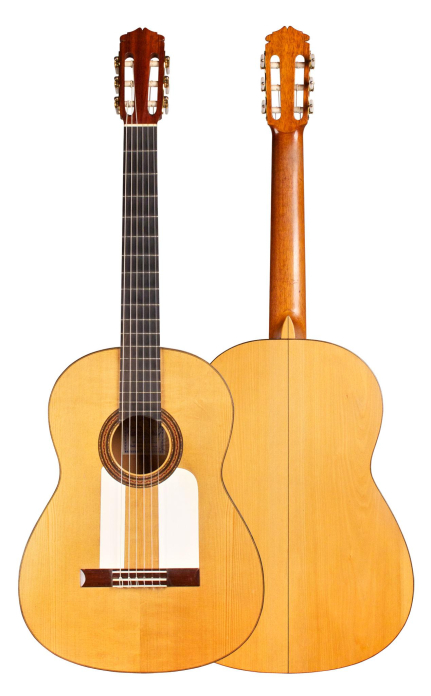
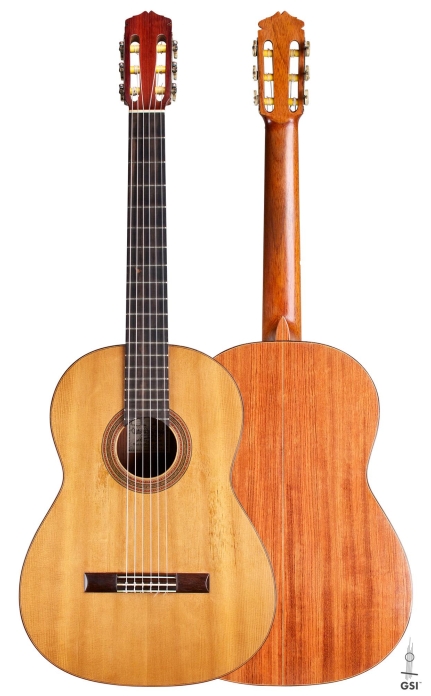
1969 Manuel de la Chica CD/CSAR
| Year | 1969 |
| Top | Cedar |
| Back & Sides | CSA Rosewood |
| Scale Length | 665 mm |
| Nut width | 52 mm |
| Finish | French Polish |
| Country | Spain |
| Luthier | Manuel de la Chica |
This guitar is no longer available in our inventory. If it interests you, click the ”notify me when available” button to be notified in the event that we re-acquire this guitar for re-sale.
Description
This 1969 Manuel de la Chica is a cedar and CSA rosewood classical guitar – one of his rarer cedar tops – with no cracks or repairs.
A Cedar-Top De la Chica
Most of his guitars have spruce tops, which makes this cedar-top classical a less common find. The label is signed and dated 1969.
Sound and Condition
It has a lyrical, singing quality to it, yet at the same time can bite if pushed; very light in weight, it has piercing volume. Although a longer-scale instrument, playability is a breeze. Condition is excellent with no cracks or repairs, only some recent finish work from the Germán Vázquez Rubio workshop. This is an exceptional instrument in every regard from this great builder.
Background
Manuel de la Chica: Granada’s Great Master
Manuel de la Chica (1911–1998) is arguably the greatest guitar builder from Granada to date. His early professional background was in cabinet making, as is the case for countless other fine guitar makers. His focus shifted to guitar making in the late 1930s when he had seen and become attracted to the Spanish guitar, primarily those of Santos Hernández. His labels – with their view of the Alhambra – come from his workshop on the Placeta de la Sillería in Granada.
Santos, Barbero and De la Chica
Often his instruments are compared to the later guitars of Marcelo Barbero (who assisted in the construction of several Santos guitars left partially built at the time of Santos’s death), which we feel is a very strong and fair comparison. Like Santos and Barbero, De la Chica was at home building both classical and flamenco guitars, and his finer instruments have the flexibility of being played in either style.

Retirement and Rediscovery
In 1973 he was forced into early retirement from guitar making due to health complications he was experiencing from inhaling dust and chemicals in his taller. From his early departure until his death in 1998, his instruments fell into relative obscurity; however, renewed interest in recent decades and a re-evaluation of his work have convinced many that his contribution, skill and insight into the art of guitar making establish him as one of the great makers of all time. Among those who learned from him was Antonio Marín Montero, his student and friend.