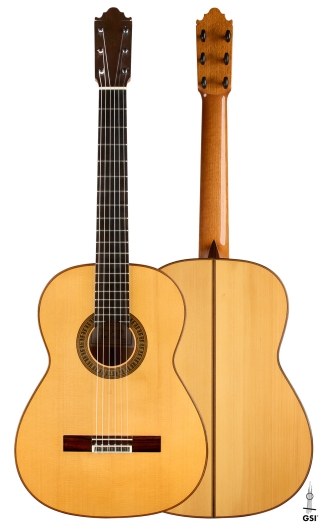
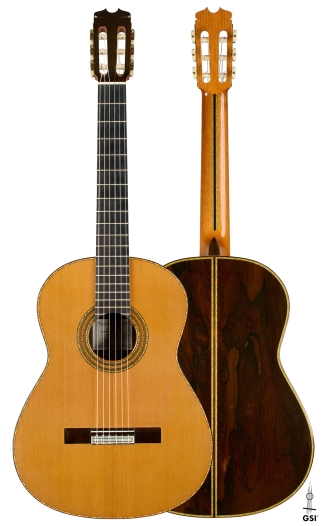
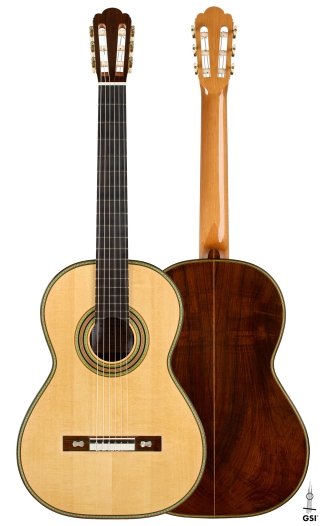
2025 Darío García "La Leona" SP/CY
| Year | 2025 |
| Top | Spruce |
| Back & Sides | Cypress |
| Scale Length | 650 mm |
| Nut width | 51 mm |
| Finish | French Polish |
| Top Construction | Traditional |
| Bracing | Seven fans with tornavoz |
| Body resonance | E |
| Tuners | Planetary Pegs |
| Weight | 2.7 lbs/1,225 grams |
| Condition | Excellent |
| Country | Spain |
| Case | Silver hardshell |
| Exchange | ExchangePlus |
| Luthier | Darío García |
$6,500.00


2025 Dario Garcia “La Leona” SP/CY AVAILABLE NOW at guitarsalon.com

Max Müller performs Sérgio Assad's "Valseana" on a 2025 Darío García "La Leona" classical guitar
Description

This 2025 Darío García “La Leona” is a classical guitar with a spruce top, cypress back and sides and a tornavoz, made in Seville, Spain – a tribute to the 1856 Antonio de Torres guitar of the same name.
“La Leona”: Antonio de Torres’ Famous Lioness
Darío won Third Prize at the seventh Antonio Marín Montero Guitar Making Competition held in Granada, Spain, in July/August 2024 for his cedar classical. This guitar is a fantastic replica of one of the most famous of Torres’ instruments – “La Leona” (FE04). Torres completed it in 1856 and immediately it was being used in concert by Julián Arcas (Torres never sold this instrument; he loaned it to Arcas on many occasions – it was still in Torres’ possession at his death in 1892). In fact, it was during an Arcas concert in 1862 that the young Francisco Tárrega (at that time aged 9) first heard “La Leona” and became enchanted. Emilio Pujol, Domingo Prat and Miguel Llobet were early admirers of this guitar as well.
Into modern times the instrument has resurfaced, having been recorded beautifully on several occasions by two contemporary virtuosos, Wulfin Lieske from Germany and Stefano Grondona from Italy. It is such a compelling instrument that an entire chapter is devoted to it in José Romanillos’ great book, Antonio de Torres, Guitar Maker – His Life & Work. The special mystique of this guitar is still strong more than 150 years later and continues to inspire luthiers and performers alike. And so here we have Darío García’s tribute to this iconic instrument.
The Tornavoz and Other Features of the 1856 Torres
Several features of “La Leona” distinguish it from the rest of Torres’ output. It was the first instrument Torres built with a tornavoz (a brass conical tube installed under the soundhole). The resulting sound was so “big” (like the roar of a lion) that it earned the name “La Leona” (“The Lioness”). It was also built with a thin, carved bridge with no saddle – the strings therefore exited the tie block with no relief or break-angle all the way to the nut at the headstock.
The internal structure also has a very interesting modification – the soundboard lacks a lower harmonic bar, one of the most important braces for keeping the soundboard from collapsing. Torres ingeniously found a workaround: the tornavoz in the soundhole is supported by small wooden posts which rest against the back, providing the soundboard all the support it needs. This also frees up more of the top to resonate freely and at the same time transmits vibration to the back. The result is astonishing – an instrument that is vibrating along almost all of its surface (back, sides and soundboard), giving the player and audience the experience of a guitar that is teeming with energy and liveliness.
Darío García’s Tribute: Sound and Playability
With a few modifications done for practical purposes (like the inclusion of a saddle, “machined” pegheads, a lower harmonic bar, etc.), this guitar is more or less an attempt to faithfully recreate the look, sound and feel of the original. Like the original, it has an enormous palette for tonal color, enhanced dynamic range, big basses almost without bottom, and sparkling, singing trebles. It has great clarity across all registers and between voices.
Playability-wise, the notes really bounce out with great ease – there’s a “plumpness” in every note from the trebles to the basses. It’s a very satisfying guitar to play and a very impressive instrument overall: beautifully made, with superb sound and playability. An impressive tribute to one of the most iconic guitars in history.