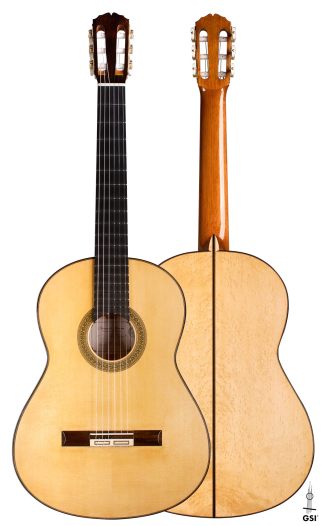
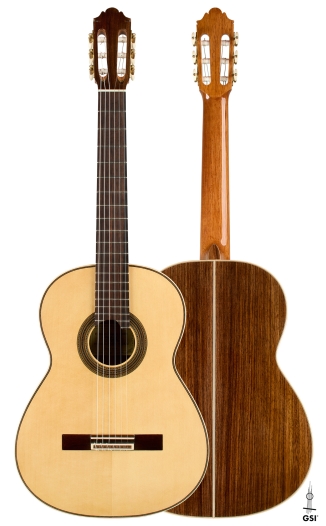
2013 Kathrin Hauser "Segovia" No. 21 SP/IN
| Year | 2013 |
| Top | Spruce |
| Back & Sides | Indian Rosewood |
| Scale Length | 645 mm |
| Nut width | 52 mm |
| Finish | Lacquer |
| Country | Germany |
| Luthier | Hermann Hauser III & Kathrin Hauser |
This guitar is no longer available in our inventory. If it interests you, click the ”notify me when available” button to be notified in the event that we re-acquire this guitar for re-sale.


Manuel Ponce's "Sonata III: II. Canción. Andante" played by Frank Wendelin on a 2013 Kathrin Hauser
Background
Kathrin Hauser: Fifth Generation of the Hauser Dynasty
Kathrin Hauser (b. 1982 – exactly 100 years after her great-grandfather Hermann Hauser I) is the daughter of Hermann Hauser III and granddaughter of Hermann Hauser II. She studied business administration and worked in business, building guitars in the workshop on weekends, before joining the family workshop in Reisbach, Bavaria, as a trainee in 2005 – taught by her father. She built her first guitar in 2006 and presented it in Tokyo, where Japan's largest guitar magazine published a major feature on her; in 2007 she passed her guitar-making exam, and since 2008 musicians around the world have ordered guitars under her own name. By the end of 2016 she had made 33 instruments of her own, besides helping her father with many of his.
Kathrin and her father work side by side in the same location as both Hermann Hauser I and II, using many of the same tools, and even woods that were acquired by their predecessors. The family's wood store, started by Hermann Hauser I, still holds woods more than 100 years old – and for every set taken out, two are bought to replenish it – while tools of Josef Hauser, Hermann I and Hermann II are still in daily use, among them a band saw from 1905. Her father, who like his father chose his trees in the forest himself, is teaching her to do the same, and the work follows the seasons: the wood is selected in autumn, the bodies are built in winter, and the guitars are finished in spring and summer. Her guitars carry the family label – "Hermann Hauser – Gitarren – Reisbach, früher München" – with her own signature and her own numbering; like her father, she attaches the label at the beginning of the build, so a guitar is often completed a year or more after the date it bears.
The Hauser "Segovia" Model
Kathrin works only in the traditional Hauser methods and designs, so she builds classical guitars only, each one made to order – clients can choose the woods and the sound they are looking for. Her standard is the Hauser "Segovia" model – the design of Segovia's 1937 Hauser I, one of the most iconic (and copied) styles since its inception, and so faithfully preserved by this workshop. Her guitars have all the classic Hauser qualities: great balance, evenness of sustain and supreme clarity – the "teutonic" sound most famously immortalized by Julian Bream and Andrés Segovia.
Books on the Hauser Family
Orfeo Magazine No. 4 is devoted to the Hauser dynasty, with a feature on Hermann Hauser III, Edmund Blöchinger and Fritz Ober – read the issue online or find it in the Orfeo 1-5 collection: