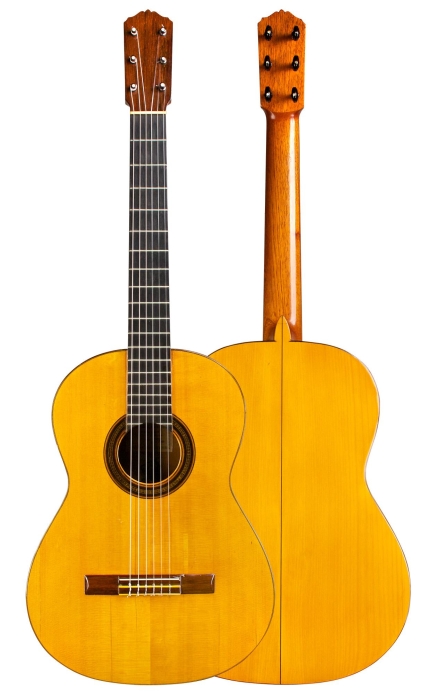
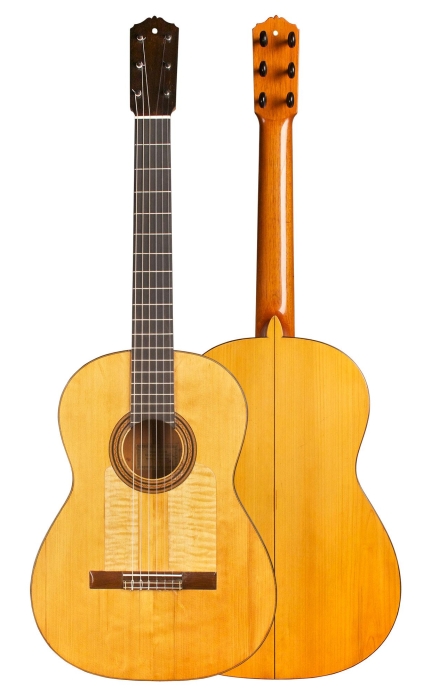
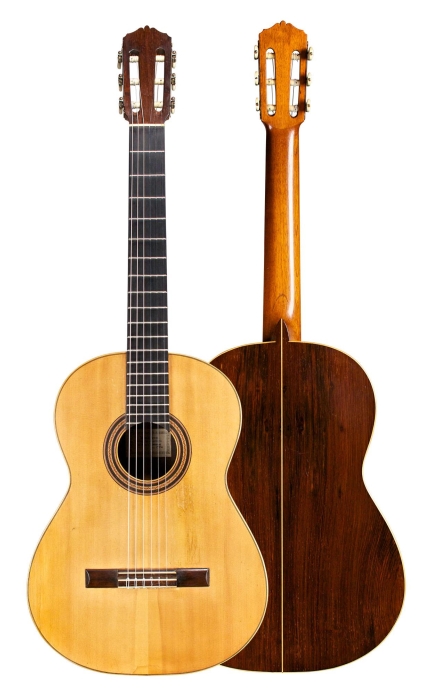
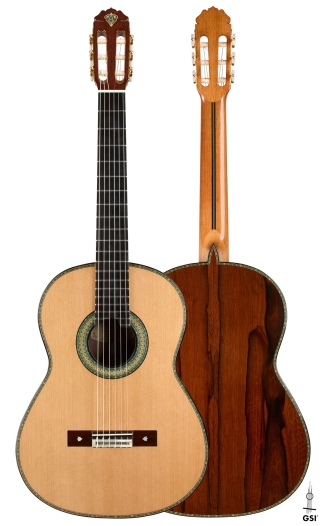
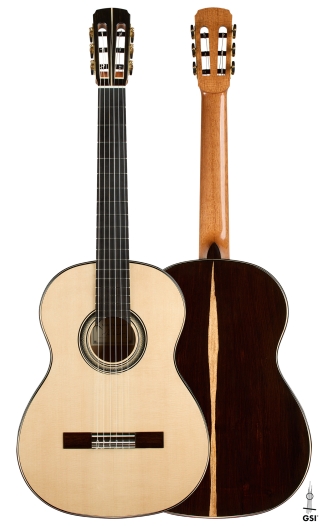
1925 Domingo Esteso SP/CSAR
| Year | 1925 |
| Top | Spruce |
| Back & Sides | CSA Rosewood |
| Scale Length | 650 mm |
| Nut width | 50 mm |
| Finish | French Polish |
| Country | Spain |
| Luthier | Domingo Esteso |
This guitar is no longer available in our inventory. If it interests you, click the ”notify me when available” button to be notified in the event that we re-acquire this guitar for re-sale.
Videos
Description
A 1925 classical guitar by Domingo Esteso, with a spruce top and CSA rosewood back and sides, made in Madrid for Romero y Fernández of Buenos Aires – a premium Esteso with a mother-of-pearl rosette, from the Russell Cleveland collection.
In the video above, Matthias Lang plays George Gershwin's Prelude No. 2 on this guitar.
A Premium Esteso for Argentina
It features a unique and intricate rosette inlaid with mother-of-pearl, along with busy inlay in the purfling around the top – the kinds of details Esteso reserved for his premium instruments. Its "Guitarras Iberia" label shows it was made for Romero y Fernández of Buenos Aires.
Sound and Condition
The volume is huge, and the warm, rich, played-in sound is magical from top to bottom – plump, lyrical and responsive to every nuance of the player's touch. Yuris Zeltins in San Diego repaired a couple of hairline cracks and refretted the guitar; otherwise it is in fine condition, with original thicknesses and finish throughout. A very charming example from one of the greatest luthiers of the early 20th century.
From the Russell Cleveland Collection
This guitar comes from the Russell Cleveland collection.
Background
Domingo Esteso: From the Manuel Ramírez Workshop to Gravina 7
Domingo Esteso (1882–1937) is one of the great names of the early Madrid school of guitar making. Born on May 12, 1882, in San Clemente, in the province of Cuenca, he learned his trade in the Madrid workshop of Manuel Ramírez, where he worked alongside Santos Hernández, Modesto Borreguero and Enrique García – the shop that carried the legacy of Antonio de Torres into the 20th century. After Ramírez died in 1916, Esteso went on building for his widow, already with his own name on the labels, and around 1919 he opened his own workshop at Calle Gravina 7, where his wife, Nicolasa Salamanca, varnished the guitars. His flamencos were played by the great names of the day, among them Ramón Montoya and Niño Ricardo, and his classical guitars are prized today for their elegance, clarity and natural, woody voice.


Guitars for Buenos Aires and the Birth of the Conde Dynasty
Many of Esteso's finest guitars were made for Argentina, then one of the richest countries in the world, under a special label for Romero y Fernández of Buenos Aires, his sole agents there – some of them branded "Guitarras Iberia". In 1926 his nephew Faustino Conde joined the workshop, followed by his brothers Mariano and Julio. After Esteso's death in Madrid in 1937, in the middle of the Spanish Civil War, they carried on at Gravina 7 as "Viuda y Sobrinos de Esteso" and later as Conde Hermanos – the start of a family tradition continued today by Felipe Conde and his son, Felipe Conde Crespo.