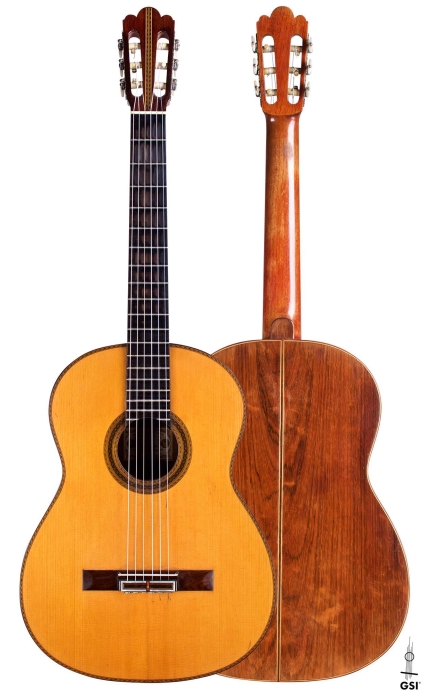
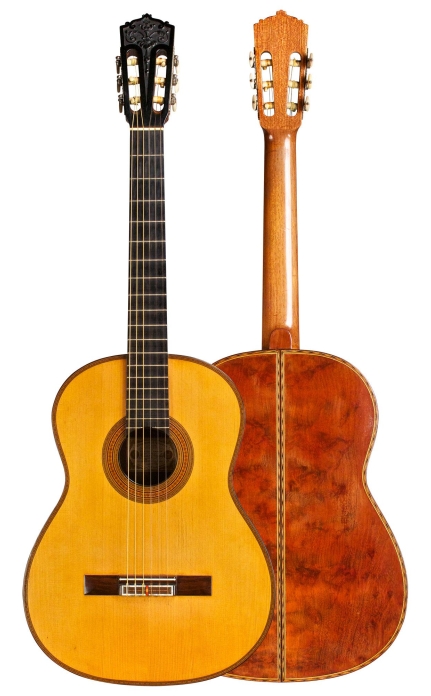
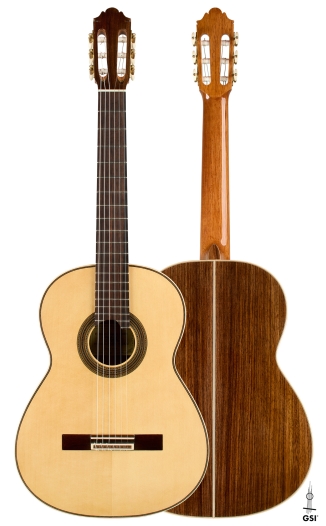
1929 Francisco Simplicio No. 240 SP/SW
| Year | 1929 |
| Top | Spruce |
| Back & Sides | Satinwood |
| Scale Length | 648 mm |
| Nut width | 49 mm |
| Finish | French Polish |
| Country | Spain |
| Luthier | Francisco Simplicio |
This guitar is no longer available in our inventory. If it interests you, click the ”notify me when available” button to be notified in the event that we re-acquire this guitar for re-sale.


"We Three Kings" by John H. Hopkins Jr. played by George Sakellariou on a 1929 Francisco Simplicio

Mela Guitar Quartet plays Claude Debussy's "Arabesque No. 1" on four rare guitars from the old world
Description

This 1929 Francisco Simplicio is a spruce and figured satinwood classical guitar from Barcelona, No. 240 – formerly in the Sheldon Urlik collection and featured in his book.
In the videos above, George Sakellariou plays "We Three Kings" on this guitar, and the Mela Guitar Quartet plays Debussy's "Arabesque No. 1" on four rare guitars from the old world, including this one.
Highly Figured Satinwood, No. 240
In addition to the beautiful and ornate carving and inlay work, the materials are striking – most notably it is built from a set of gorgeous and rarely used highly figured satinwood for the back and sides. The engraved headstock and ornate rosette show this maker at his best.
From the Sheldon Urlik Collection
This guitar was formerly housed in the Sheldon Urlik collection and featured on pages 84-85 of the 2nd edition of his book. A second label inside the guitar, from Celestino Fernández & Hno. in Buenos Aires, suggests that an old repair to the top center seam was done there. The guitar was recently revisited by Jeff Elliott, who re-enforced it and also did some other minor gluing internally of purfling and binding joints. It is now concert-ready and in otherwise original condition – including finish and tuning machines.
Sound
The sound of this Simplicio is particularly magnificent – great depth to every note up the entire register with a firm bottom-end and lyrical trebles. It also has plenty of power, even by modern standards today. Overall, a highly desirable example from this famous builder.
Orfeo article on Simplicio – the French guitar magazine Orfeo devoted a feature to Francisco and Miguel Simplicio in its first issue.