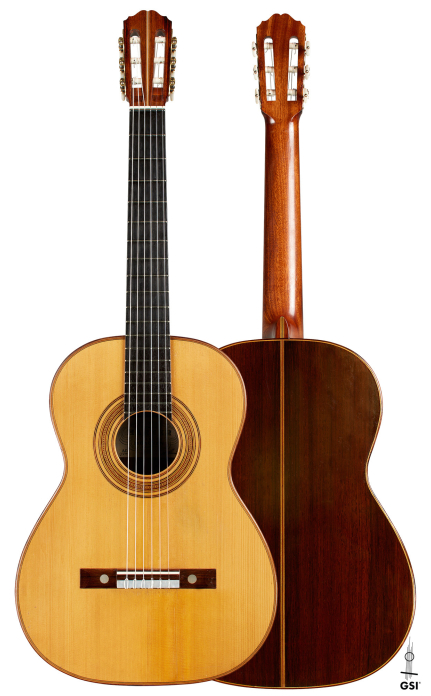
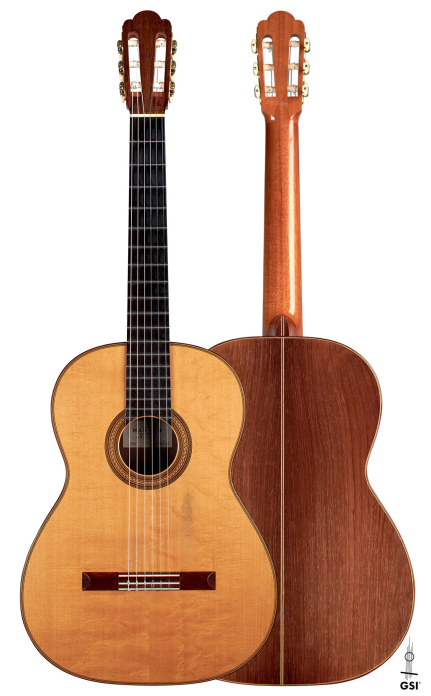
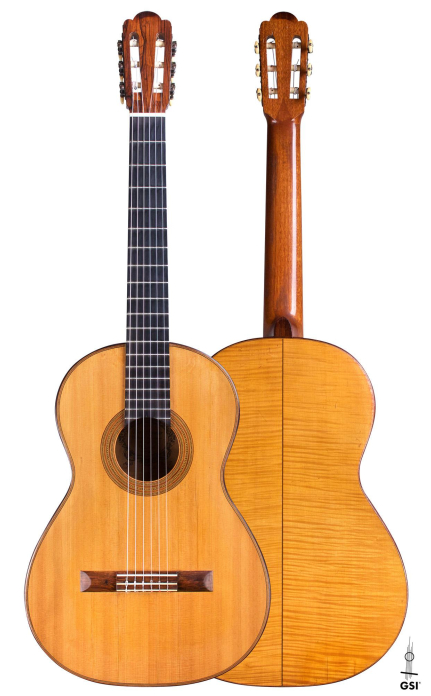
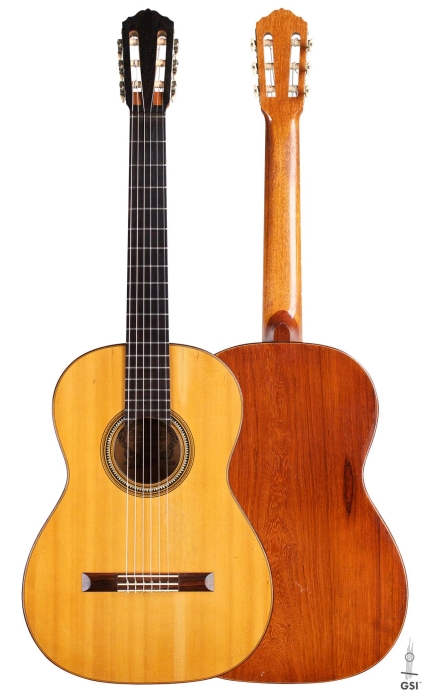
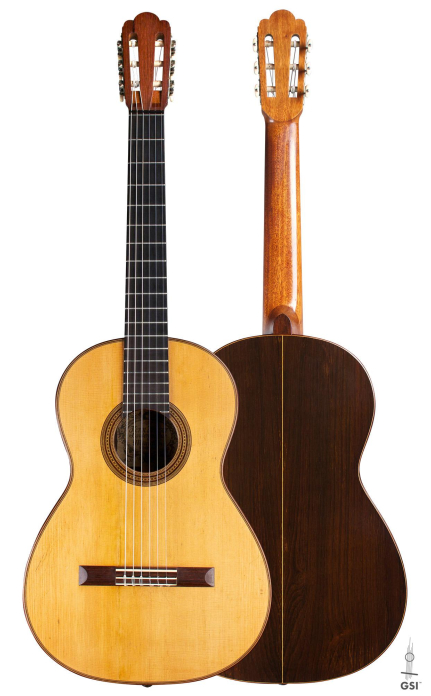
This 1951 Hermann Hauser I classical guitar in spruce and CSA rosewood belonged to one family from the day it was made: jazz and session guitarist John DeRose bought it new in 1951 and recorded the Oscar-winning soundtrack of "The Godfather Part II" on it.
One of Hauser I's Last Guitars
Built one year before Hermann Hauser I's passing in 1952, this instrument contains all of the most refined qualities of the great style that Hauser pioneered over the course of his long, colorful and productive career. But before we wax poetic about its musical qualities, a brief description of its history is in order. This is one of the most exciting Hauser guitars we've had here in a very long time, and it has a very special story.
John DeRose, Segovia and the Letters from Hauser
It has been in the possession of a single family since it was made, so this is the first time it has entered the market since it was bought by its first owner, the great jazz and session guitarist John DeRose, in 1951. John was a very eclectic professional musician: he accompanied Sammy Davis Jr. in his band for many years, played in the "Tonight Show" band during the "New York" Johnny Carson era (when Skitch Henderson was music director), and between New York and Los Angeles did much session work for TV and film. John was also a very established classical player and regularly played recitals with this guitar, performing pieces from the standard repertoire by Antonio Lauro, Fernando Sor, Francisco Tárrega, etc. (we also have some audio recordings of John playing these pieces on this Hauser). He had been a student of Andrés Segovia, who introduced John to Hauser I, which ultimately led to John acquiring this instrument. With it we have copies of many letters from Hauser I to John, updating him on the progress of the build – fascinating documents with several small, interesting anecdotes and the occasional photograph of Hauser at work.
The Hauser on "The Godfather Part II"
A major highlight in this guitar's history came when John was hired to be the session guitarist for the Academy Award-winning soundtrack of "The Godfather Part II", composed by Nino Rota – and this Hauser was the instrument featured on that very recording! Of note, the guitarist for "The Godfather" Part I was Laurindo Almeida, and for Part III, Tommy Tedesco. After John's passing in 1975, the guitar remained with the family until it came to us.
Sound: a Warm, Played-In Hauser I
Now a word about the sound – as would be expected, it has an absolutely beautiful tone, quite complex and extremely expressive. Since this was John's primary classical guitar, used extensively throughout his career both in recitals and in the studio, it has a warm, played-in sound that is simply sublime. At the same time, it possesses the famous Hauser "piano-like" clarity, with precise balance and a strong fundamental with very controlled overtones. Simply a marvel to hear and play.
Original Condition, Conservatively Restored by German Vázquez Rubio
When the guitar arrived to us, it was in very "used" but completely original condition – including the original nut and saddle, finish and Landstorfer tuning machines, which are still in excellent working condition. But it did have wear throughout and some unrepaired cracks that needed tending to, and the original frets were worn down to the fingerboard. We had the guitar attended to by German Vázquez Rubio, who took the most conservative approach to do the lightest of repairs to the finish and cracks, and a re-fret, so as to preserve the original condition as much as possible. So although it still "looks" worn, this is absolutely part of its history, and it is now in perfect working order, ready for many more years of playing and enjoyment. A standout instrument for every reason – perfectly preserved and very original, majestic in its sound and playability, with an amazing history. A real treasure.