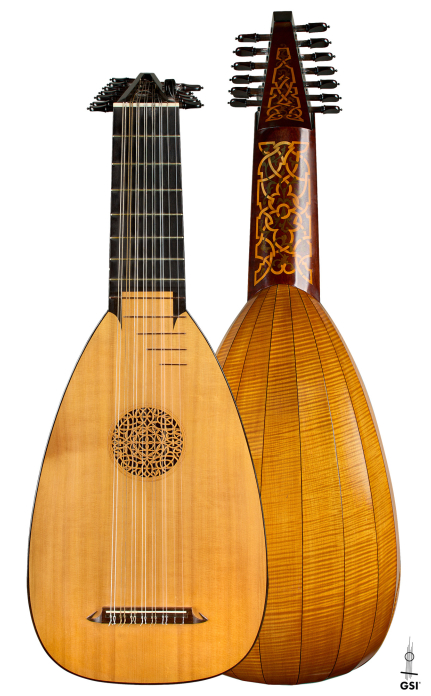
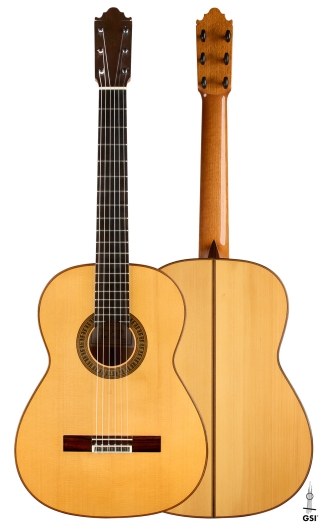
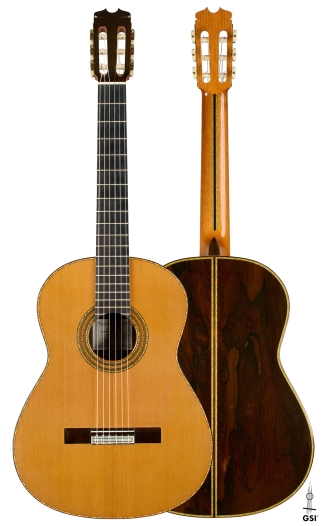
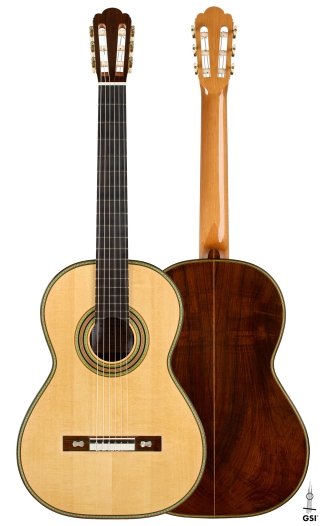
1966 "Jose" David Rubio 9-course Lute SP/MP
| Year | 1966 |
| Top | Spruce |
| Back & Sides | Maple |
| Scale Length | 644 mm |
| Nut width | 86 mm |
| Finish | French Polish |
| Country | USA |
| Luthier | David Rubio |
This guitar is no longer available in our inventory. If it interests you, click the ”notify me when available” button to be notified in the event that we re-acquire this guitar for re-sale.
Description
A 1966 9-course lute by David Rubio, with a spruce soundboard and a 9-stave maple back, made in New York – from the years when Julian Bream played Rubio's guitars and, from 1967, a Rubio lute.
A Rubio Lute from the New York Years
Rubio was a master craftsman of Baroque and Renaissance period instruments as well as guitars, and this lute shows his creative and elegant craftsmanship: an ornately carved bridge and soundhole rose, a 9-stave maple back, an inlaid neck and head, and inlaid frets. The first two courses (and the optional 9th) are single.

Music as Written
It would be a great instrument for the guitarist seeking a more authentic sound in lute music from the Renaissance into the Baroque – with the additional courses, this music can be played as written, with no arranging. There are no known repairs or cracks, only normal playing wear, and it comes with its original custom-fitted case. Rubio lutes appear on the market very rarely.


Background
David Rubio: From Flamenco Guitarist to Master Instrument Maker
David Rubio (1934–2000) is arguably the most important guitar maker to emerge from England, and the founding father of the English school. Born David Spink and raised in London, he studied medicine at Trinity College Dublin, then left for Spain, where he earned his living as a flamenco guitarist accompanying singers and dancers – and picked up the nickname "Rubio" for his red beard. A touring flamenco company brought him to New York, where, from what he had seen in the guitar shops of Spain, he taught himself to build guitars under the name "Jose" Rubio. Within a few years Julian Bream was playing his instruments.
Guitars, Lutes, Harpsichords and Violins
Rubio returned to England in 1967 and, from workshops near Oxford and, from 1979, in Cambridge, built a remarkably wide range of instruments: guitars and lutes, harpsichords, baroque and modern violins, violas and cellos. In the late 1960s and 1970s he trained three young makers in his methods – Kazuo Sato, Edward B. Jones and Paul Fischer – who built guitars of his design marked with their initials. Late in his life he developed a radical 8-string guitar, the "Brahms" model, with Paul Galbraith. He died in Cambridge on October 21, 2000, leaving more than a thousand instruments.