Guitar Salon International
+1 (310) 586.1100 | +1 (877) 771.4321
Museum
Classical Guitars
Classical Guitars
Flamenco Guitars
Flamenco Guitars
Cleveland Collection
Luthiers
Luthiers
Your Cart

Your shopping cart is empty!

Sub-Total: $0.00
Total: $0.00
Edit cart
Checkout
Museum

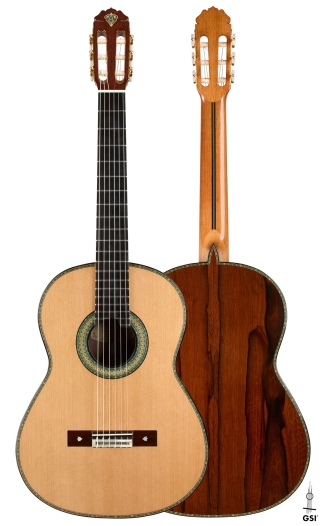
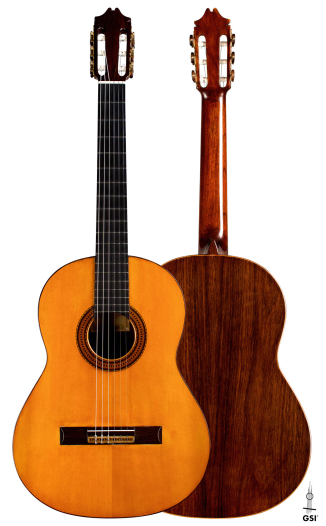
1970 Hermann Hauser II No. 867 CD/CSAR (ex Celedonio Romero)

Year 1970
Top Cedar
Back & Sides CSA Rosewood
Scale Length 650 mm
Nut width 52 mm
Finish French Polish Top
Country Germany
Luthier Hermann Hauser II

This guitar is no longer available in our inventory. If it interests you, click the ”notify me when available” button to be notified in the event that we re-acquire this guitar for re-sale.

Inquire
See more from Hermann Hauser II

Videos

1970 Hermann Hauser II No. 867 CD/CSAR (ex Celedonio Romero)

Legendary Guitars: 1970 Hermann Hauser II, ex Celedonio Romero

1970 Hermann Hauser II No. 867 CD/CSAR (ex Celedonio Romero)

Leo Brouwer's "El Decaméron Negro: Mov. 3" played by Laura Mazon Franqui on a 1970 Hermann Hauser II

Description
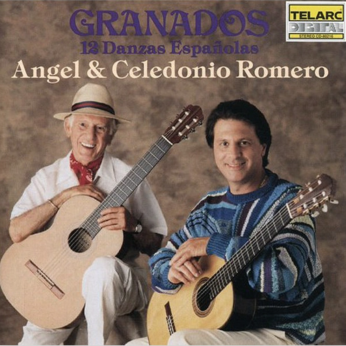
Celedonio and Angel Romero - Granados Album

This 1970 Hermann Hauser II No. 867 is a cedar and CSA rosewood classical guitar built for Celedonio Romero – one of his favorite guitars for 25 years of recordings and concerts, later inherited by his son Angel Romero.

"Gebaut für Celedonio Romero"

This instrument was built by Hermann Hauser II for Celedonio Romero in 1970 – a second label above the No. 867 label reads "gebaut für Celedonio Romero", signed by the maker – and for the next two and a half decades it was used regularly by Celedonio as one of his favorite instruments for recordings and live performances. Indeed the guitar was recorded (and photographed for the album cover) on one of Celedonio's last albums – duos with his son Angel of the Enrique Granados "Spanish Dances" – as well as in a private concert at the Vatican in Rome for Pope John Paul II (see photos in gallery). Upon Celedonio's passing in 1996, the guitar was inherited by his youngest son and protégé Angel Romero.

Cedar Top and a Split "V-Shaped" Harmonic Bar

It is made with cedar for the top – a wood that Hauser II was very comfortable with – and this guitar features a unique bracing pattern under the top with a split "V-shaped" lower harmonic bar, which opens up more of the soundboard to the vibration emanating from the bridge area, much like the 1969 Hauser II No. 852 made for another member of the Romero family – Pepe Romero. The sound is lush yet firm and bold, a beautiful blend of the Hauser "teutonic" style (clear, balanced, strong fundamental) with a bit of "Spanish" character (controlled but rich overtone content, loose/romantic quality of sound), which made it one of the prized "trophies" in Celedonio's collection.

Condition

Condition is excellent – no damage or repairs, only some expected playing wear in the finish from decades of professional use by one of the twentieth century's greatest virtuosos. This is an exceptional guitar in every regard – provenance, history, condition, beauty and quality of materials, playability, tonal character – simply put, it has it all.

Background

Hermann Hauser II: Third Generation of the Hauser Dynasty

Hermann Hauser II (1911–1988) – Hermann Hauser Jr. – is considered to be one of the greatest makers of the twentieth century. Grandson of the luthier Josef Hauser and son of Hermann Hauser I, he learned his craft working alongside his father, and after his father's death in 1952 he carried the family's Torres-based "teutonic" style into the second half of the century from the Hauser workshop in Reisbach, Bavaria. His son Hermann Hauser III (the fourth generation) and granddaughter Kathrin (the fifth) still work there today – see Hermann Hauser III & Kathrin Hauser – with many of the same tools and even woods stocked by the earlier generations.

The Hauser dynasty, now spanning five generations, has produced instruments played by countless concert artists including Andrés Segovia, Julian Bream, the Romeros and many others.

The Hauser II Sound

The sound has the attributes of a great Hauser that have attracted great players from Bream to Segovia to the Romeros and beyond – crystal-clear fundamental tones with almost perfect separation, basses that are steady and precise, and at the same time a lyrical charm and sweetness, particularly in the trebles. At its best, a Hauser II is like a loud and balanced piano, with the warmth of a great Hauser I. Playability is easy, thanks to his slender and very comfortable neck shape.

Books on Hermann Hauser II

Orfeo Magazine No. 4 is devoted to the Hauser dynasty, and a 1960 Hauser II is among the guitars shown in Orfeo's "34 Classical Guitars in Life Size":

Guitars by Hermann Hauser II