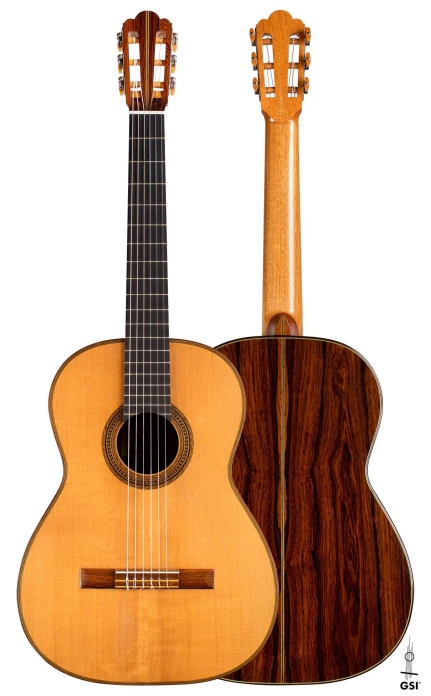
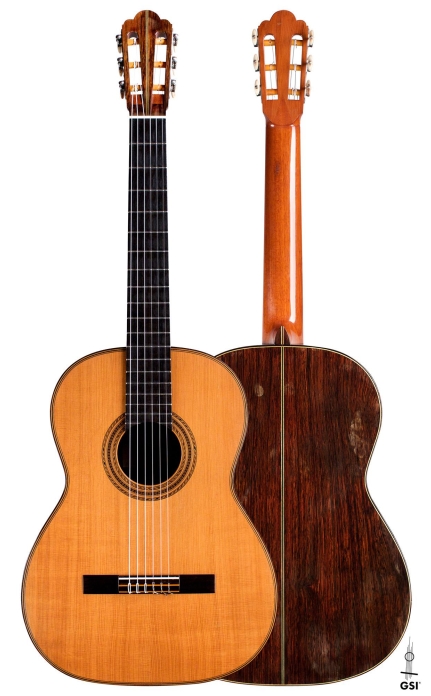
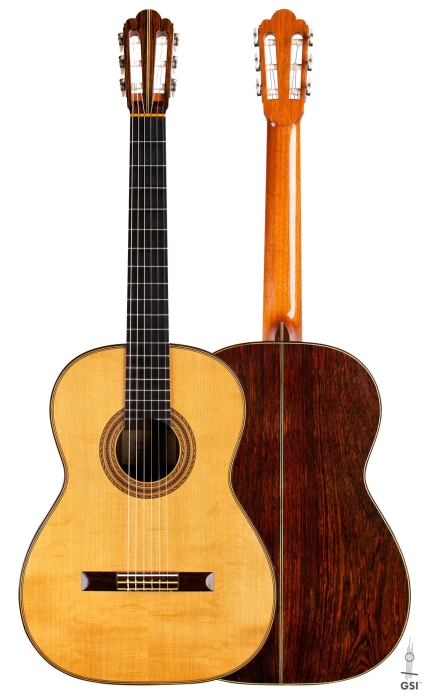
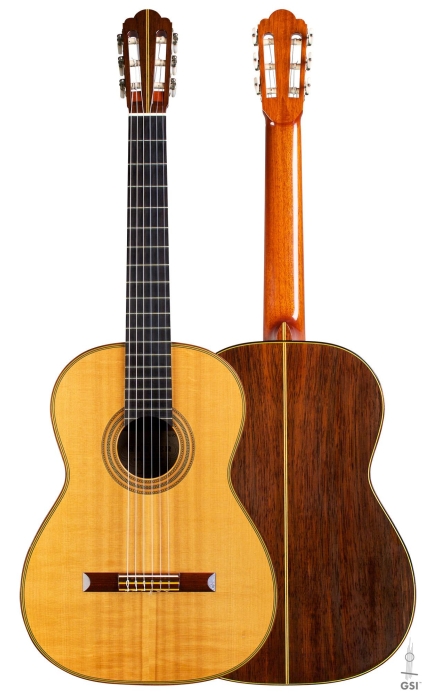
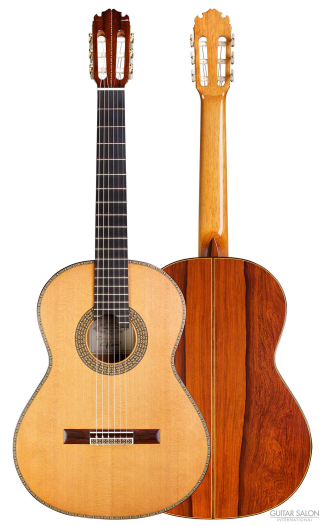
1971 Hermann Hauser II "Llobet" No. 886 SP/CSAR
| Year | 1971 |
| Top | Spruce |
| Back & Sides | CSA Rosewood |
| Scale Length | 645 mm |
| Nut width | 51 mm |
| Finish | Lacquer |
| Country | Germany |
| Luthier | Hermann Hauser II |
This guitar is no longer available in our inventory. If it interests you, click the ”notify me when available” button to be notified in the event that we re-acquire this guitar for re-sale.


Description
This 1971 Hermann Hauser II "Llobet" No. 886 is a spruce and CSA rosewood classical guitar from Reisbach, after Miguel Llobet's 1859 Torres – from the Russell Cleveland collection and shown in the Cleveland book "The Classical Guitar – A Complete History".
A "Llobet" Model from 1971
This is an elegant and beautifully preserved instrument, based on the style of instrument preferred by the great Catalan guitarist Miguel Llobet (1878–1938) – primarily his 1859 Torres, the model for several Hauser I and II instruments. It is not a strict copy: it shows features more commonly associated with Hauser designs, including the famous "V joint" at the back of the head and a curved lower harmonic bar inside. The rosette borrows heavily in its design from Manuel Ramírez and Santos Hernández.
Sound
Soundwise, however, this is pure Hauser – supreme clarity and piano-like balance across all registers. Although it is slightly more compact in body proportions, it has plenty of sound – enough to fill any concert hall. Overall an impressive and charming instrument, even by Hauser standards.
In "The Classical Guitar – A Complete History"
From the Russell Cleveland collection, this guitar is featured on pages 60–61 of the book "The Classical Guitar – A Complete History".

Background
Hermann Hauser II: Third Generation of the Hauser Dynasty
Hermann Hauser II (1911–1988) – Hermann Hauser Jr. – is considered to be one of the greatest makers of the twentieth century. Grandson of the luthier Josef Hauser and son of Hermann Hauser I, he learned his craft working alongside his father, and after his father's death in 1952 he carried the family's Torres-based "teutonic" style into the second half of the century from the Hauser workshop in Reisbach, Bavaria. His son Hermann Hauser III (the fourth generation) and granddaughter Kathrin (the fifth) still work there today – see Hermann Hauser III & Kathrin Hauser – with many of the same tools and even woods stocked by the earlier generations.
The Hauser dynasty, now spanning five generations, has produced instruments played by countless concert artists including Andrés Segovia, Julian Bream, the Romeros and many others.
The Hauser II Sound
The sound has the attributes of a great Hauser that have attracted great players from Bream to Segovia to the Romeros and beyond – crystal-clear fundamental tones with almost perfect separation, basses that are steady and precise, and at the same time a lyrical charm and sweetness, particularly in the trebles. At its best, a Hauser II is like a loud and balanced piano, with the warmth of a great Hauser I. Playability is easy, thanks to his slender and very comfortable neck shape.
Books on Hermann Hauser II
Orfeo Magazine No. 4 is devoted to the Hauser dynasty, and a 1960 Hauser II is among the guitars shown in Orfeo's "34 Classical Guitars in Life Size":