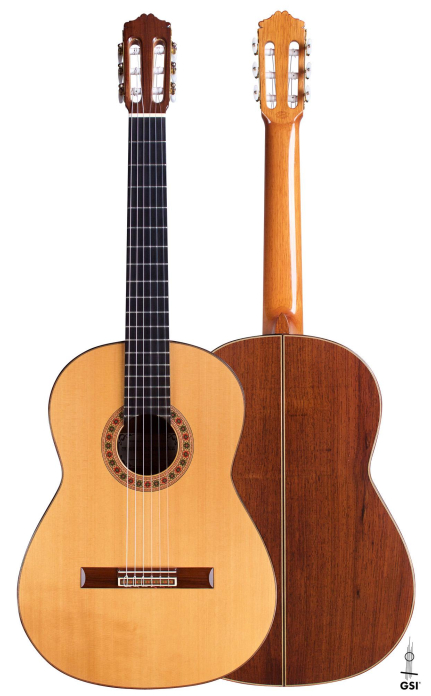
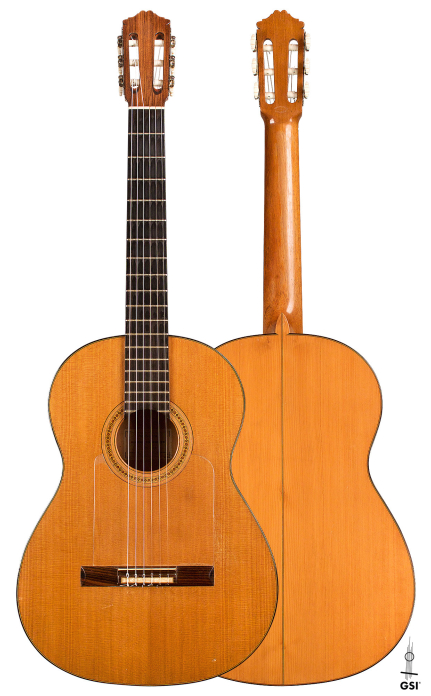
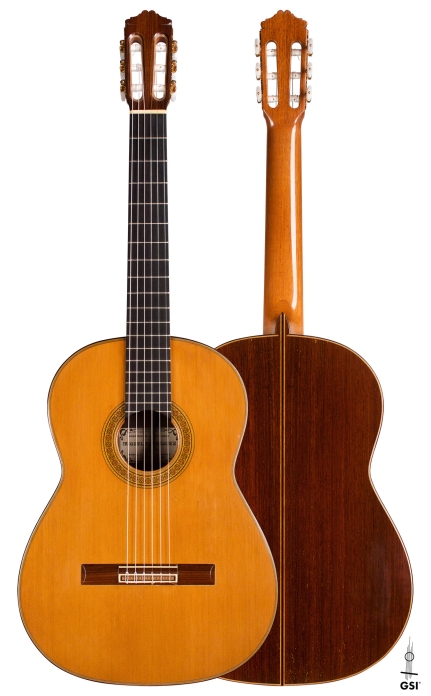
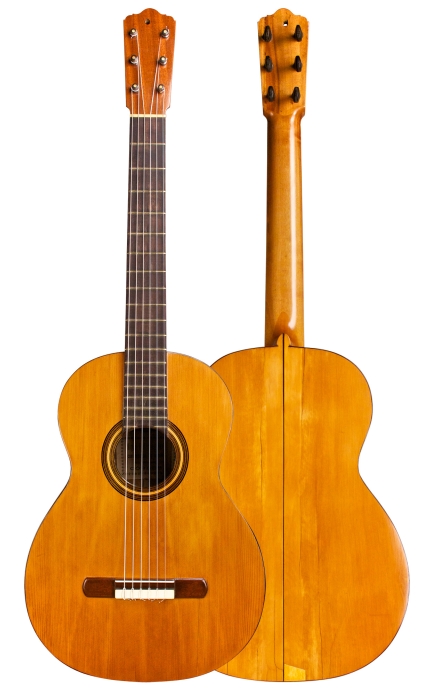
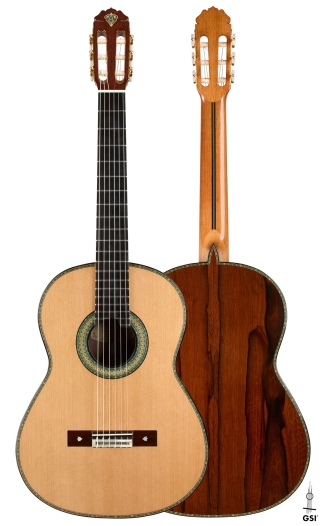
1975 Miguel Rodríguez "Churchdoor 7-String" CD/CSAR (ex Angel Romero)
| Year | 1975 |
| Top | Cedar |
| Back & Sides | CSA Rosewood |
| Scale Length | 664 mm |
| Nut width | 62 mm |
| Finish | French Polish |
| Country | Spain |
| Luthier | Miguel Rodríguez |
This guitar is no longer available in our inventory. If it interests you, click the ”notify me when available” button to be notified in the event that we re-acquire this guitar for re-sale.


Background
The Rodríguez Family of Córdoba
The classical and flamenco guitars of Miguel Rodríguez have been the favorite pick of many leading concert artists, most notably all members of the Romero family. In actuality, when speaking of Miguel Rodríguez, one is really making reference to a family of four guitar builders spanning three generations, all working in Córdoba – deep in Andalucía, the region of southern Spain that gave birth to the modern Spanish guitar in the person of Antonio de Torres. The early labels give the address San Fernando 70; in 1939 the family moved to Calle Alfaros 15, the address printed on every Rodríguez label from then on.
Four Makers, Three Generations
The workshop was founded by Miguel Beneyto Rodríguez (1888–1975, also known as “Miguel Sr.”). His twin sons, Rafael Rodríguez Serrano (1921–1965) and Miguel Rodríguez Serrano (1921–1998, also known as “Miguel Jr.”), worked alongside him, followed by Miguel Jr.’s son, José Rodríguez Álamo (1949–1996, also known as “Pepe”). The guitars of Miguel Sr. were lightly built and small-to-medium-bodied, with a very expressive, lyrical and singing quality to the sound and overwhelming projection. As the twins rose to prominence in the 1950s and 1960s, the guitars evolved into a more consistent, streamlined style with larger bodies, still quite lightweight. The later period of Miguel Jr. and Pepe (1970s–1998) – the time of the “Churchdoor” and the decorated “Centenario” guitars – is perhaps the best known, with longer scales, deeper bodies and an even lighter bracing system, yet always with a fast, flamenco-like response and a warm, romantic and soulful Spanish character. After the deaths and illnesses in the family in the mid-1990s, the workshop closed in 1998.
Who Built It? Reading the Rodríguez Stamp
All four makers used the same printed label, so the family marked each guitar with the position of a small, peanut-shaped “M. Rodríguez · Córdoba” stamp in purple ink – often half on the label and half on the wood, and sometimes faded: no stamp – Miguel Sr.; a stamp in the upper right corner of the label – Rafael; in the lower right corner – Miguel Jr.; midway down the right edge – Pepe. From the mid-1970s the labels were also signed “Miguel Rodríguez” across the right side. The “Centenario” model, with extra inlay in the rosette and purfling, was created to celebrate the 100th anniversary of Miguel Sr.’s birth (1888–1988), and its labels are marked “Centenario” – from 1992 “Centenario 1888–1988”.
Miguel Rodríguez Guitars and the Romero Family
All members of the Romero family have performed on these instruments since the late 1950s, and their own artistic development and expression are immutably linked to them – a lifelong relationship that wrote one of the great chapters in the history of the guitar. As Pepe Romero has told us, “What the jet engine did for aviation, the Rodríguez family did for the guitar.” You can read more in our article on the Rodríguez family of guitar makers.
Books on Miguel Rodríguez
Two Rodríguez guitars – a 1936 Miguel Rodríguez Beneyto and Pepe Romero’s 1973 “La Wonderful” – are reproduced in Alberto Martínez’s book “34 Classical Guitars in Life Size”, with photographs and full-size drawings of each instrument: