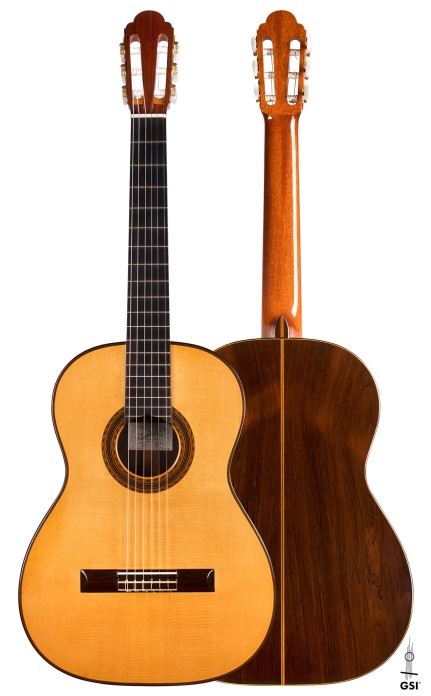
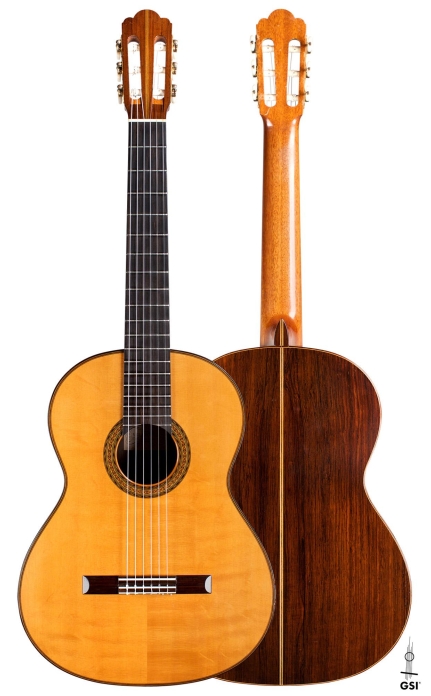
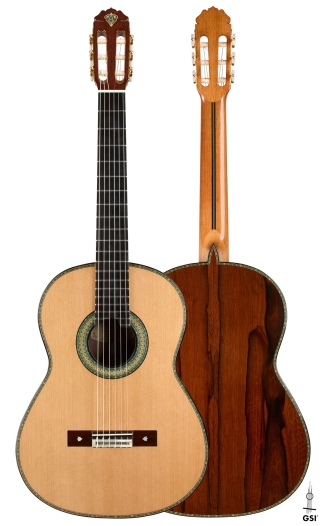
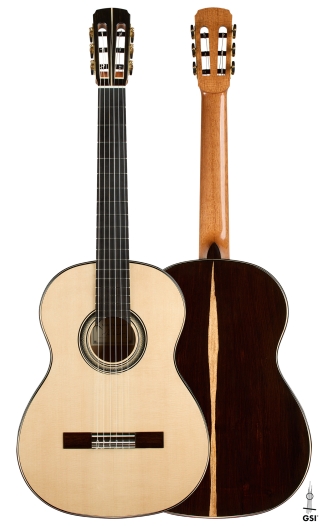
1987 Manuel Velázquez SP/CSAR
| Year | 1987 |
| Top | Spruce |
| Back & Sides | CSA Rosewood |
| Scale Length | 650 mm |
| Nut width | 52 mm |
| Finish | French Polish |
| Country | USA |
| Luthier | Manuel Velázquez |
This guitar is no longer available in our inventory. If it interests you, click the ”notify me when available” button to be notified in the event that we re-acquire this guitar for re-sale.


Dyens Tango En Skai - Tavi Jinariu plays 1987 Manuel Velazquez

Gioacchino Rossini's "The Barber of Seville: Overture" played by Dulcet Guitar Duo on M. Velazquez
Background
Manuel Velázquez: An American Master in the Spanish Tradition
Manuel Velázquez (1917–2014) was born in Puerto Rico and made his name in New York, where his workshop at 420 Third Avenue became a meeting place for leading guitarists. He was perhaps the greatest American luthier to build in the European tradition, and his guitars yield nothing in craftsmanship or sound to those of his Spanish and German contemporaries. Over a career of nearly eight decades – in New York, Puerto Rico, Virginia and Florida – his instruments were played by Andrés Segovia, Julian Bream, Pepe Romero, Rey de la Torre and Sabicas, and by musicians far beyond the classical world, from Earl Klugh to Paul Simon and Keith Richards.
The Velázquez Sound
Velázquez guitars are most often compared to those of Hermann Hauser I and Hermann Hauser II – not only in appearance but in the style of sound: great clarity and separation between voices, perfect balance, sparkling trebles over steady basses and a natural, beautiful “woody” quality of tone. Most of his guitars follow this compact, Hauser-like model; in the 1970s and early 1980s he also built a larger, more rounded body with a deeper box and an even bigger sound. His son Alfredo Velázquez, who learned the craft in his father’s workshop, continues the tradition.
Books on Manuel Velázquez
A 1978 Velázquez – a guitar that later passed through our hands – is reproduced in Alberto Martínez’s book “34 Classical Guitars in Life Size”, and a 1955 Velázquez from the Russell Cleveland collection appears in “The Classical Guitar – A Complete History”: