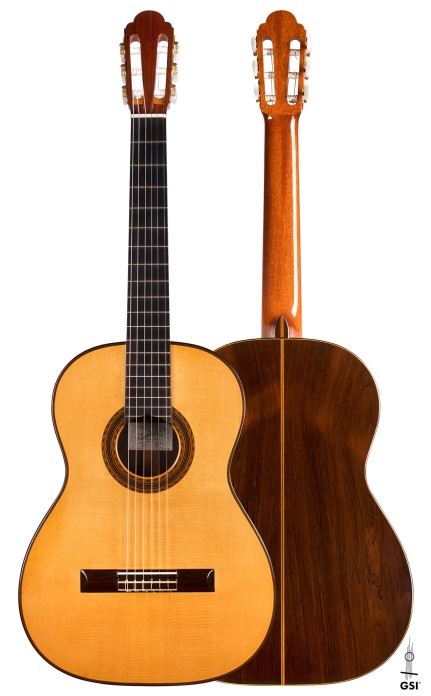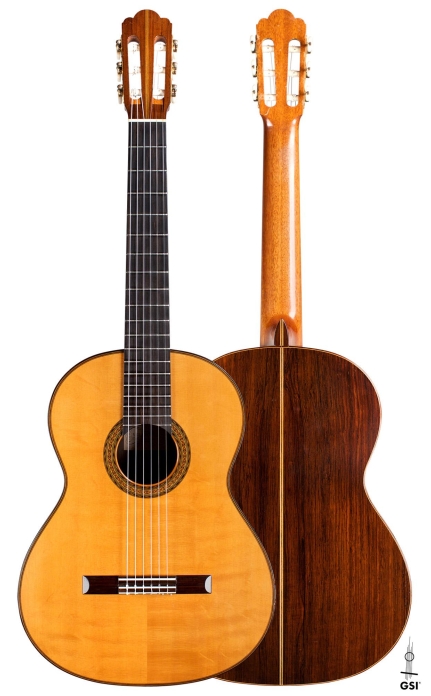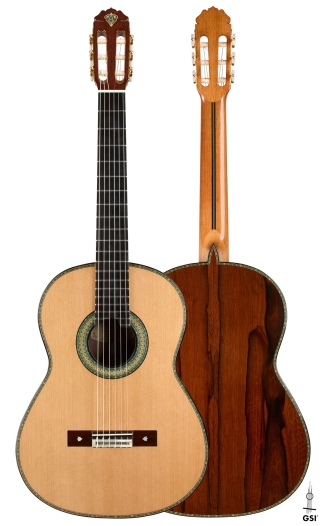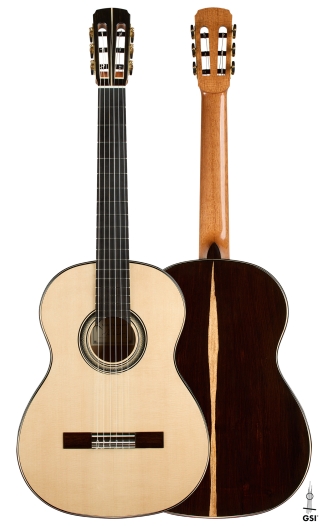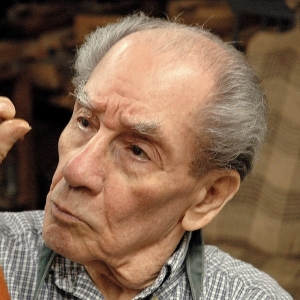
Manuel Velázquez (1917–2014) was a Puerto Rican-born classical guitar maker who made his name in New York and is widely regarded as the greatest American luthier in the European tradition – a builder whose Hauser-inspired guitars were played by Andrés Segovia, Julian Bream and Pepe Romero.
Manuel Velázquez at a Glance
- Born: February 20, 1917, Puerto Rico
- Died: April 4, 2014, at his family home in Central Florida, aged 97
- Workshops: New York (420 Third Avenue), Puerto Rico (Ponce 1972–1982), Virginia (1982–1992) and Central Florida (from 1992)
- Learned from: his older brother Ofelio, a cabinetmaker, and his father, who taught him about woods; first guitar around 1929, aged 12
- Honors: Guitar Foundation of America Industry Leadership Award (1996), Florida Folk Heritage Award (2004)
- Style: compact, Hauser-like guitars in the tradition of Hermann Hauser I and Hermann Hauser II
- Played by: Andrés Segovia, Julian Bream, Pepe Romero, Rey de la Torre, Sabicas, Jorge Morel, Chet Atkins, Paul Simon, Keith Richards
- Son: Alfredo Velázquez (b. 1970), who learned the craft in his father’s workshop
From Puerto Rico to New York
Manuel Velázquez was born in Puerto Rico on February 20, 1917, one of thirteen children. His father, a farmer, had a deep knowledge of wood, his older brother Ofelio was a cabinetmaker who also experimented with instrument making, and the family's woodworking tradition went back to his maternal grandfather, Justo Hernández, who had come from Spain. Manuel built his first guitar around 1929, at the age of twelve, and after Ofelio's early death he took up guitar making partly as a tribute to his brother. The Colombian musician and conductor Jorge Rubiano, then living in Puerto Rico, encouraged him to become a professional maker and showed him important Spanish guitars by Torres and Santos Hernández – and hearing Andrés Segovia play his 1937 Hauser left a lasting mark on his ideal of sound.
Around 1941 he moved to New York, where he worked as a cabinetmaker and in a wartime shipyard before establishing his guitar workshop at 420 Third Avenue in Manhattan, which became a meeting place for some of the leading guitarists of the day; in the late 1960s he also built and repaired guitars at Noah Wulfe's shop on 57th Street.
Puerto Rico, Virginia and Florida
In 1962 Velázquez returned to Puerto Rico to expand his production with government support, and for some years he moved between New York and Puerto Rico. From 1972 the family lived in Ponce, from 1982 in Virginia, near Arlington, and in 1992 they settled in Central Florida, where Manuel later worked side by side with his son Alfredo and kept building into his nineties. He died at his family home in Central Florida on April 4, 2014, at the age of 97.
The Hauser Tradition in America
Velázquez guitars are most often compared to those of Hermann Hauser I and Hermann Hauser II, and the comparison holds both for their appearance and for their sound: great clarity and separation between voices, perfect balance, sparkling trebles over steady basses and a natural, “woody” quality of tone. His early guitars of the 1950s are astonishingly close to the Hausers of the same years. In the 1970s and early 1980s he also built a larger, more rounded and deeper body with an even bigger sound, before returning to the compact, Hauser-style model that for many players defines the Velázquez guitar. He built mostly spruce-top classical guitars, but also some cedar tops, a few flamenco guitars and “Torres” models, one of them dedicated by hand to Antonio de Torres, “the father of the modern guitar”.
Velázquez Labels
His earliest labels read “Manuel Velázquez, Constructor de Guitarras, New York”, with the year and his signature. From the mid-1950s he used the scroll label that stayed with him for the rest of his career – “Manuel Velázquez, Constructor de Guitarras, New York” – dated by hand and signed across the center, long after he had left New York. On guitars of the 1950s and early 1960s he also wrote a number in the corner of the label (for example No. 151, 157 and 163 in 1955, No. 3 in 1957, No. 20 in 1960), and on some guitars of the late 1960s the words “New York” are blacked out by hand. When he restored one of his own guitars decades later, he added a second, dated label.
Played by Great Guitarists
Andrés Segovia sought out his guitars, and his instruments were played by Julian Bream, Pepe Romero, Rey de la Torre, Jorge Morel, Ichiro Suzuki and the flamenco master Sabicas – and by musicians far beyond the classical world, including Chet Atkins, Earl Klugh, Harry Belafonte, Paul Simon and Keith Richards, who bought a 1956 Velázquez. He received the Guitar Foundation of America's Industry Leadership Award in 1996 and a Florida Folk Heritage Award in 2004.
Alfredo Velázquez
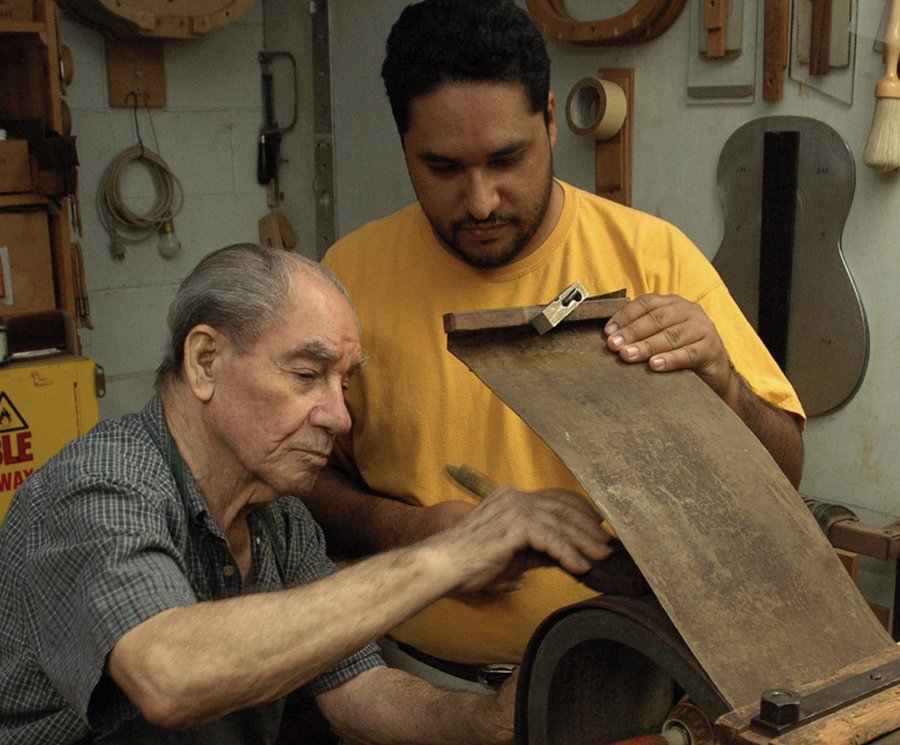
His son Alfredo Velázquez, born in Manhattan on October 23, 1970, built his first guitar in 1991 and learned the craft from his father, carrying forward his construction principles – above all the influence of Torres, Santos Hernández and Hermann Hauser I. Father and son worked together in their Florida studio, and Alfredo's labels follow his father's scroll design.
Books on Manuel Velázquez
A 1978 Velázquez is reproduced in Alberto Martínez’s book “34 Classical Guitars in Life Size”, and a 1955 Velázquez from the Russell Cleveland collection appears in “The Classical Guitar – A Complete History”:


Manuel Velázquez Guitars at GSI
We have always been big fans of Velázquez’s guitars – he was one of the best champions of the traditional style of guitar making in the United States – and many of his guitars have passed through our doors over the years. You’ll find guitars currently in stock by clicking the “Guitars In Stock” button in the header of this page as well as earlier examples in our Museum by clicking the “Guitars In Museum” button.
Frequently Asked Questions
Who was Manuel Velázquez?
A Puerto Rican-born guitar maker (1917–2014) who made his name in New York and became the most celebrated American maker of classical guitars in the European tradition.
What are Manuel Velázquez guitars like?
Most are compact, Hauser-style classical guitars with great clarity, balance, sparkling trebles and steady basses.
Who played Manuel Velázquez guitars?
Andrés Segovia, Julian Bream, Pepe Romero, Rey de la Torre, Jorge Morel and Sabicas, as well as Chet Atkins, Paul Simon and Keith Richards.
Did Manuel Velázquez number his guitars?
On some guitars of the 1950s and early 1960s he wrote a number in the corner of the label; later labels carry only the year and his signature.
Who is Alfredo Velázquez?
Manuel Velázquez’s son (b. 1970), who learned guitar making from his father and continues his tradition.