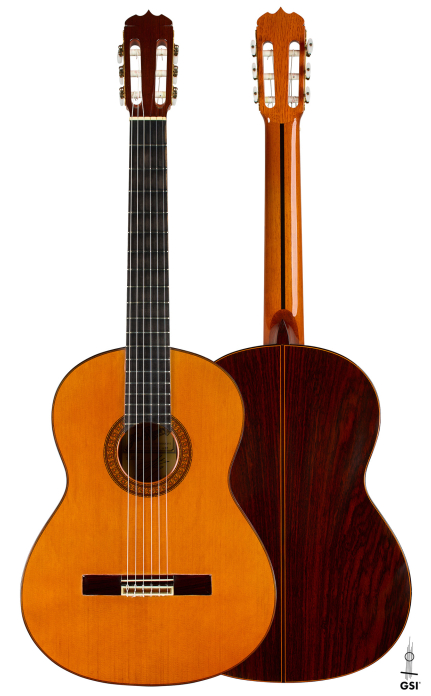
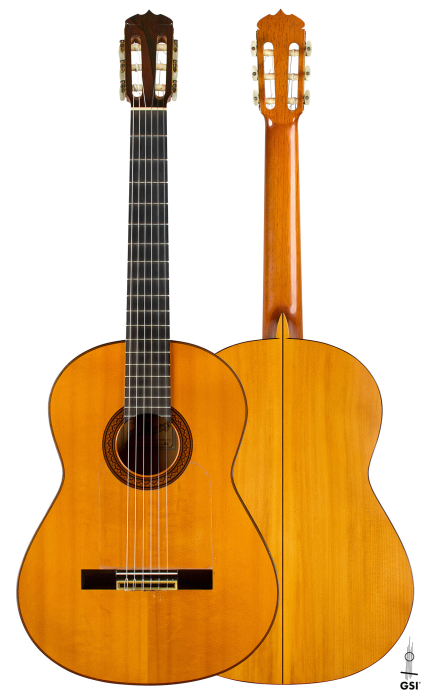
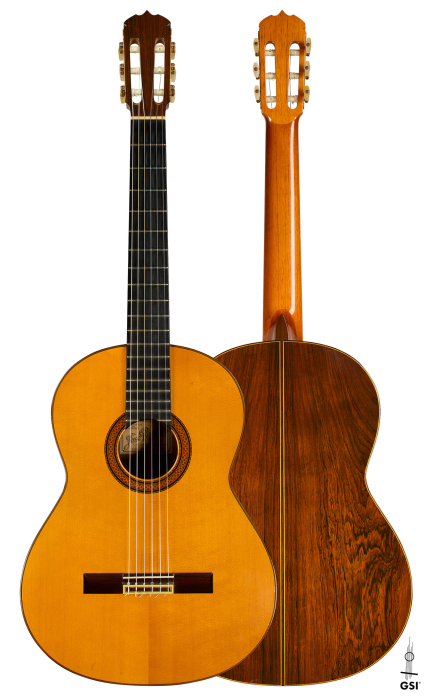
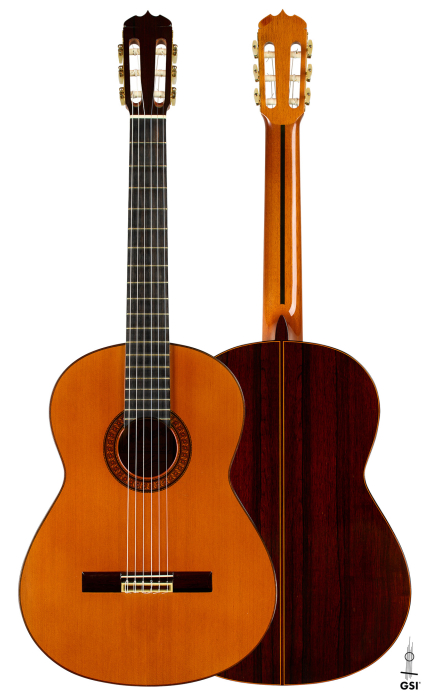
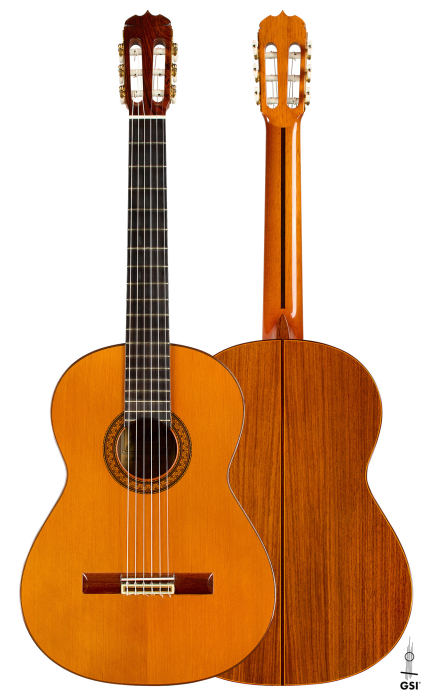
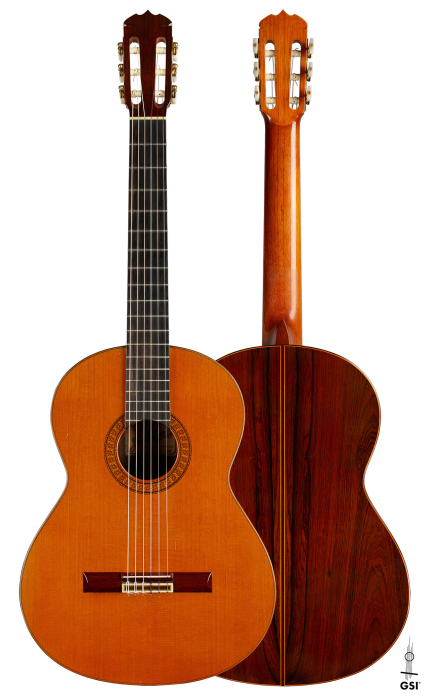
1990 José Ramírez "1a" No. A2480 CD/IN (ex Gianvito Pulzone)
| Year | 1990 |
| Top | Cedar |
| Back & Sides | Indian Rosewood |
| Scale Length | 664 mm |
| Nut width | 53 mm |
| Finish | Lacquer |
| Country | Spain |
| Luthier | José Ramírez III |
This guitar is no longer available in our inventory. If it interests you, click the ”notify me when available” button to be notified in the event that we re-acquire this guitar for re-sale.
Description
This 1990 José Ramírez "1a" No. A2480 is a classical guitar with a cedar top and Indian rosewood back and sides, one of a series with a mahogany band inside the sides, originally owned by Gianvito Pulzone.

Mahogany Instead of Cypress
Few Spanish guitars in history have been played as much, or are as well known, as the Ramírez 1a – and the model continues to satisfy players as a truly outstanding performance instrument by any standard. This particular guitar was built with "almost" all the same specs as the traditional 1a guitars that came before it; however, instead of the cypress lining on the inside of the sides, it features a band of mahogany (about half the depth of the box) that runs all the way around the sides, attached at the soundboard lining. Many years ago Gianvito Pulzone asked Carmelo Llerena – at the time the first official of the Ramírez shop – about this guitar, and learned that it belonged to a series that eventually led to the Especial model (no lining to the sides at all). The aim was to bring back a little more of the body's vibrational resonance and an old-world, traditional sound, as an alternative to the more focused, sturdy, "boxy" sound of the cypress-lined guitars. To our ears it is simply a great Ramírez, with the immediately identifiable classic sound of this famous workshop.

Label and Condition
The label is numbered A2480 and dated 1990. For attention to detail, quality of construction and sound, we rate this instrument very highly. It is in great condition, with only some wear in the finish, but no structural damage or previous repairs.
Ex Gianvito Pulzone
The guitar's first owner, Gianvito Pulzone, is a member of the Guitart Quartet in Italy; as a soloist, he was the only Italian guitarist to reach the final round of the 2020 Latin Grammys, with his CD dedicated to Leo Brouwer.
For the story of the workshop, read The Ramírez Family: Masters of the Guitar and The José Ramírez Dynasty; for some interesting fact-checking, see José Ramírez: myths and facts.
Background
The José Ramírez Workshop of Madrid
Founded in Madrid in 1882 by José Ramírez I, the Ramírez workshop has produced guitars for more than a century and through five generations of the family. José Ramírez III (1922–1995) took over as maestro in 1957 and developed the Ramírez concert guitar we know today – large in body, with a long string length and a cedar or spruce top, with great power, sustain, sweetness and balance across the entire register. He popularized western red cedar as a soundboard wood, and from the 1960s Andrés Segovia played José Ramírez guitars to the end of his days.
Ramírez Craftsmen and the Next Generations
From the 1960s to the 1990s the workshop trained many of the most talented guitarreros of the day, among them Paulino Bernabé and Manuel Contreras. In 1995 the shop moved from Calle Concepción Jerónima 2 to Calle de la Paz 8, and since the death of José Ramírez IV in June 2000 the business has been directed by his sister, Amalia Ramírez, who inspects every guitar during and after construction.
Ramírez Models, Labels and Builders' Stamps
For decades the workshop sold its guitars by class rather than by model name. The "1a" (first class) was the standard concert guitar; the "2a" (second class) was built the same way, and the shop explained its lower price tag by materials that might have minor aesthetic blemishes, or by its having been built by an apprentice rather than a foreman. Flamenco guitars add an "F" – "1aF" and "2aF". Until 1967 the labels carried only the year; from 1967 they were signed by José Ramírez III and gave the guitar's number and class, and from 1973 the 2a had a grey label of its own, with a red border and "R" numbers. Until 1971, many Ramírez guitars were stamped inside with the initials of the craftsman who built them – AM for Antonio Martínez, MT for Mariano Tezanos, PB for Paulino Bernabé and many more (see our list of Ramírez workshop luthiers). Later decades brought new models: the "Centenario", which roughly marked the workshop's hundredth anniversary; the "Da Cámara"; the shorter-scale C86 of 1986; and, under José Ramírez IV, the "Tradicional" and the "Especial".