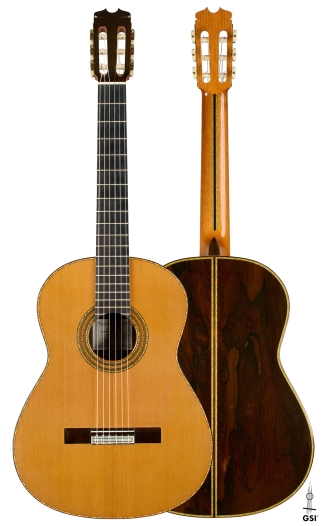
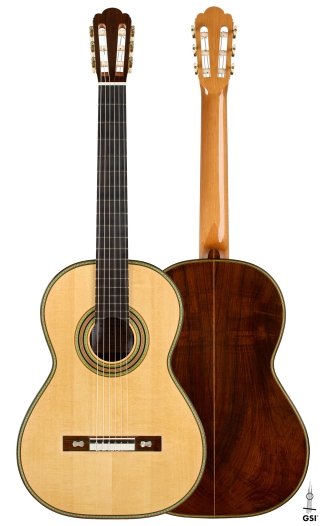
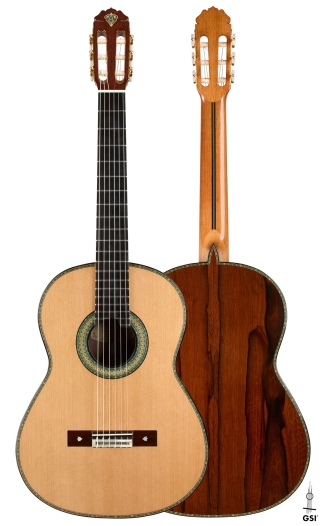
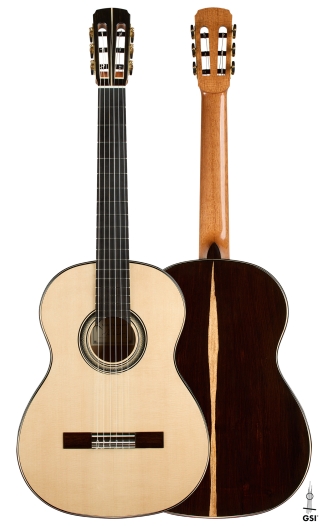
1997 Lester DeVoe "Negra" Model AAA CD/IN
| Year | 1997 |
| Top | Cedar |
| Back & Sides | Indian Rosewood |
| Scale Length | 650 mm |
| Nut width | 53 mm |
| Finish | Lacquer |
| Country | USA |
| Luthier | Lester DeVoe |
This guitar is no longer available in our inventory. If it interests you, click the ”notify me when available” button to be notified in the event that we re-acquire this guitar for re-sale.
Videos
Description
This 1997 Lester DeVoe is a cedar and Indian rosewood guitar built in Maine as one of his “Model AAA” classical guitars and later converted into a flamenco negra.

A “Model AAA” from Maine
The label reads “Long Look Farm, Paris Hill, Maine, 1997” and “Model AAA”. Lester told us he built a handful of these lower-priced classical guitars; the only differences from his full-priced guitars were less expensive Schaller tuners and a pre-made rosette – otherwise they were built to the same standard.
Classical or Flamenco
An owner had the setup adjusted and thin tap plates added, turning it into a flamenco negra – with many traditional makers the same guitar serves beautifully either way. Picado releases instantly, intonation is perfect, the action is low, and the sound is “flamenco puro”, bright and snappy. Steven Lerman plays Castelnuovo-Tedesco on it in the video above.
Background
Lester DeVoe: An American Flamenco Master
Lester DeVoe (born 1951) is among the most celebrated flamenco guitar makers of the last fifty years. Self-taught, he began building in 1975 and worked in San José, California, in Paris, Maine, and from the early 2000s in Nipomo, California. He was “discovered” in the 1980s by Sabicas, who played DeVoe guitars for the rest of his career, and his guitars were then embraced by Paco de Lucía, Vicente Amigo, El Viejín and Antonio Rey. He has now retired from guitar making.


The DeVoe Flamenco

DeVoe builds in the style of the old masters, with guitars as light as a feather – comparable in weight to a great Marcelo Barbero or Santos Hernández – and a “flamenco puro” sound: bright, vibrant basses and snappy trebles. Players prize them above all for their playability and balance – even string tension across the strings and up the fingerboard, a fast-releasing picado, precise intonation and low action. His classic rosette is a “roses” design after early José Ramírez guitars, and many players feel his finest guitars date from after 2010.