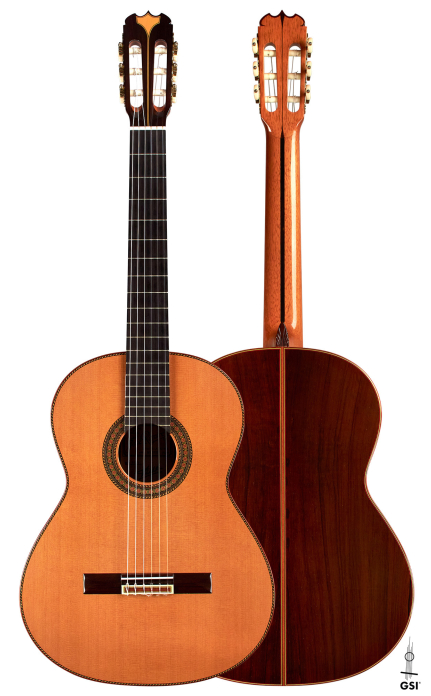
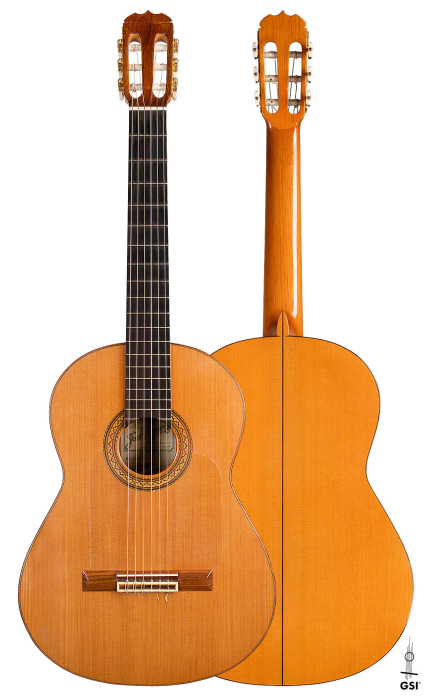
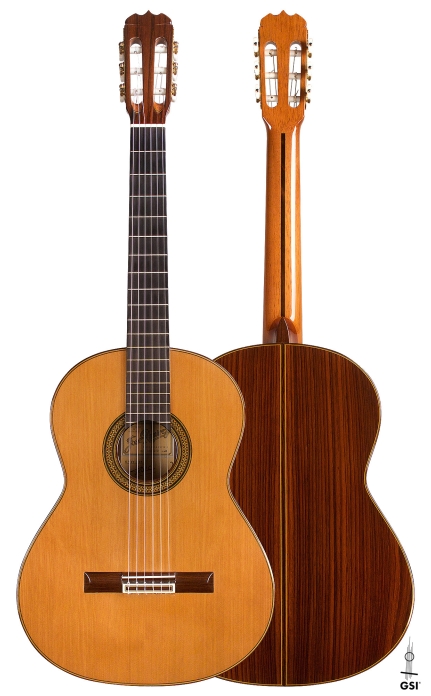
2007 José Ramírez "1a C650-AP" No. Y7-108 SP/CSAR
| Year | 2007 |
| Top | Spruce |
| Back & Sides | CSA Rosewood |
| Scale Length | 650 mm |
| Nut width | 52 mm |
| Finish | Lacquer |
| Country | Spain |
| Luthier | Amalia Ramírez |
This guitar is no longer available in our inventory. If it interests you, click the ”notify me when available” button to be notified in the event that we re-acquire this guitar for re-sale.
Videos
Description
This 2007 José Ramírez "1a C650-AP" No. Y7-108 is a classical guitar with a spruce top and CSA rosewood back and sides; Nshan Mkrtchyan and Miguel Ángel Carrillo play it in the videos above.
From the Ramírez Workshop in Madrid
The Ramírez workshop, where this guitar was made, has supplied countless professionals over more than half a century: Andrés Segovia and Sabicas, Christopher Parkening and Chet Atkins, Lee Ritenour and even Sting. It was made at Calle de la Paz 8 in the first decade under Amalia Ramírez, who took over the family business after the death of her brother José IV in 2000.
The Ramírez "1a": Primera Quality
The Ramírez "1a" may well be the most played and best-known Spanish-made guitar in history – a truly outstanding performance instrument by any standard. The Tradicional goes back to the classic concert guitar of José Ramírez III, with the standard 650mm string length and an easy neck angle. The rosette and purflings are classic Ramírez designs, and absolutely stunning. "AP" in the code stands for an abeto (spruce) top with palosanto (CSA rosewood) back and sides.

Playability, Sound and Condition
Its voice is the immediately identifiable, classic sound that only comes from a great Ramírez concert guitar. It plays easily, with a comfortable neck and a low, easy action. It is in excellent condition, with virtually no signs of prior use other than some very minor wear in the finish. The label (Calle de la Paz 8) is signed by Amalia Ramírez, dated 2007 and numbered Y7-108.
Two Videos
Nshan Mkrtchyan plays Albéniz's "Rumores de la Caleta" on this guitar in the first video above, and Miguel Ángel Carrillo plays Malats's "Serenata Española" in the second.
To learn more about the family and its workshop, read The Ramírez Family: Masters of the Guitar, our history of the family from Amalia Ramírez back to José I, and myths and facts about this legendary workshop.
Background
The José Ramírez Workshop of Madrid
Founded in Madrid in 1882 by José Ramírez I, the Ramírez workshop has produced guitars for more than a century and through five generations of the family. José Ramírez III (1922–1995) took over as maestro in 1957 and developed the Ramírez concert guitar we know today – large in body, with a long string length and a cedar or spruce top, with great power, sustain, sweetness and balance across the entire register. He popularized western red cedar as a soundboard wood, and from the 1960s Andrés Segovia played José Ramírez guitars to the end of his days.
Ramírez Craftsmen and the Next Generations
From the 1960s to the 1990s the workshop trained many of the most talented guitarreros of the day, among them Paulino Bernabé and Manuel Contreras. In 1995 the shop moved from Calle Concepción Jerónima 2 to Calle de la Paz 8, and since the death of José Ramírez IV in June 2000 the business has been directed by his sister, Amalia Ramírez, who inspects every guitar during and after construction.
The Workshop Under Amalia Ramírez
Under Amalia Ramírez the workshop has kept the classic concert guitar at the heart of its range – the "1a" (first class) in the "Tradicional" design, its model code written by hand on the label: C650 for a cedar top with Indian rosewood, "-A" for a spruce (abeto) top, "-P" for CSA rosewood (palosanto) and "-AP" for both, with F656 and F656-A for the cedar and spruce flamencos. Around it she has built a wider family of models: the "Centenario" and "Elite", made with the workshop's most precious woods; the reissued "SP" and "2a"; the "Auditorio", "Antigua" and "Guitarra del Tiempo"; anniversary series such as the "125 Años" and "130 Años"; replicas of historic guitars, from the 1912 Manuel Ramírez played by Segovia to the 1913 "Guitarra de Tablao" of José Ramírez I; and the studio lines NE, R and FL. The concert guitars carry the Calle de la Paz 8 label, signed by Amalia Ramírez with her star signature and numbered with a letter-and-number code (Centenario and Elite have numbers of their own), while the studio guitars have an orange "Guitarras de Estudio" label, "Diseñada, Revisada y Certificada por Ramírez", with the red "Calidad Ramírez" stamp.