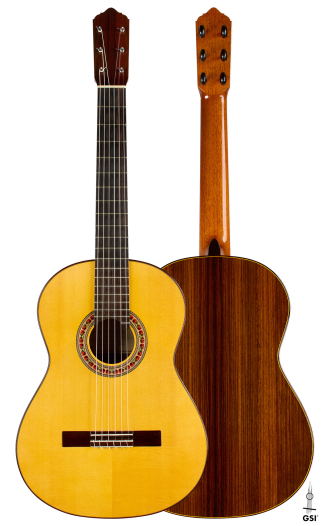
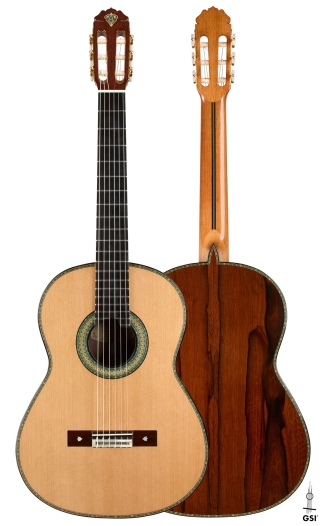
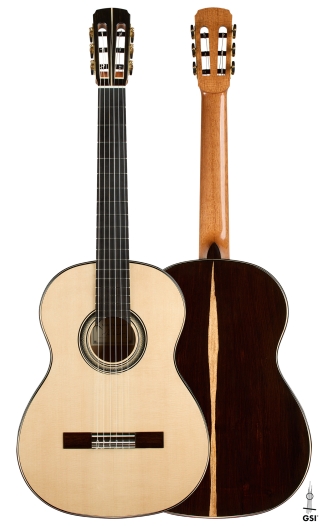
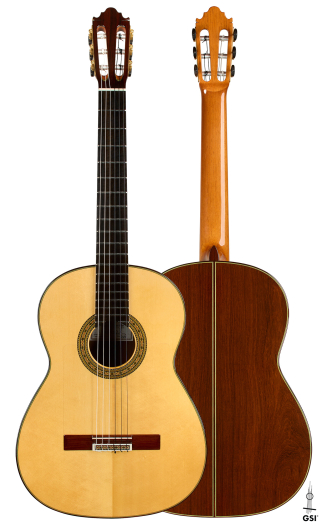
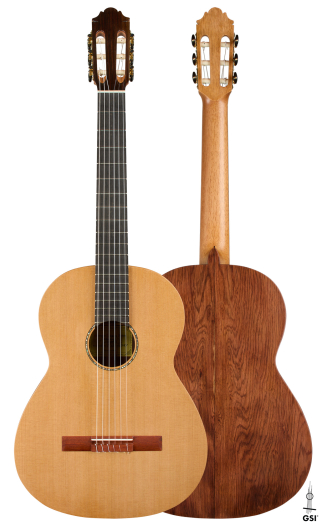
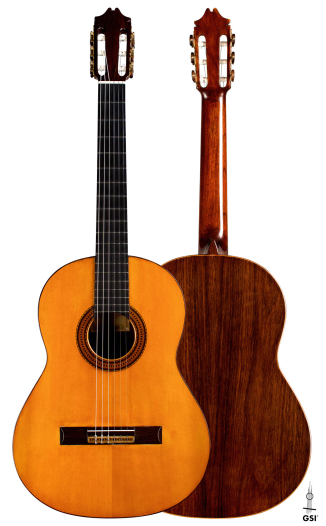
2012 Marcelino López "1851 José Pernas" SP/IN
| Year | 2012 |
| Top | Spruce |
| Back & Sides | Indian Rosewood |
| Scale Length | 650 mm |
| Nut width | 51 mm |
| Finish | French Polish |
| Country | Spain |
| Luthier | Marcelino López Nieto |
This guitar is no longer available in our inventory. If it interests you, click the ”notify me when available” button to be notified in the event that we re-acquire this guitar for re-sale.


Elle Davisson performs Joaquín Rodrigo's "Sonata Giocosa: Mov. I" on a 2012 Marcelíno López guitar
Description
 This 2012 Marcelino López Nieto is a replica of an 1851 José Pernas guitar in spruce and Indian rosewood, made in Madrid, Spain, from the original in his collection – kept in his private collection until his passing in 2018 and offered through the GSI Foundation.
A Copy of an 1851 José Pernas
As well as his traditional "Torres" style guitars, Marcelino built many historical instruments on pre-Torres designs – vihuelas, Baroque guitars, Baroque and Renaissance lutes, and other instruments such as violas da gamba, harps, harpsichords, clavichords and period-styled violins and violas. This guitar, made in 2012, is a meticulously built copy of an 1851 José Pernas guitar from Marcelino's vast collection of historical instruments, so he was able to study the original first-hand when building this replica.
José Pernas, born in 1804, was a guitar maker living and working in the Andalusian city of Granada, where he allegedly gave early advice to a young Antonio de Torres. Pernas was greatly celebrated for his work in his lifetime, and in 1851 (the same year as the original of this guitar) he was awarded a gold medal by the Sociedad Económica de Amigos del País.
Colorful Details and an Authentic Period Sound
The instrument itself is extremely charming – it has a smaller, more compact box with a very "flat" bottom and colorful detailing (top purflings include half herringbone flanked by 4 layers of green, yellow, beige and red, and the rosette has a multi-colored mosaic with purflings in green, red, yellow and purple!). Although smaller in size than a contemporary "full-sized" guitar, it is very comfortable and easy to play and has surprisingly large volume. The quality of sound is very authentic, with an "antiquey," pre-Torres tonal character, perfect for getting closer to the period sound of the early-to-mid-19th-century music of such composers as Sor, Giuliani, Aguado, Legnani, Diabelli, Carulli and Coste, just to name a few!
The guitar is in excellent condition with no damage or repairs, only some very mild wear in the finish. It is concert-ready for any performance situation. This is a fantastic "period style instrument" by one of Spain's most enduring and experienced legends. Includes a custom hardshell case perfectly fitted to the dimensions of the instrument. This instrument was in Marcelino López's private collection and was only sold after his passing in 2018.
A GSI Foundation Guitar
This guitar was donated to our non-profit charitable organization, the GSI Foundation. Guitar sales through the GSI Foundation raise money to directly benefit music education in public schools.
Read more: Orfeo Magazine No. 3 – interview with Marcelino López Nieto · Orfeo No. 3 on our blog · our 2008 interview with Marcelino