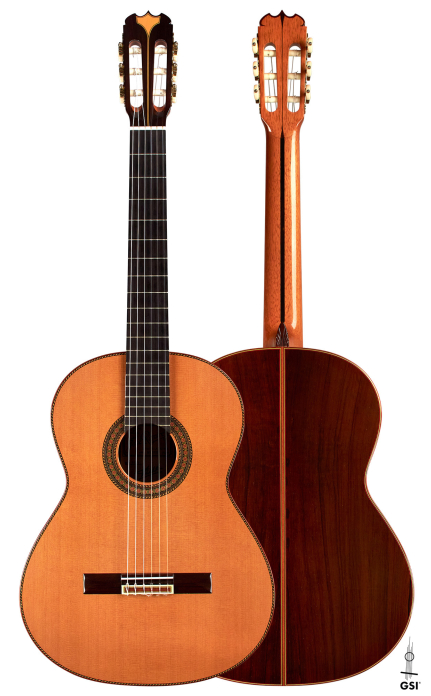
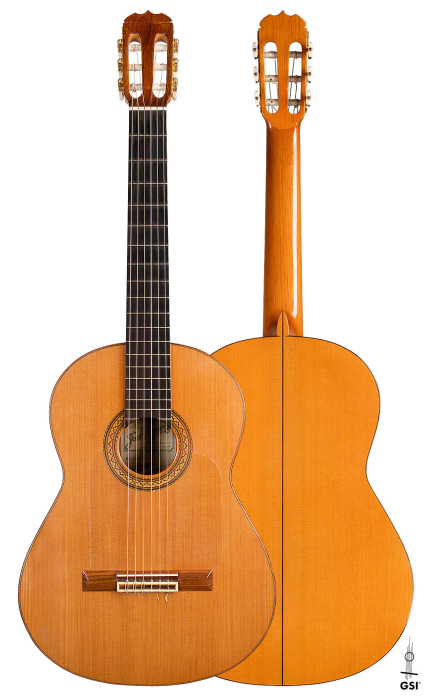
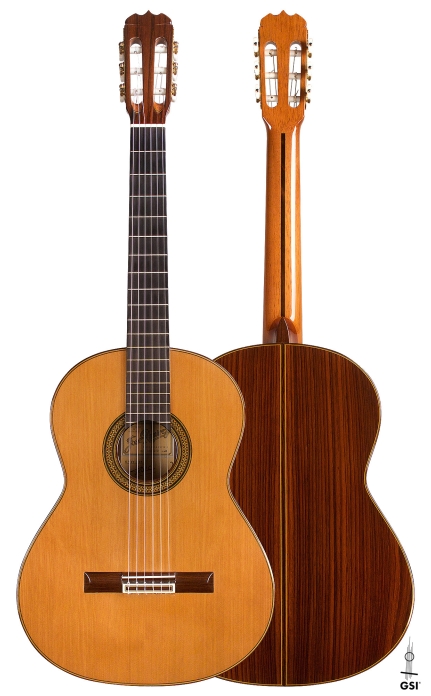
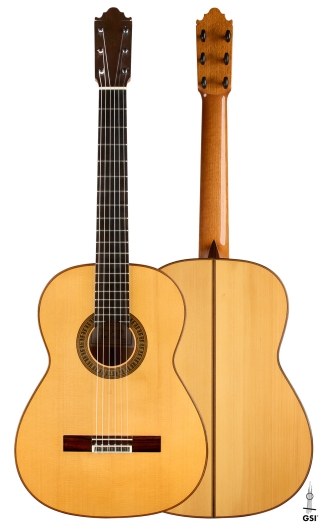
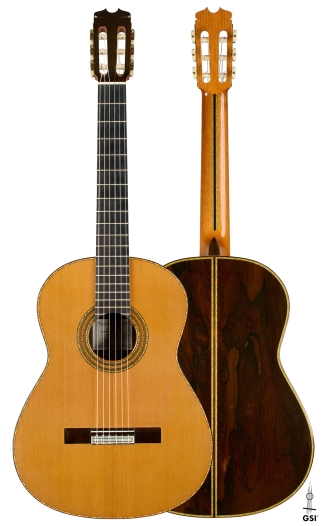
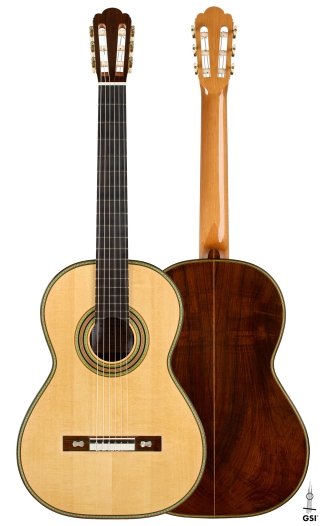
This 2016 José Ramírez "Auditorio Trio C650" No. X6-010 is a classical guitar with a cedar top and Indian rosewood back and sides – the Auditorio with a double top and double back and sides.
A 2016 Ramírez from Calle de la Paz
The Ramírez workshop, where this guitar was made, has supplied countless professionals over more than half a century: Andrés Segovia and Sabicas, Christopher Parkening and Chet Atkins, Lee Ritenour and even Sting. Since 2000 the workshop has been in the hands of Amalia Ramírez, and this guitar was made well into her direction.
The "Auditorio Trio"
The "Auditorio Trio" is the latest development in the evolution of the Auditorio models. Like them, it is essentially the famous "1a" with a modern double-top ("Nomex sandwich") soundboard – but here the sides and back are double too, with honeycomb like the top. The sides and back are Indian rosewood outside and cypress inside, following the traditional Ramírez formula. As far as we know, it is the first guitar with double sides and back with honeycomb.
Inside the Sound
Many guitarists who have played it say the system makes the player feel inside the sound – not only projecting it, but surrounded by it. A truly explosive and fun guitar to play, and a perfect compromise between traditional and modern. A hardshell case was included. The label (Calle de la Paz 8) is signed by Amalia Ramírez, dated 2016 and numbered X6-010 – with the model code "Auditorio Trio C650" written beside it.
How the Auditorio Was Born
The Auditorio guitar was born, as a project, in 2006, when we made the first prototypes. I was making my experiments with the called double top using nomex, and I knew that the first luthier who ever started using this material was Gernot Wagner. For this reason I contacted him, and he was very kind helping me since the very beginning to let me know how to work with it. He even came to my workshop to make a top with us. After this, my guitar makers and me have been making some changes to adapt this system to our own criteria, techniques and design, until we got what we were looking for.
The double top helps get a better projection and sustain. However, it does not improve the quality. If the guitar has a good sound, then it will give it more power, but if the sound of the guitar is not good, then it will be more powerful but with a poor sound.
My intention was to keep the personality of Ramírez guitars, and we have really done it, so we have the sweetness, depth and richness, as well as the balanced sound that is characteristic of Ramírez, adding more power, wideness and sustain. The best things of our guitars are even more noticeable with this new technique. It takes much more work, because building a double top is very delicate and takes a long time, but it is well worth the effort.
– Amalia Ramírez
Two Videos
In the videos above Amalia Ramírez presents the Auditorio Trio guitar and talks about the Ramírez legacy.
There is much more about the workshop on our blog – The Ramírez Family: Masters of the Guitar, the family members from Amalia Ramírez back to José I, and some fact-checking on myths and facts about this legendary workshop.