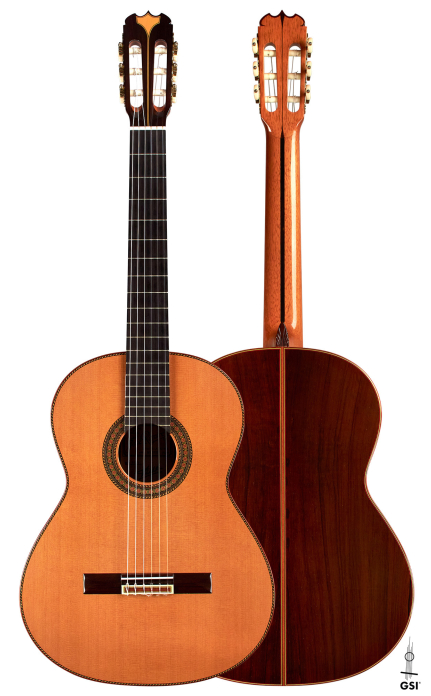
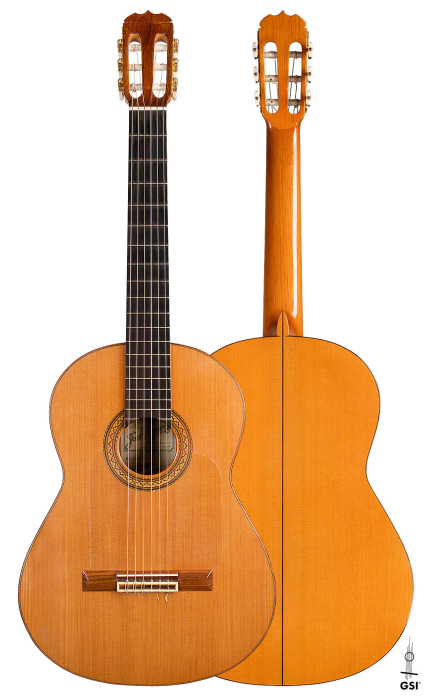
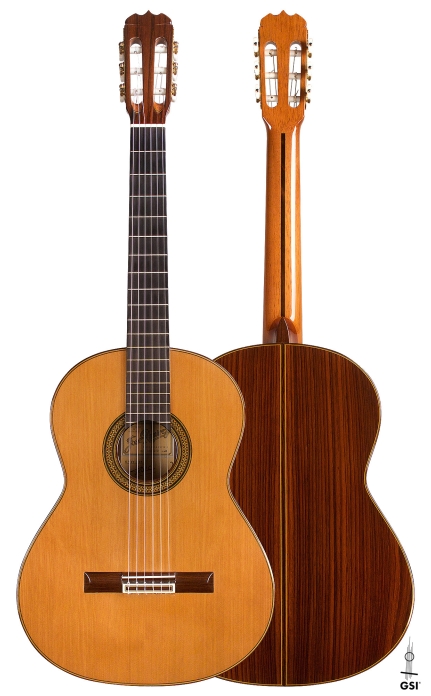
This 2020 José Ramírez "1a Mangoré" No. 1 is a classical guitar with a spruce top and Indian rosewood back and sides – the first replica of Agustín Barrios Mangoré's 1911 José Ramírez I.
Built in the Calle de la Paz Workshop
It comes from the famous José Ramírez workshop – today directed by Amalia Ramírez – whose instruments have been played by countless professionals over more than half a century, from Segovia and Sabicas to Sting, Chet Atkins, Lee Ritenour and Christopher Parkening. Amalia Ramírez, the fifth generation of the family, has directed the workshop since 2000 and inspects every guitar during and after construction.
Barrios's 1911 José Ramírez I
Agustín Barrios Mangoré's 1911 José Ramírez I is a legendary guitar, and undoubtedly one of the most significant guitars of the 20th century. Barrios acquired it shortly after arriving in the Río de la Plata region, from his acquaintance Carlos Trapani, who ran a music store in Montevideo, and he played it on his first commercial recordings in 1913. That same year the guitar was famously damaged when it sank in a shipwreck on the Tanqueras River in Uruguay. This replica, the first built in the Ramírez workshop, more than a century after the original, has the look and feel of the guitar as it would have been before the water damage – its soundboard is much clearer, since the original is now as dark as cedar.
Sound and Label
Like the tablao guitars, it has an "antique" quality of sound, largely due to the flatter box depth and the extra width of both bouts; it is absolutely charming to play, with plenty of power for any concert setting, and a 50mm nut. This is No. 1 of the limited series of the "Mangoré" model – "Nº de guitarra 1" on the label, which is dated 2020 and signed by Amalia Ramírez.
Amalia Ramírez on the Mangoré
Amalia Ramírez told us about seeing the original: "I visited Asunción in 2014, La Casa de la Música, where the original tablao guitar built by my great grandfather and that belonged to Mangoré, is exhibited in the entrance and it is one of Paraguay's most valuable treasures as they told me… with the words written by Agustín Barrios on its soundboard, which is a legend. Almost six years later we have reproduced that guitar using the templates of the original Tablao model designed at the beginning of the 20th century, corresponding to Barrios' guitar. Of course we have not reproduced his written dedication on the soundboard, but in every other respect the guitar is the same, with its spruce top and its rosewood back and sides and the intricate design of its mother-of-pearl rosette, as an initiative of my nephews Cristina and Enrique, being Enrique who built the first copy following the parameters of his great-great-grandfather, José Ramírez I."
The Video
In the video above Ashley Lucero plays Matthew Dunne's "Miniature 12" on this guitar.
For the story of the workshop, read The Ramírez Family: Masters of the Guitar and The José Ramírez Dynasty; for some interesting fact-checking, see José Ramírez: myths and facts.